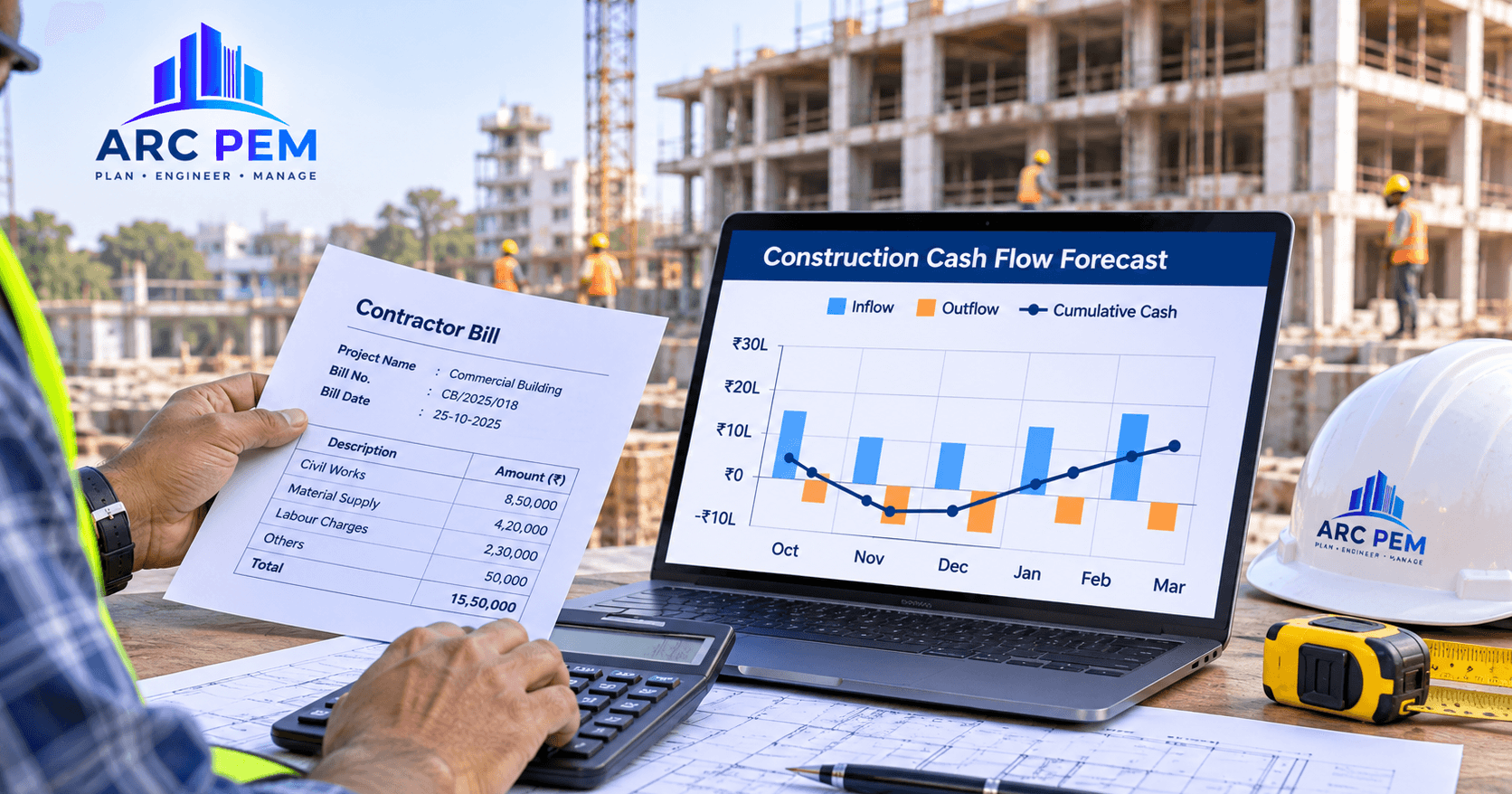
Quick answer: A construction cash flow forecast is a month-by-month table of cash coming in (RA bill receipts, advances) and cash going out (materials, labour, subcontractors, overheads), with a running balance. Its real job is to show your peak funding gap: the lowest point your cash balance will hit before client payments catch up with your costs. On Indian projects that gap is driven mainly by the delay between doing the work and getting paid, plus retention and TDS deducted from each bill.
Contractors rarely run out of cash because a project is losing money. They run out because costs are paid this month and the bill for that work is paid two or three months later. A forecast makes that gap visible before it becomes a crisis.
Why Cash Flow Is Not the Same as Profit
A project can show a healthy margin on paper and still leave you short of cash, because:
- You pay first, get paid later. Labour is paid weekly and materials often on short credit. The RA bill follows after measurement, certification and approval.
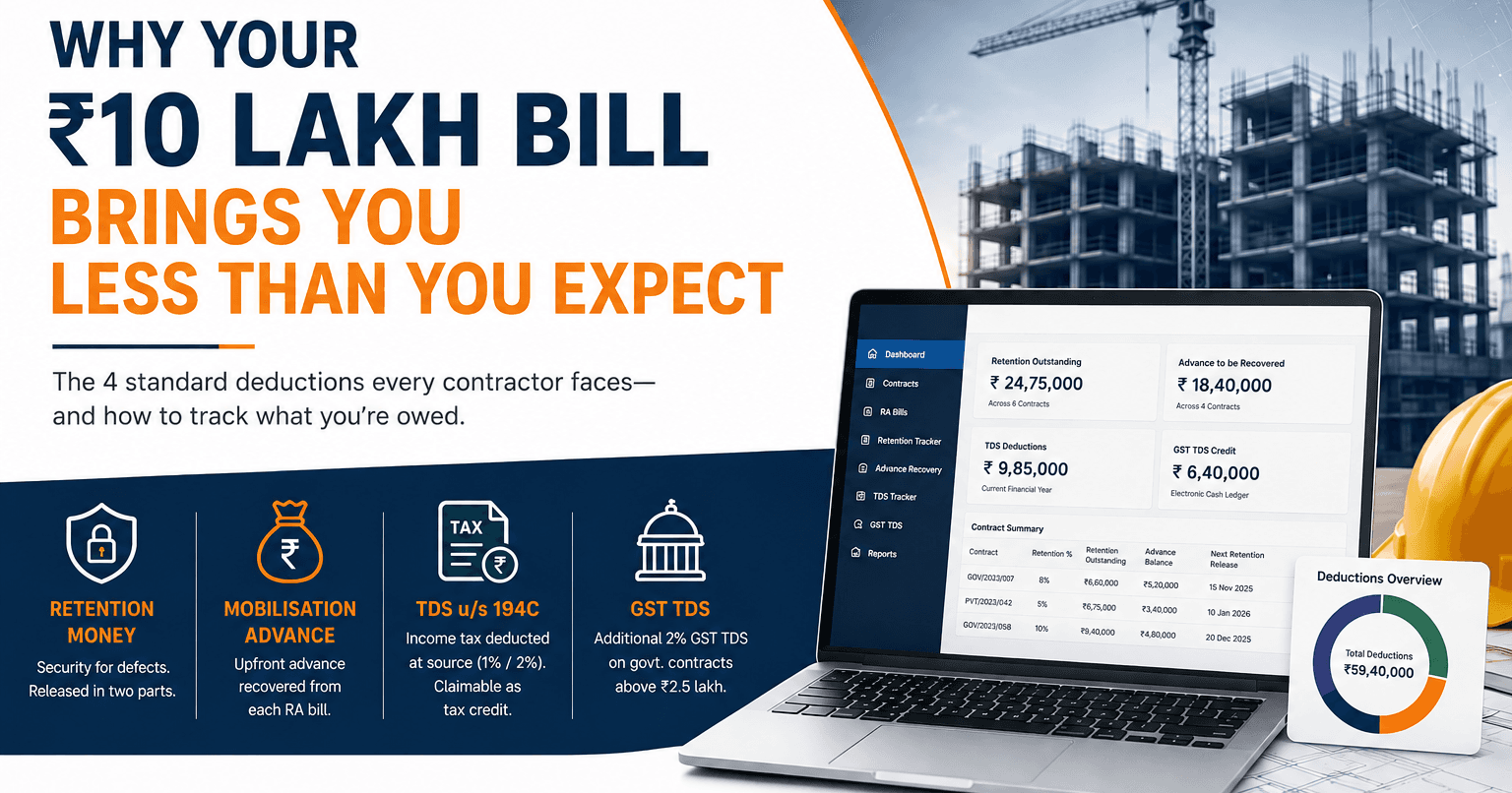
- Part of every bill is held back. Retention money is deducted from each bill and released much later. See Retention Money, Advances and TDS.
- TDS reduces the cash you receive. The client deducts tax at source from the payment. See TDS on Contractor Payments.
- GST can fall due before the client pays. GST on an invoice is generally payable through your return by the due date, whether or not the client has paid that invoice (subject to input tax credit adjustments). Keep a GST line in your forecast. See GST changes for contractors.
- Disputed or pending extras sit unpaid. Work done on a verbal instruction can stay unbilled. See Variation Order in Construction.
The Two Delays You Must Model Separately
Do not use a single "payment delay" number. Break the lag into two parts, because they have different causes and different fixes:
- Certification lag: from the end of the measurement period to the client or engineer certifying the bill. It depends on how clean your measurement sheet is and how quickly quantities are agreed.
- Payment lag: from certification to money in your account. It depends on the client's approval chain and payment terms in the contract.
Use your own history. Look at your last five bills for the same client, note the date work was measured and the date cash arrived, and use that average, not a guess. Published figures for typical Indian approval delays are mostly from vendor blogs and are not reliable benchmarks, so your own data is better.
Cash Flow Forecast Format
Copy this into Excel. One row per line, one column per month.
| Section | Line items |
|---|---|
| Opening cash | Cash and bank balance at the start of the month |
| Cash in | RA bill receipts (net of retention and TDS), mobilisation advance, variation order payments, other receipts |
| Cash out | Materials, labour, subcontractors, equipment hire, site overheads, head-office overheads, GST payable, loan EMIs |
| Net cash flow | Cash in minus cash out |
| Closing cash | Opening cash plus net cash flow |
| Funding gap | The lowest negative closing balance across all months |
Add a short assumptions block under the table: billing date, certification lag, payment lag, retention percentage, TDS rate and credit days from suppliers.
Worked Example
All figures are illustrative. Amounts are in ₹ lakh and exclude GST to keep the example readable.
Project: a G+2 building, 6-month contract value of ₹60 lakh.
Assumptions:
- Work value is billed at the end of each month through an RA bill.
- Cash arrives 2 months after the month of billing (certification plus payment lag combined).
- Retention: 5% of each bill. TDS: 2% of each bill (assumed rate for the example; check the correct rate for your payee type).
- So net cash received from each bill = 100% − 5% − 2% = 93% of the bill value.
- Costs are 85% of the work value, paid in the month the work is done.
- Opening cash is zero and there is no advance.
| Month | Work billed | Cash in (93% of bill, 2 months later) | Cash out (85% of work) | Net | Closing cash |
|---|---|---|---|---|---|
| 1 | 5 | 0 | 4.25 | −4.25 | −4.25 |
| 2 | 10 | 0 | 8.50 | −8.50 | −12.75 |
| 3 | 12 | 4.65 | 10.20 | −5.55 | −18.30 |
| 4 | 12 | 9.30 | 10.20 | −0.90 | −19.20 |
| 5 | 11 | 11.16 | 9.35 | +1.81 | −17.39 |
| 6 | 10 | 11.16 | 8.50 | +2.66 | −14.73 |
| 7 | 0 | 10.23 | 0 | +10.23 | −4.50 |
| 8 | 0 | 9.30 | 0 | +9.30 | +4.80 |
What the forecast shows:
- The project is profitable (₹60 lakh billed against ₹51 lakh of cost), yet cash is negative for seven months.
- The peak funding gap is ₹19.2 lakh, reached at the end of month 4. That is about 32% of the contract value (19.2 ÷ 60).
- The ₹3 lakh retention (5% of ₹60 lakh) is not in the table at all. It comes back after the defect liability period, and the TDS of ₹1.2 lakh is recovered as tax credit, so neither is immediate cash.
- Site overheads, head-office costs and GST are not included. Adding them makes the gap larger.
What If Payment Slips by One More Month?
If cash arrives 3 months after billing instead of 2, every receipt shifts one month later. The closing balance drops to ₹−28.55 lakh at the end of month 5. The peak gap grows from ₹19.2 lakh to ₹28.55 lakh, an extra ₹9.35 lakh from one month of delay. This is why chasing certification matters as much as controlling cost.
Ways to Reduce the Funding Gap
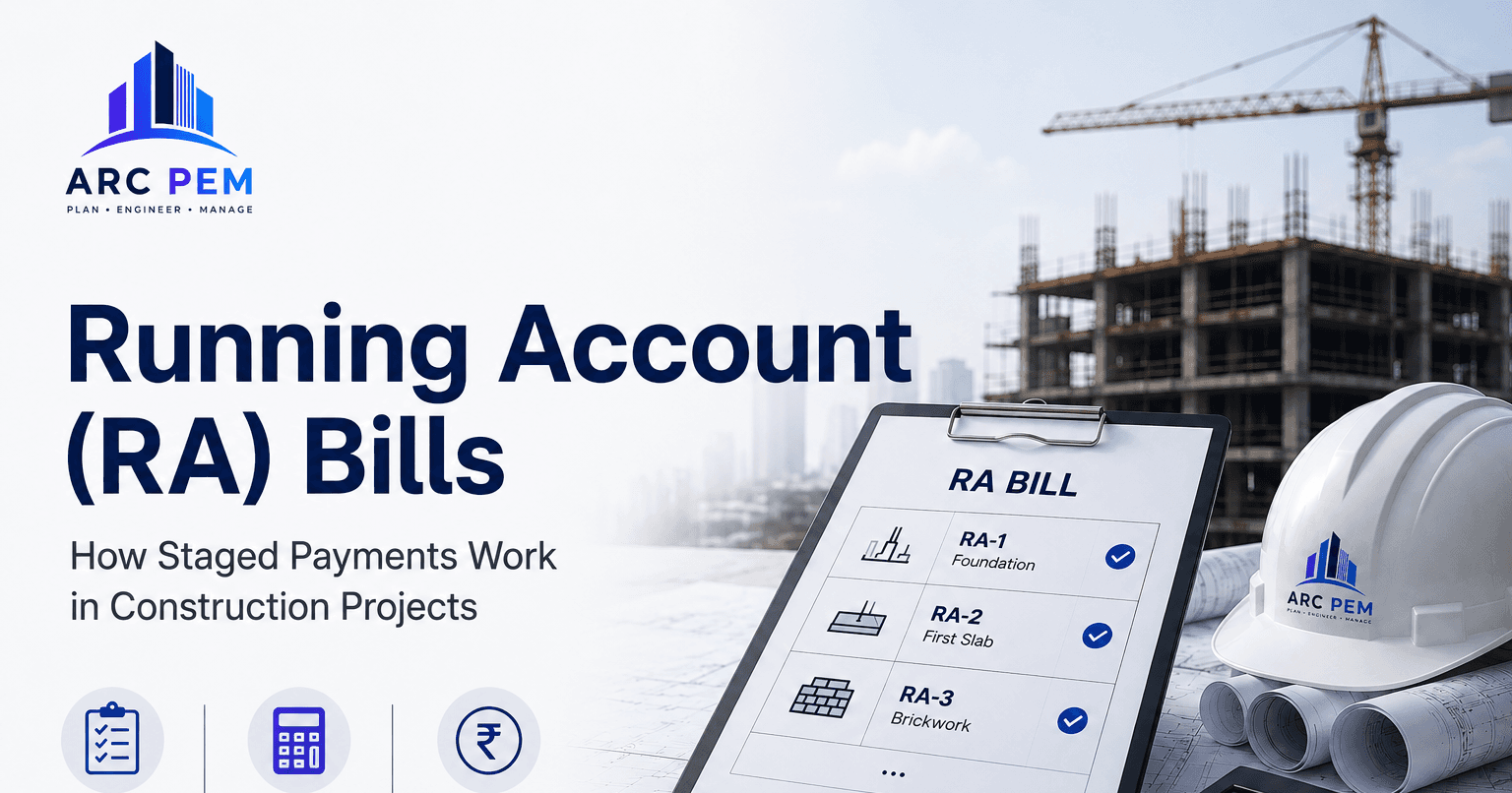
- Bill on time, every time. Measure and raise the RA bill at the agreed cut-off. Use a GST-compliant RA bill and a clean contractor bill format.
- Get measurements signed on site. An unsigned measurement sheet is the most common reason certification stalls.
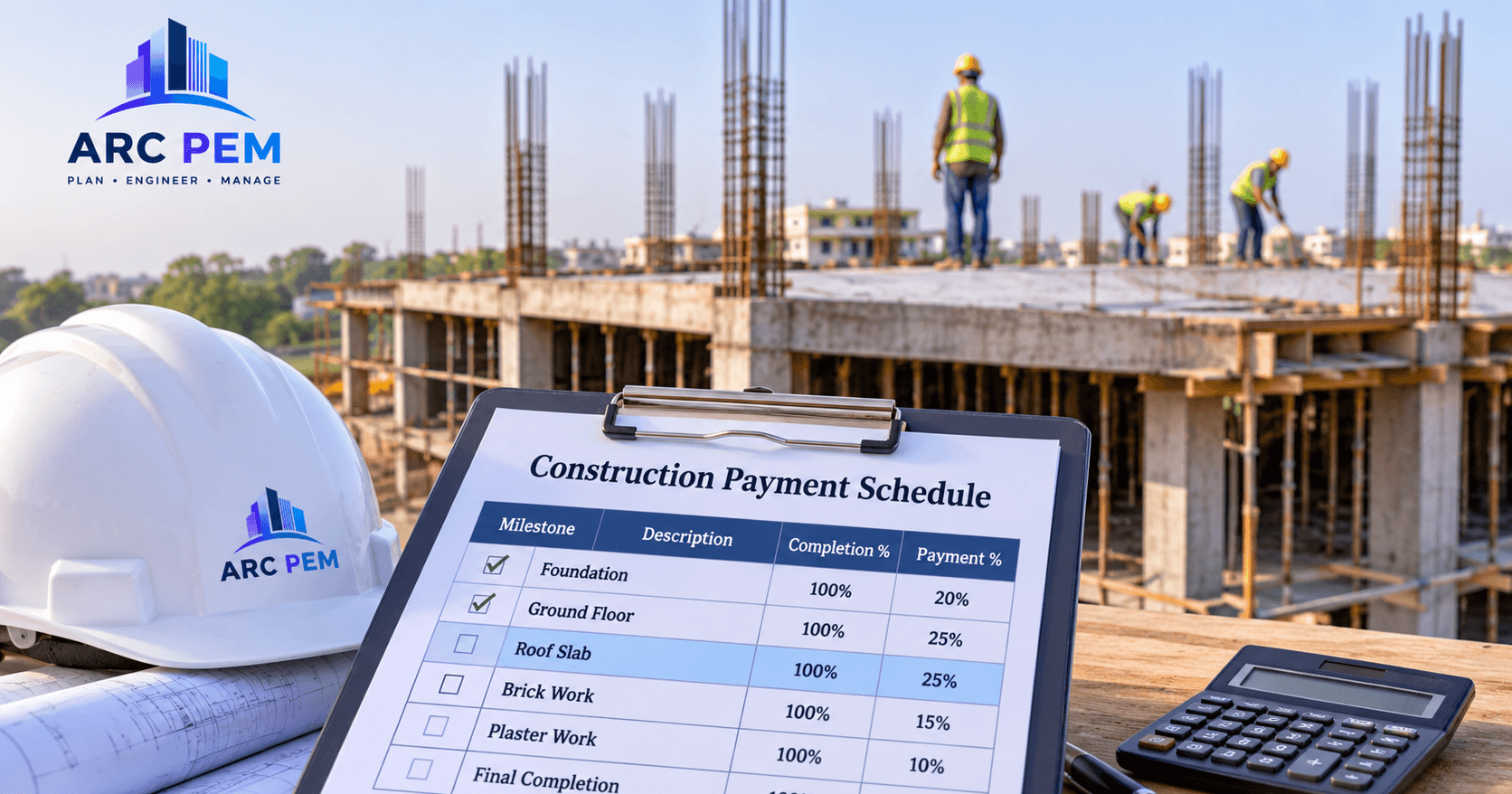
- Negotiate mobilisation advance and milestone terms. See Construction Payment Schedule and Types of Construction Contracts in India.
- Negotiate retention and its release. Smaller retention, or a bank guarantee in place of cash retention where the client accepts it, frees up cash.
- Match supplier credit to client payment. If the client pays in 60 days, try to get at least 30 days of credit on major materials.
- Bill variations promptly. Log extra work as it happens and get written approval.
- Check cost against plan monthly. Overspending widens the gap. See Construction Job Costing and Cost Value Reconciliation.
Common Cash Flow Forecasting Mistakes
- Forecasting profit instead of cash. Margin does not tell you when money arrives.
- Ignoring retention, TDS and GST. These change what actually reaches your account.
- Using one lag for all clients. A private client and a government department rarely pay alike.
- Never updating the forecast. Revise it monthly with actuals, otherwise it stops being useful.
- Skipping overheads. Site and office costs run whether or not bills are paid.
Keeping the Forecast Accurate
A forecast is only as good as the data behind it: billed amounts, measured quantities, supplier payments and labour costs. If those live in separate files, the forecast gets stale quickly. ARC PEM links expenses to BOQ lines and supports GST billing, so billed work and actual cost sit in one place. See From BOQ to Bill, and use the free GST Contractor Bill Generator to prepare compliant bills.
Example figures and assumed rates (retention, TDS, lags and cost percentage) are for illustration. Check your contract for the actual retention, payment terms and applicable tax rates, and consult your tax adviser for GST and TDS treatment.