Every contractor payment you release carries a TDS obligation most firms only think about at year-end — by which point splitting errors, missed thresholds, or a wrong rate have already happened. This is a working reference for how contractor TDS actually works, including a genuine change worth knowing about: the provision you know as Section 194C now sits under a different section number.
What Changed: Section 194C Is Now Section 393(1)
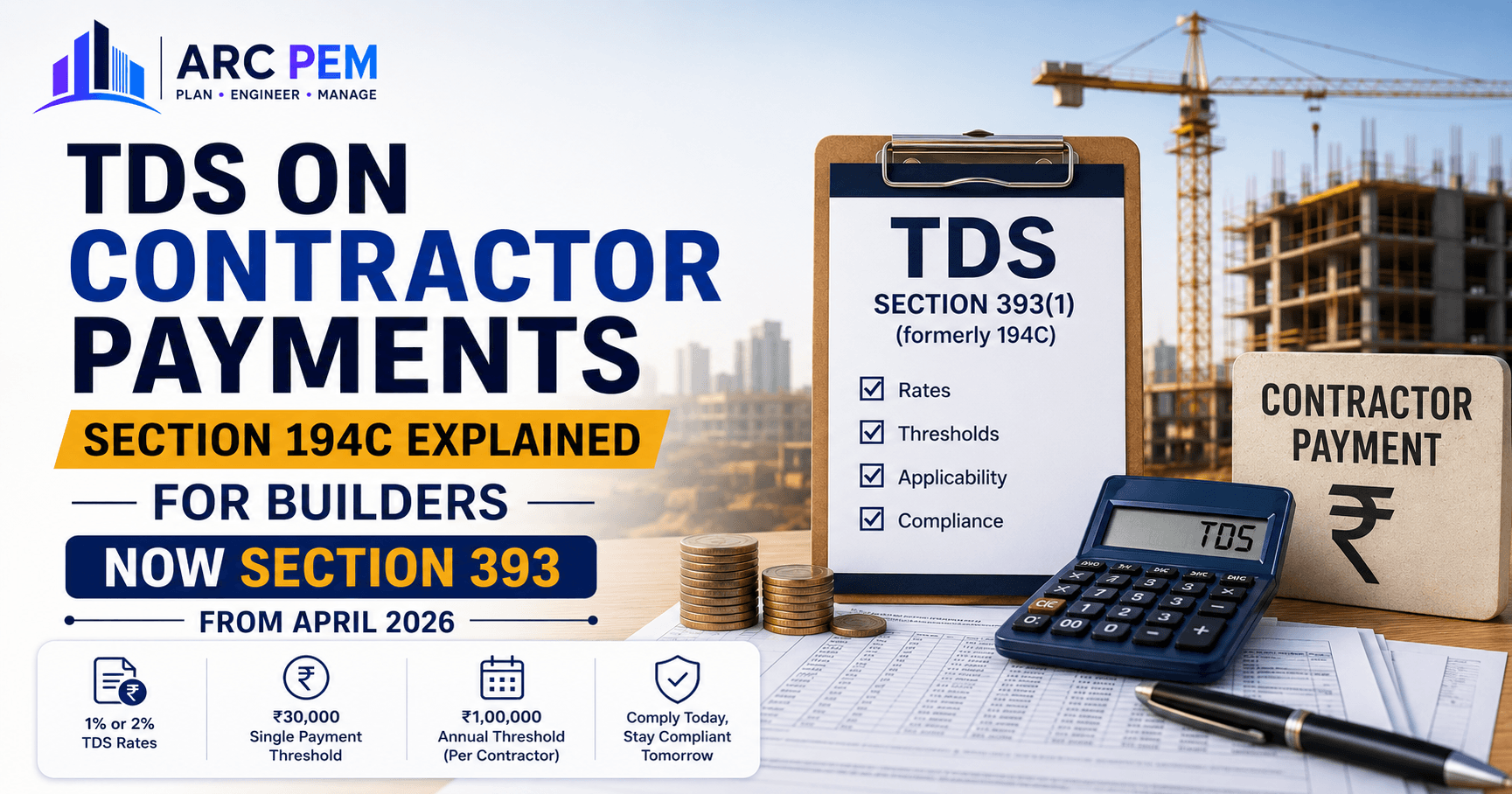
From 1 April 2026, the Income-tax Act, 2025 replaced the Income-tax Act, 1961 — and the familiar Section 194C on contractor payments now sits under Section 393(1) [Table, Sl. No. 6(i)]. For payments made or credited up to 31 March 2026, the old Section 194C reference still applies; for anything from 1 April 2026 onward, it's Section 393(1).
The good news: the rates and thresholds themselves haven't changed. What's changed is the section number, the TDS return form (Form 26Q is now Form 140), and the TDS certificate form (Form 16A is now Form 131). If your accounting or billing software still references "194C" and "Form 26Q," it's worth confirming it's been updated to reflect the new form numbers for FY 2026-27 filings, even though the underlying compliance logic is identical.
One genuinely useful clarification also came with the new Act: supply of manpower — security, housekeeping, labour staffing — is now explicitly confirmed as "work" under this section, not a professional/technical service under the higher-rate provision. If your firm was treating manpower supply invoices differently, this is worth correcting for payments from April 2026 onward.
Who Has to Deduct This TDS
Not everyone paying a contractor is obligated to deduct TDS. The obligation falls on "specified persons," which includes:
- Companies, firms, LLPs, trusts, co-operative societies, and local authorities — essentially always covered
- Central and state government bodies
- Individuals and HUFs — but only if their business turnover exceeded ₹1 crore, or professional receipts exceeded ₹50 lakh, in the immediately preceding financial year (the tax-audit threshold)
If you're a smaller proprietorship below those turnover limits, you're not obligated to deduct TDS on contractor payments — though many firms choose to anyway once they're close to that threshold, to avoid a mid-year compliance scramble.
The Rates: 1% or 2%
- 1% — where the contractor is an individual or HUF
- 2% — where the contractor is a company, partnership firm, LLP, AOP, BOI, or any entity other than an individual/HUF
No surcharge or cess is added on top of these rates for resident payments. The most common rate mistake worth flagging to your accounts team: an OPC (One Person Company) or an LLP is taxed at 2%, not 1% — even though both are often run by a single person, they're legally body corporates, not individuals. Conversely, a sole proprietorship trading under a business name ("XYZ Construction, Prop: Ramesh Kumar") is still taxed at the individual rate of 1%, because the proprietor and the business are legally the same person.
The Thresholds: ₹30,000 and ₹1,00,000
TDS doesn't apply to every contractor payment — two thresholds govern it:
- No TDS if a single payment is ₹30,000 or less, AND
- No TDS if the total paid to that same contractor across the financial year stays at or below ₹1,00,000
Here's the part that trips up a lot of site accountants: the ₹1,00,000 limit is a cumulative, per-contractor, per-year test — not a per-invoice one. If you pay the same electrical subcontractor ₹25,000 in April, ₹25,000 in July, ₹25,000 in October, and ₹25,000 in January, no single payment crosses ₹30,000 — but the annual total hits ₹1,00,000, and TDS becomes applicable on the full amount, including the earlier payments that individually looked exempt. Splitting a contract into smaller invoices specifically to dodge the ₹30,000 test doesn't work, because the aggregate threshold catches it regardless.
What Counts as "Contractor Work" Under This Section
Section 393(1)/194C applies broadly to payments for carrying out work, which for a construction firm typically includes:
- Civil construction and renovation contracts
- Supply of labour (including manpower/staffing arrangements, now explicitly confirmed)
- Transport contracts for material movement
- Job-work or fabrication done to your specifications (structural fabrication, custom millwork, etc.)
- Advertising and signage contracts
What it does not cover: a pure sale of goods. If a vendor is simply selling you material — say, TMT bars or cement — with no work or service attached, that's a goods purchase, not a works contract, and falls outside Section 393(1)/194C entirely (though it may attract TDS under a different provision, like Section 194Q for large purchases, depending on your turnover).
Two Practical Rules Worth Knowing
TDS is calculated on the payment value, excluding GST — if GST is shown as a separate line on the invoice. If a contractor's invoice shows ₹1,00,000 as the service value and ₹18,000 as GST, TDS is deducted on the ₹1,00,000 base value only, not on the GST-inclusive total.
No PAN means a much higher rate. If your contractor doesn't furnish a valid PAN, TDS jumps to a flat 20%, regardless of whether the standard rate would otherwise have been 1% or 2%. On a ₹60,000 payment, that's the difference between ₹1,200 (at 2%) and ₹12,000 (at 20%) — a strong reason to collect PAN details from every contractor before the first payment, not after.
Sub-contractor payments follow the same rules. If your main contractor further engages a sub-contractor, the same Section 393(1)/194C thresholds and rates apply to what the contractor pays the sub-contractor — this is your contractor's compliance obligation, but worth being aware of if you're structuring a multi-tier contract.
What Happens If You Get This Wrong
Missing a TDS deduction you were obligated to make isn't just a compliance footnote — under the disallowance provisions, 30% of that expense can be disallowed when your firm's own income is assessed, directly hitting your P&L. Combined with automated AIS-based mismatch notices becoming more common, contractor TDS has become one of the more closely tracked compliance areas for construction firms specifically, given how many contractor relationships a typical project involves.
Building This Into Your Billing Workflow
The practical fix isn't remembering all of this at filing time — it's tracking cumulative payments per contractor as they happen, so the ₹1,00,000 threshold never sneaks up on you mid-project. If you're already tracking RA bills and contractor payments through ARC PEM, the same running-account view that tracks retention and advances against a contractor is the natural place to also flag when a contractor's annual payment total is approaching the TDS threshold — worth checking your vendor payment history against this before your next release.
This article is for general reference and does not constitute tax advice. TDS rates, thresholds, and form requirements are subject to change — always confirm current provisions with a tax professional before finalising a contractor payment or filing a TDS return.