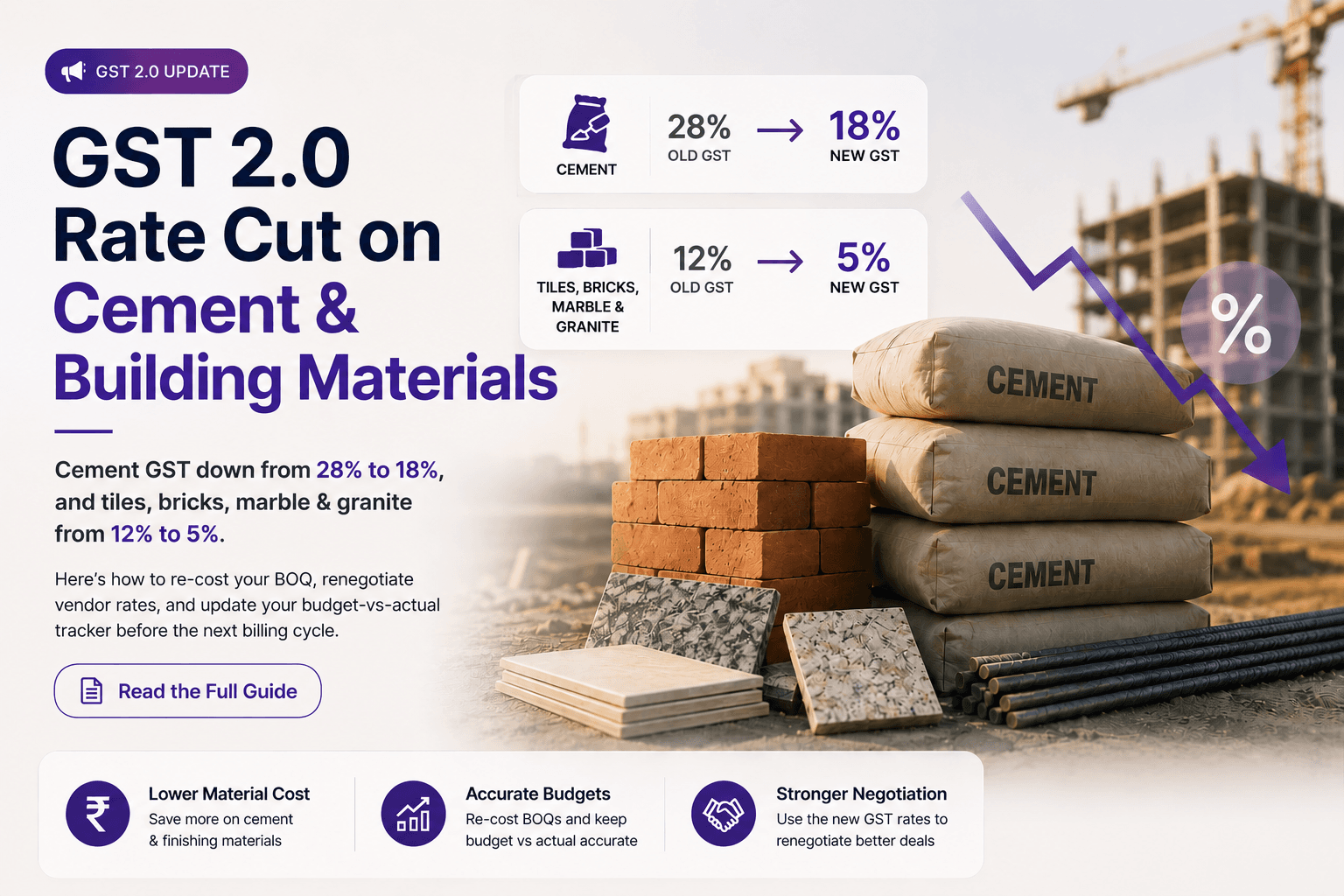
Cement just got cheaper to bill — but only if your budget actually knows it. As part of the GST 2.0 rationalisation, the GST rate on cement has been cut from 28% to 18%, and on finishing materials like bricks, tiles, marble and granite from 12% to 5%. Steel stays unchanged at 18%, with TMT bars still trading in the ₹52–60/kg range depending on city and grade. For a homeowner, this is a headline. For a contractor running five sites with open BOQs, it's a line-by-line re-costing job — and if you skip it, your budget-vs-actual reports will quietly go wrong in both directions.
Why this isn't just "good news"
GST is charged on the invoice date, not the purchase order or delivery date. That creates two failure modes if you don't touch your budgets: Overstated cost. Any open BOQ line still priced at the old 28% cement rate will show a cost that's no longer real once vendors start invoicing at 18%. Your "actual" comes in under budget for the wrong reason, and you draw the wrong conclusion about vendor performance. Silent margin leakage. Some suppliers don't pass the cut through automatically — they hold the landed price steady and absorb the difference themselves, or worse, keep billing you at the old effective price. If you're not checking the GST breakup line on every invoice, you won't catch it. Neither of these shows up unless someone actually reconciles the tax component, not just the total.
What changed, at a glance
| Material | Old GST | New GST | Change |
|---|---|---|---|
| Cement | 28% | 18% | ↓ 10% |
| Bricks | 12% | 5% | ↓ 7% |
| Tiles | 12% | 5% | ↓ 7% |
| Marble & granite | 12% | 5% | ↓ 7% |
| TMT steel | 18% | 18% | No change |
What to actually do this week
- Pull every open BOQ line that touches cement, bricks, tiles, marble or granite and hasn't been fully billed.
- Re-rate those lines at the new slab so your projected cost matches what vendors will legally invoice going forward.
- Audit incoming invoices for the GST breakup, not just the total — confirm the new rate is actually being applied, not absorbed by the supplier.
- Refresh budget-vs-actual so variance reports reflect real cost movement instead of a stale tax assumption from before the cut. This is exactly the kind of change that's easy to lose track of manually across multiple sites and vendors — it's a rate change buried inside hundreds of line items, not a single number you can adjust once.## Where ARC PEM fits If you're tracking this by hand, two things help immediately: The GST Contractor Bill Generator lets you generate a compliant bill at the correct current rate in seconds, so you're never invoicing (or accepting an invoice) at a stale slab. The [Construction Cost Calculator
](/tools/construction-cost-calculator) gives you an updated per- sq-ft estimate that already reflects current material pricing, useful for sanity-checking a BOQ before you revise it project-wide. Inside ARC PEM's Project Control, budget-vs-actual tracking picks up re-costed BOQ lines automatically, so a rate change like this shows up as a genuine cost movement — not noise you have to explain away later.
The takeaway
A GST rate cut is a tailwind, but only for the contractors who go back and update their numbers. Everyone else just ends up with a budget-vs-actual report that's technically wrong in a way nobody will notice until reconciliation.