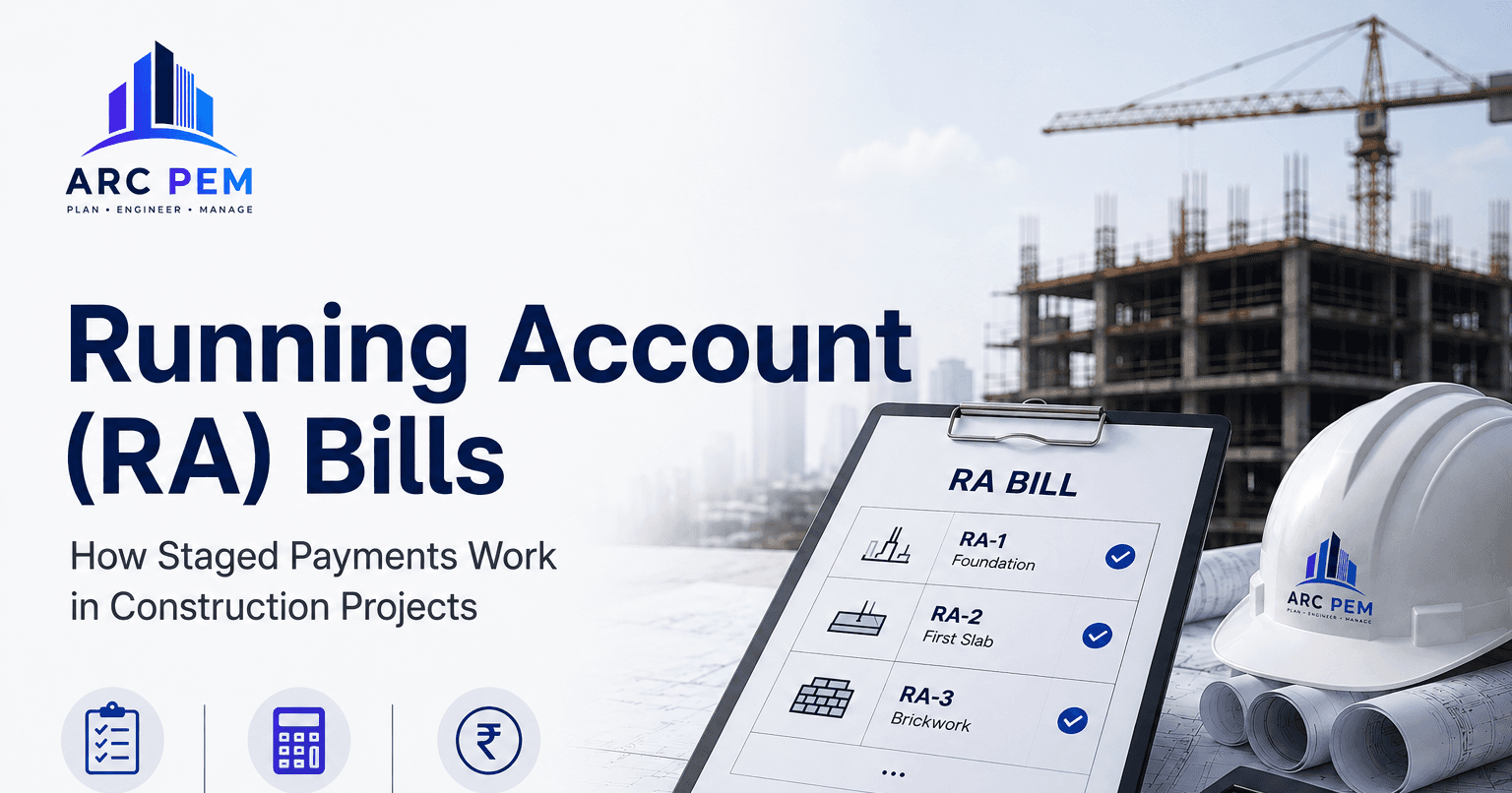
A construction contract worth ₹80 lakh doesn't get billed once at the end. It gets billed in pieces — RA-1 after the foundation, RA-2 after the first slab, RA-3 after brickwork, and so on — because no client wants to fund a year of construction against a single invoice they can't verify, and no contractor wants to fund a year of labour and material before seeing a rupee. The running account (RA) bill is the mechanism that makes staged payment possible, and getting it wrong is one of the most common ways contractors leave money on the table or end up in a dispute.
This is the full walkthrough — the actual sequence, not just the GST math.
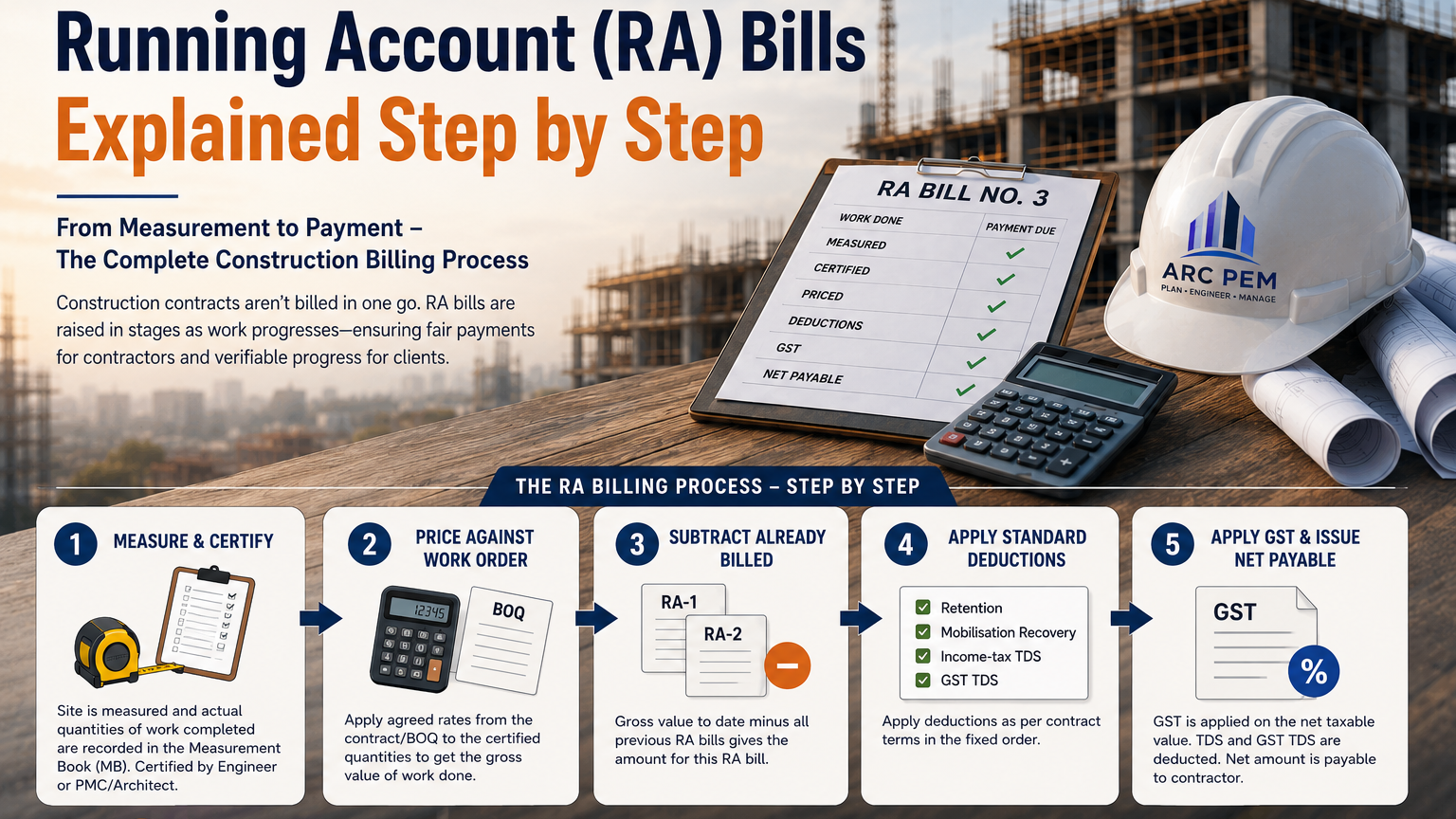
Step 1: Get the measurement certified, not estimated
Everything downstream depends on this step, so it's worth doing properly. The site engineer (yours or the client's) walks the site and records exact quantities of work completed since the last RA — length of brickwork, area of plastering, cubic metres of concrete poured — in a measurement book (MB). On any contract with a PMC or consulting architect, this measurement needs their signature before it counts as certified.
Skipping this and estimating "roughly 60% done" is how disputes start. A certified MB is the one document that ends an argument about how much work was actually completed.
Step 2: Price the certified quantities against the work order
Apply the rates already agreed in the contract or BOQ to the certified quantities. This gives you the gross value of work done to date — not the amount you're about to bill, just the cumulative value if nothing had been billed before.
Step 3: Subtract what's already been billed
RA bills are cumulative by nature — RA-3's "amount due" is (gross value of work to date) minus (everything already invoiced in RA-1 and RA-2). This is the step most spreadsheet-based billing gets wrong, because it requires the previous bills to be tracked accurately and referenced correctly. Miss this and you either double-bill (which gets caught and damages trust) or under-bill (which just costs you cash flow for no reason).
Step 4: Apply the standard deductions
A clean RA bill has four deduction lines, in this order:
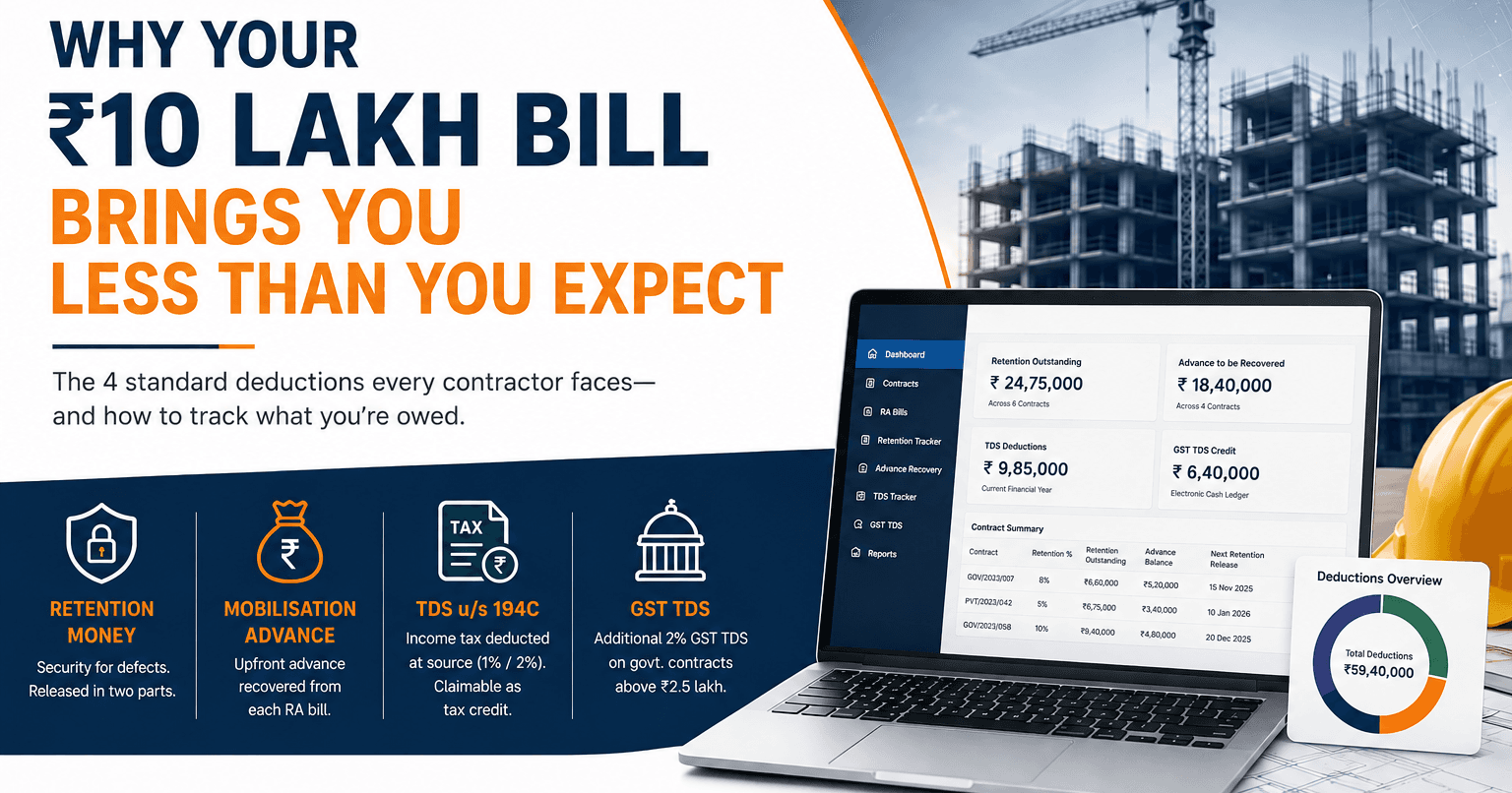
- Retention — commonly 5–10% of the bill value, held back by the client as security against defects. Contract-specific; check the work order.
- Mobilisation advance recovery — if the client gave an upfront advance, a proportion of it is typically recovered from each RA bill until it's fully adjusted.
- Income-tax TDS — under Section 194C, typically 1% (individual/HUF contractor) or 2% (company), deducted at source by the client.
- GST TDS — 2% on contracts with government bodies or PSUs above ₹2.5 lakh (not applicable on private contracts).
Step 5: Apply GST on the net taxable value
Most works contracts attract 18% GST — split as 9% CGST + 9% SGST if you and the client are registered in the same state, or 18% IGST if the site/client's registration is in a different state. GST is calculated on the taxable value of the work billed in this RA bill, not the cumulative contract value.
Worked example: RA-3 on a ₹80 lakh residential contract
- Work certified to date: ₹42,00,000 (gross value across RA-1 through RA-3)
- Already billed in RA-1 + RA-2: ₹28,00,000
- This RA bill's gross value: ₹14,00,000
- Retention @ 8%: −₹1,12,000
- Mobilisation advance recovery (10% of gross): −₹1,40,000
- Net taxable value: ₹11,48,000
- CGST @ 9%: ₹1,03,320
- SGST @ 9%: ₹1,03,320
- Gross RA-3 invoice value: ₹13,54,640
- Less TDS (194C, 1%): −₹11,480
- Less GST TDS (if applicable): −₹22,960
- Net payable to contractor: ₹13,20,200
Notice how far the final payable number sits from the "gross value of this RA bill" (₹14 lakh vs ₹13.2 lakh net) — nearly 6% disappears into retention, advance recovery and TDS before it ever reaches the contractor's account. Contractors who don't track this precisely per RA bill routinely lose track of exactly how much retention they're owed back at project close, because it was never logged bill-by-bill in the first place.
Labelling the bill correctly
Write "RA Bill No. 3" clearly on the invoice, reference the previous RA number, and state the cumulative work done to date alongside this bill's incremental value — a client's accounts team should be able to reconcile your bill against their own running total without calling you to ask.
Where this usually breaks down
The pattern that causes the most damage isn't a wrong GST rate — it's losing track of cumulative billed value across many RA bills on a long project, especially when it's happening in a spreadsheet that different people edit. A contractor running 4-5 active projects, each with 8-10 RA bills over the build, is tracking dozens of running totals by hand. One transposed number in RA-6 and every subsequent bill's "already billed" figure is wrong, silently, until someone reconciles the whole contract at the end and finds a mismatch.
This is the exact problem project-wise expense tracking solves — the running total per contract, per project, updated automatically as each RA bill is entered, instead of recalculated by hand each time.