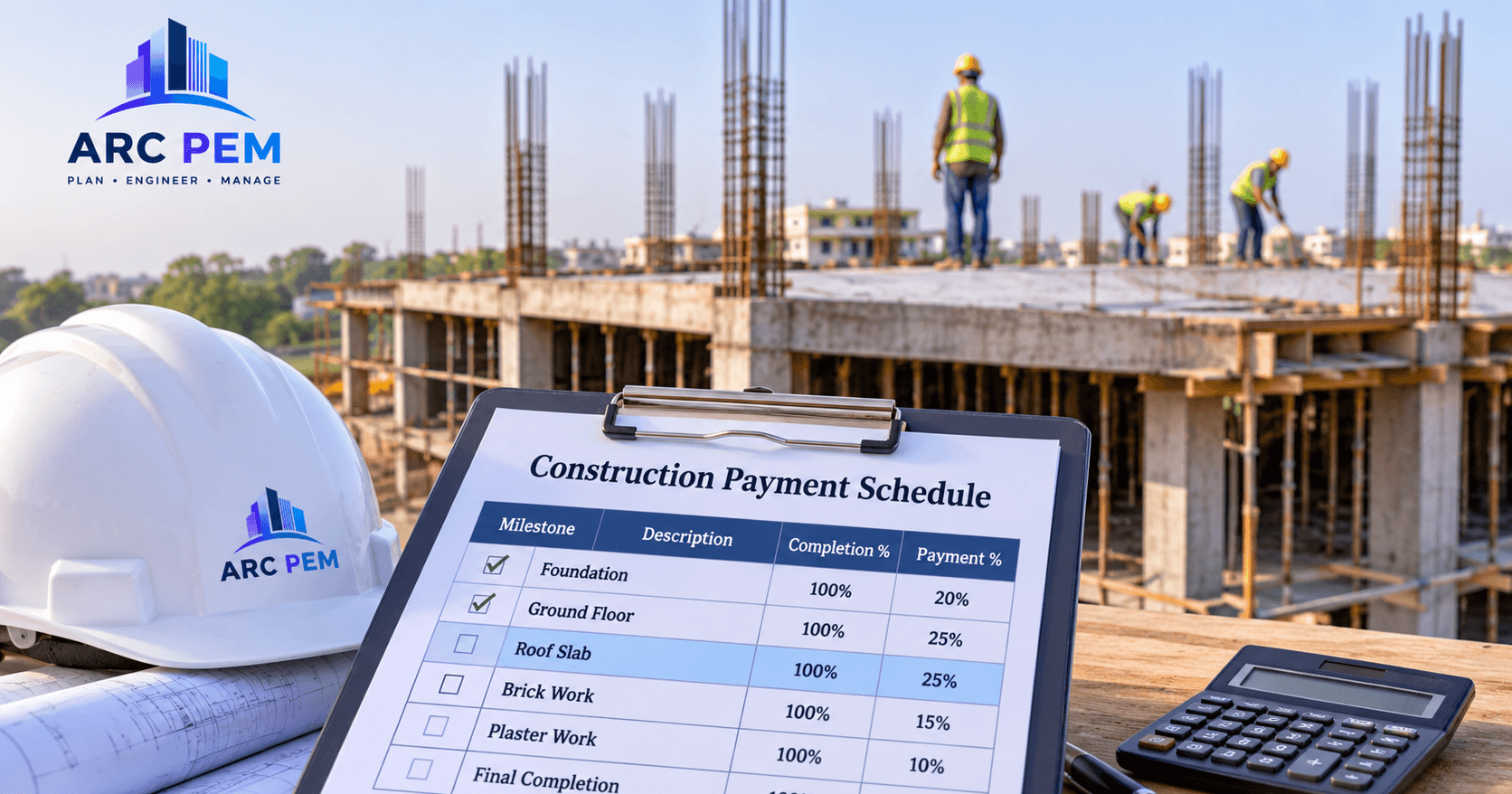
A construction payment schedule is the plan, written into the contract, that says how much the owner pays the contractor, when, and against which stage of work. A good schedule ties each payment to a measurable milestone, so the contractor is funded as work progresses and the owner never pays far ahead of what has been built.
Quick answer: break the contract value into stages such as foundation, superstructure, roof slab, masonry and plaster, services and flooring, and finishing. Give each stage a percentage of the contract value. At each stage, pay the stage value less any retention and less the advance recovered, and release the retention only after the defect liability period. Always pay against certified completion, not against a date.
This guide shows a stage-wise schedule with percentages, a worked ₹40 lakh example, Excel formulas and the mistakes to avoid. The percentages are illustrative, because your contract decides what applies. This is general information, not legal advice.
What a Payment Schedule Should Do
- Fund the work as it progresses. The contractor needs money to buy materials and pay labour.
- Protect the owner. The owner should not have paid more than the value of the work done, plus a controlled advance.
- Be objective. Each milestone should be a stage that can be seen and certified, such as "roof slab cast and cured".
- Show all deductions. Advance recovery, retention, taxes and other recoveries should be listed, as in retention money, advances and TDS.
Sample Milestone Payment Schedule
The percentages below are illustrative for a small building on a ₹40,00,000 contract. They are a starting point to adapt, not a standard.
| Milestone | Share of contract value | Value (₹) |
|---|---|---|
| 1. Foundation and plinth complete | 20% | 8,00,000 |
| 2. Columns, beams and first slab complete | 25% | 10,00,000 |
| 3. Roof slab complete | 15% | 6,00,000 |
| 4. Masonry and plastering complete | 15% | 6,00,000 |
| 5. Services and flooring complete | 15% | 6,00,000 |
| 6. Finishing, painting and handover | 10% | 4,00,000 |
| Total | 100% | 40,00,000 |
Heavy structural stages carry a larger share, because they consume most of the materials and labour. The last stage is kept meaningful, so the contractor has a reason to finish properly.
Worked Example: Advance, Retention and Net Payments
Assume the contract has these terms, which are hypothetical:
- Mobilisation advance: 10% of the contract value, ₹4,00,000, paid at the start
- Advance recovery: 10% of each milestone value, so the advance is fully recovered by the last milestone
- Retention: 5% of each milestone value, ₹2,00,000 in total, released after the defect liability period
Net payment for a milestone = milestone value − advance recovery − retention
| Milestone | Value (₹) | Advance recovery (₹) | Retention (₹) | Net paid (₹) |
|---|---|---|---|---|
| 1. Foundation and plinth | 8,00,000 | 80,000 | 40,000 | 6,80,000 |
| 2. Columns, beams, first slab | 10,00,000 | 1,00,000 | 50,000 | 8,50,000 |
| 3. Roof slab | 6,00,000 | 60,000 | 30,000 | 5,10,000 |
| 4. Masonry and plastering | 6,00,000 | 60,000 | 30,000 | 5,10,000 |
| 5. Services and flooring | 6,00,000 | 60,000 | 30,000 | 5,10,000 |
| 6. Finishing and handover | 4,00,000 | 40,000 | 20,000 | 3,40,000 |
| Total | 40,00,000 | 4,00,000 | 2,00,000 | 34,00,000 |
Check the totals. The owner pays ₹4,00,000 as advance plus ₹34,00,000 across the milestones, which is ₹38,00,000. The ₹2,00,000 retention is held, and it brings the total to the contract value of ₹40,00,000 when released. This is before GST and TDS, which are handled separately on each bill. See the GST-compliant RA bill and TDS on contractor payments guides.
How far ahead of the work is the owner?
This is the question a schedule must answer. Compare the total paid with the value of work completed at each stage.
| After milestone | Total paid including advance (₹) | Value of work done (₹) | Paid ahead of work (₹) |
|---|---|---|---|
| 1 | 10,80,000 | 8,00,000 | 2,80,000 |
| 2 | 19,30,000 | 18,00,000 | 1,30,000 |
| 3 | 24,40,000 | 24,00,000 | 40,000 |
| 4 | 29,50,000 | 30,00,000 | −50,000 |
| 5 | 34,60,000 | 36,00,000 | −1,40,000 |
| 6 | 38,00,000 | 40,00,000 | −2,00,000 |
After the first milestone, the owner has paid ₹2.8 lakh more than the work done, because the advance has been only partly recovered. By the third milestone the gap has almost closed, and from then on the owner holds a cushion, which at the end equals the retention of ₹2,00,000. A large advance with slow recovery increases the owner's risk early on, so many owners limit the advance and recover it faster, or ask for security on it.
Payment Schedule in Excel
Set up one row per milestone. If the contract value is in B1, the milestone share is in B3 (as a percentage), the advance recovery rate is in B5 and the retention rate is in B6:
- Milestone value:
=$B$1*B3 - Advance recovery:
=C3*$B$5 - Retention:
=C3*$B$6 - Net paid:
=C3-D3-E3 - Total paid so far: a running sum of the advance and the net paid column
- Paid ahead of work:
=total paid so far − cumulative milestone value
Keep each issued payment as its own record, so you can show what was paid and certified at each stage.
What to Put in the Contract
- Milestone definitions. State what "complete" means, for example "roof slab cast, cured and cubes tested".
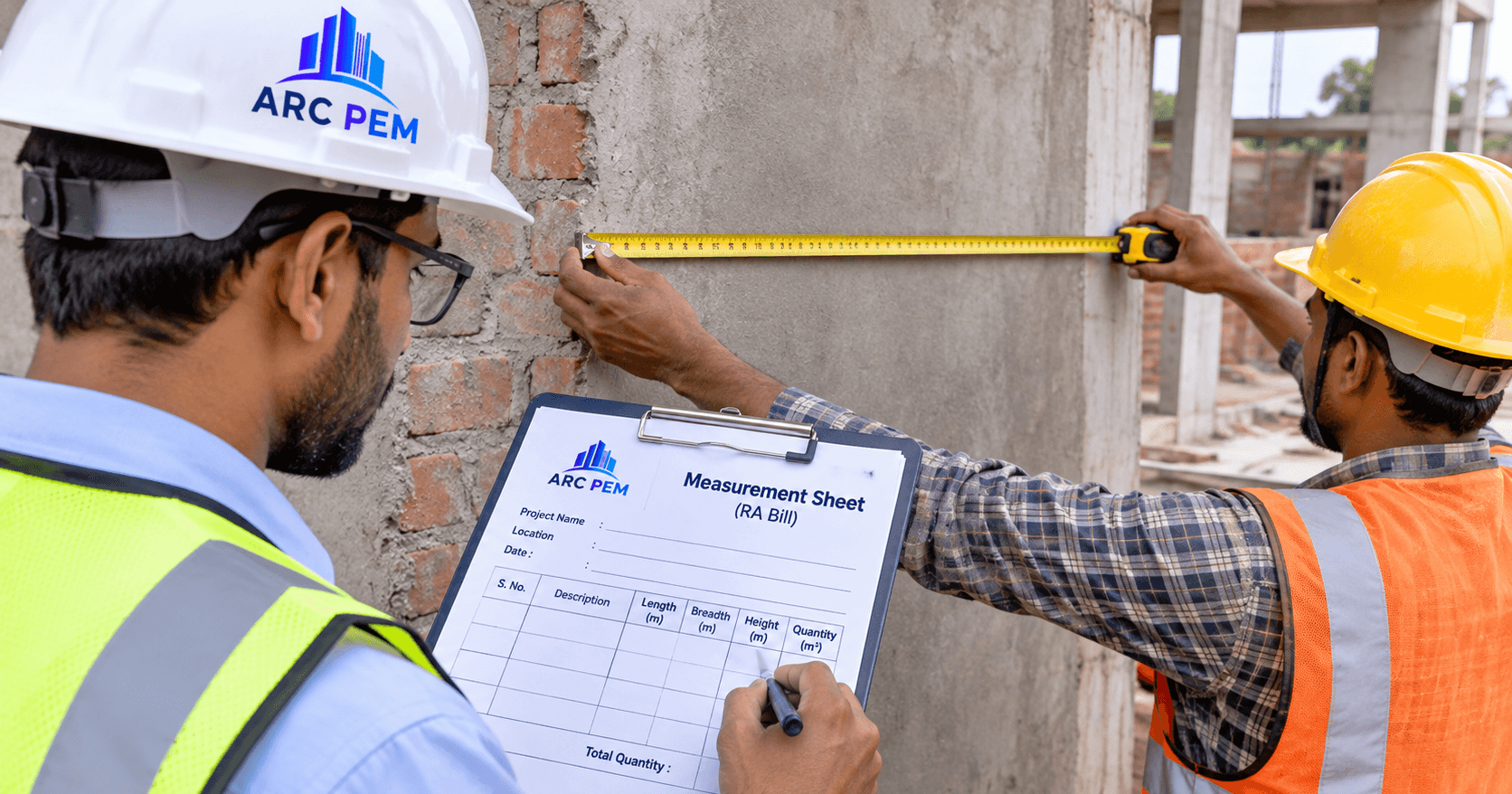
- Certification. Who certifies completion, and the measurement basis. See how to take measurements for an RA bill.
- Payment timeline. How many days after certification the payment is made.
- Advance. The amount, whether it is secured, and how it is recovered.
- Retention. The rate, the defect liability period and the release conditions.
- Variations. How extra work is priced and paid. See types of construction contracts.
- Taxes. GST and TDS treatment on each payment, confirmed with your CA.
- Delays and disputes. What happens if a milestone is late or contested.
Stage-Wise Payment vs Running Account Bills
A milestone schedule pays a fixed percentage on completing a stage. A running account (RA) bill pays for the quantity of work measured in a period. Lump sum contracts often use milestones, and item rate contracts often use RA bills. Some contracts combine them. If you are building a house with a contractor for a fixed price, a milestone schedule is simple to follow. If quantities may change, RA bills based on measurement are more accurate. See the contractor bill format.
If you are buying an apartment from a developer, your payment plan is set out in your agreement and is governed by RERA. For example, the RERA Act limits the advance a promoter can take before signing the agreement for sale to 10% of the cost. Check the rules in your state.
Common Mistakes in Payment Schedules
- Paying by date, not by progress. The owner pays for work that hasn't been done.
- Vague milestones. "Structure done" means different things to the owner and the contractor.
- A large advance with slow recovery. The owner carries the risk early, as the example shows.
- Front-loading. Back-loaded schedules protect the owner but starve the contractor. Balance them.
- No retention or defect period. Nothing is left to fix problems after handover.
- No certification step. Payments are made on verbal approval.
- Ignoring variations. Extra work is paid informally and the totals no longer match.
- Forgetting tax on each payment. GST and TDS apply to each bill, not just the last one.
Track Every Stage and Payment
A payment schedule only works if you track what was certified, what was paid, what was recovered and what is still held. A spreadsheet per contractor becomes hard to reconcile across projects.
ARC PEM's expense and finance tracking keeps vendor, labour and GST records organised project by project, so billed, paid and pending amounts are visible in one place. Prepare each bill with the free GST Contractor Bill Generator, read how a project moves from BOQ to final bill, or view pricing.