
The type of contract you sign decides three things before work starts: how you will be paid, who carries the risk if quantities or costs change, and what your running bills will look like. This guide explains the main types of construction contracts used in India, with a billing example for each.
Quick answer: the main types of construction contract in India are:
- Item rate contract: you are paid the measured quantity of each item multiplied by its agreed rate.
- Percentage rate contract: you quote a percentage above or below the owner's schedule of rates.
- Lump sum contract: you are paid one fixed price for a defined scope, whatever the measured quantities turn out to be.
- Labour-only contract: the contractor supplies labour and the owner supplies the materials.
- Cost-plus contract: you are paid the actual documented cost plus a percentage or fixed fee.
Contracts in India are governed by the Indian Contract Act, 1872, and the exact terms always come from your agreement. This article is general information, not legal advice.
Why the Contract Type Matters for Billing
Two projects with the same drawings can produce completely different bills depending on the contract. In one, the contractor measures work and bills quantity × rate each month. In another, the contractor bills a fixed percentage at each stage. In a third, the contractor sends invoices for actual costs plus a fee.
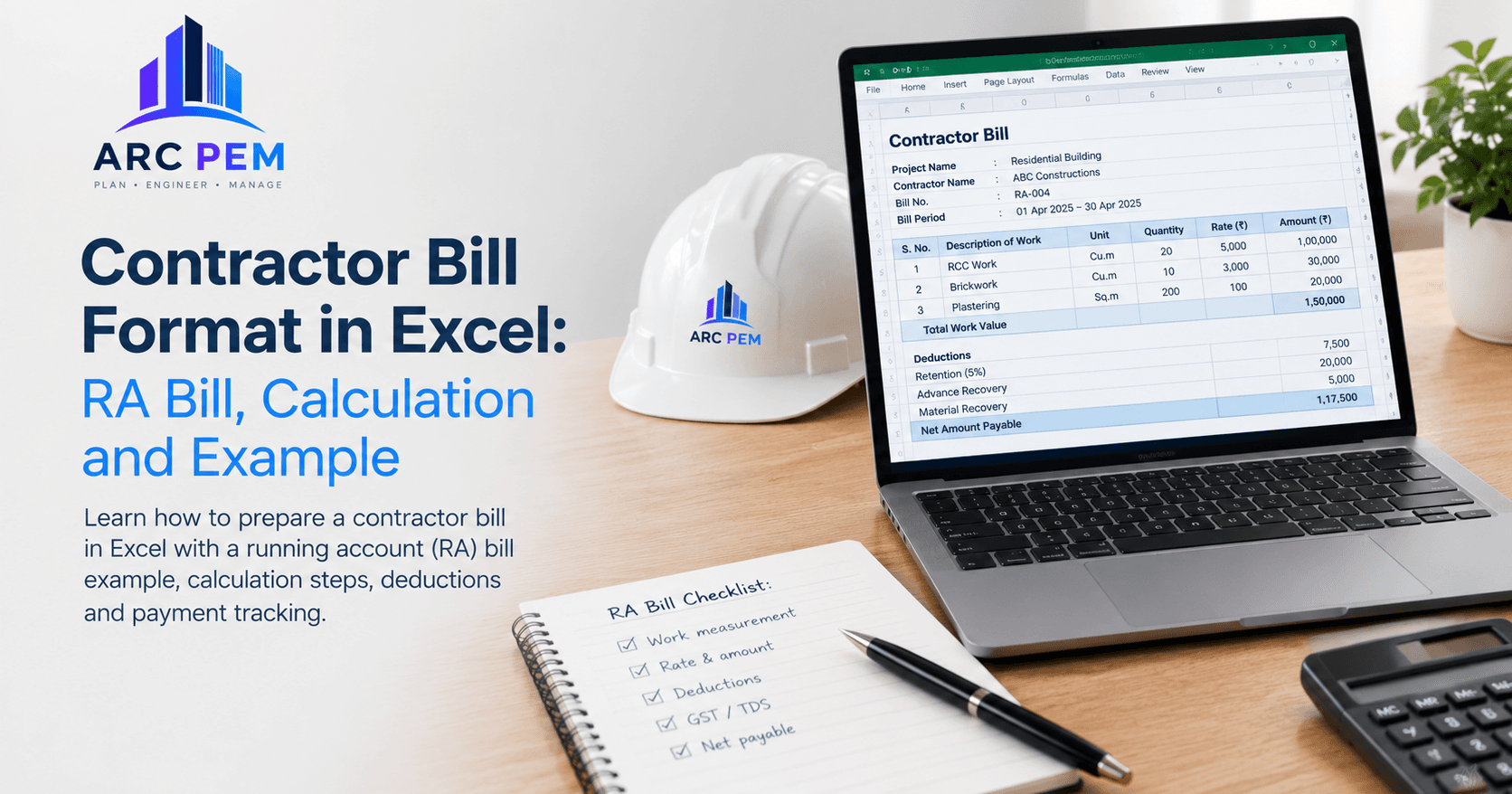
The contract type therefore affects measurement, retention, advance recovery and how pending payments are tracked. If you are new to running bills, read how a contractor bill format in Excel works first, and our guide to the GST-compliant RA bill for the tax side.
1. Item Rate Contract
In an item rate contract (also called a measurement or unit-price contract), the work is divided into items, and a rate and unit of measurement are fixed for each. The owner pays for the actual quantity of work done multiplied by the item's rate. The agreement normally includes a priced BOQ.
- How you are paid: measured quantity × rate, usually through monthly running bills.
- Who carries the quantity risk: the owner, because if quantities grow the total grows.
- Who carries the rate risk: the contractor, who must deliver at the quoted rate even if costs rise.
- Suits: projects where quantities will change or aren't final, which is most building work.
A common source of dispute is what each rate includes. A good item rate says clearly whether it covers ancillary work such as formwork, curing or testing, and what it excludes.
2. Percentage Rate Contract
A percentage rate contract is a variation of the item rate contract. The owner provides an estimate or schedule of rates for every item. The contractor bids a percentage by which those rates are to be increased or decreased, for example plus 6% or minus 4%. All items are then paid at the schedule rate adjusted by that percentage.
- How you are paid: measured quantity × (schedule rate ± the quoted percentage).
- Suits: small and repetitive works, and owners who maintain a schedule of rates.
3. Lump Sum Contract
In a lump sum contract, the contractor agrees to complete a defined scope for one fixed price. The price does not change with the quantities measured, unless the scope itself changes through an agreed variation. A turnkey contract is a larger form of lump sum, where the contractor delivers the finished building, often including design, for a fixed price.
- How you are paid: the fixed price, usually in stages or milestones.
- Who carries the quantity risk: the contractor.
- Suits: projects with complete drawings and specifications, where the owner wants cost certainty.
- Watch for: vague scope. If the scope is not clear, every disagreement becomes a variation claim.
4. Labour-Only Contract
In a labour-only contract, the contractor supplies the labour and the owner buys and supplies the materials. The contractor is typically paid for the measured quantity of each item at a labour rate, or at a rate per unit of built-up area.
- How you are paid: measured quantity × labour rate.
- Who carries the material risk: the owner, including wastage and price changes. Controls such as material reconciliation matter most here.
- Suits: owners who can buy materials and supervise closely, and builders who sub-let labour packages.
5. Cost-Plus Contract
In a cost-plus contract, the owner reimburses the contractor's actual, documented cost of materials, labour and other items, plus a fee. The fee may be a percentage of the cost or a fixed amount.
- How you are paid: actual cost + fee.
- Who carries the cost risk: the owner. The contractor's profit is protected.
- Suits: bespoke or uncertain work where the scope cannot be fixed in advance. It needs detailed expense records and, ideally, a cap or audit rights for the owner.
Billing Example: The Same Job Under Each Contract
All figures below are hypothetical and for teaching only. They are not market rates.
The job is 20 m³ of RCC work. By the end of the month, 12 m³ is complete.
| Contract type | How this month's bill is worked out | Amount |
|---|---|---|
| Item rate | 12 m³ × ₹8,000 per m³ | ₹96,000 |
| Percentage rate | Schedule rate ₹7,500 + 6% = ₹7,950; 12 m³ × ₹7,950 | ₹95,400 |
| Lump sum | Stage payment of 40% on the agreed stage, on a fixed price of ₹1,60,000 | ₹64,000 |
| Labour-only | 12 m³ × ₹1,800 labour rate (the owner buys materials separately) | ₹21,600 |
| Cost-plus | Documented cost to date ₹82,000 + 10% fee | ₹90,200 |
What happens if the quantity changes?
Suppose the work turns out to need 22 m³ instead of 20 m³.
- Item rate: the total becomes 22 × ₹8,000 = ₹1,76,000, which is ₹16,000 more. The owner pays for the extra quantity.
- Lump sum: the price stays at ₹1,60,000, unless the extra 2 m³ is a change in scope and an agreed variation is added. The contractor carries the extra cost.
- Cost-plus: the owner pays the extra documented cost plus the fee.
This is the practical meaning of "who carries the risk".
Comparison at a Glance
| Item rate | Percentage rate | Lump sum | Labour-only | Cost-plus | |
|---|---|---|---|---|---|
| Payment basis | Measured quantity × rate | Measured quantity × adjusted schedule rate | Fixed price, in stages | Measured quantity × labour rate | Actual cost + fee |
| Total cost known upfront | No | No | Yes | No | No |
| Needs complete drawings | No | No | Yes | No | No |
| Owner's control | Medium | Medium | Lower | High, but more effort | High, with audit |
| Quantity risk | Owner | Owner | Contractor | Owner | Owner |
| Material buying | Contractor | Contractor | Contractor | Owner | Contractor, reimbursed |
How to Choose the Right Contract Type
- Check how complete the drawings are. Lump sum works only when the scope is fixed. If quantities may change, use item rate.
- Decide how much cost certainty you need. A fixed budget points to lump sum. A flexible scope points to item rate or cost-plus.
- Decide who will buy materials. If you want to control procurement and can supervise, a labour-only contract can work. If not, choose a contract that includes materials.
- Match the contract to your record-keeping. Item rate and cost-plus need good measurement and expense records. Lump sum needs good milestone records.
- Write the inclusions and variations down. State what each rate or price covers, how variations are valued and approved, and how disputes are handled.
Clauses That Affect Every Contract's Billing
- Scope and what each rate includes. Ancillary work, testing and wastage should be stated.
- Method of measurement. For example, the standard your contract follows, such as IS 1200 for building works.
- Variations. How changes are instructed, priced and approved.
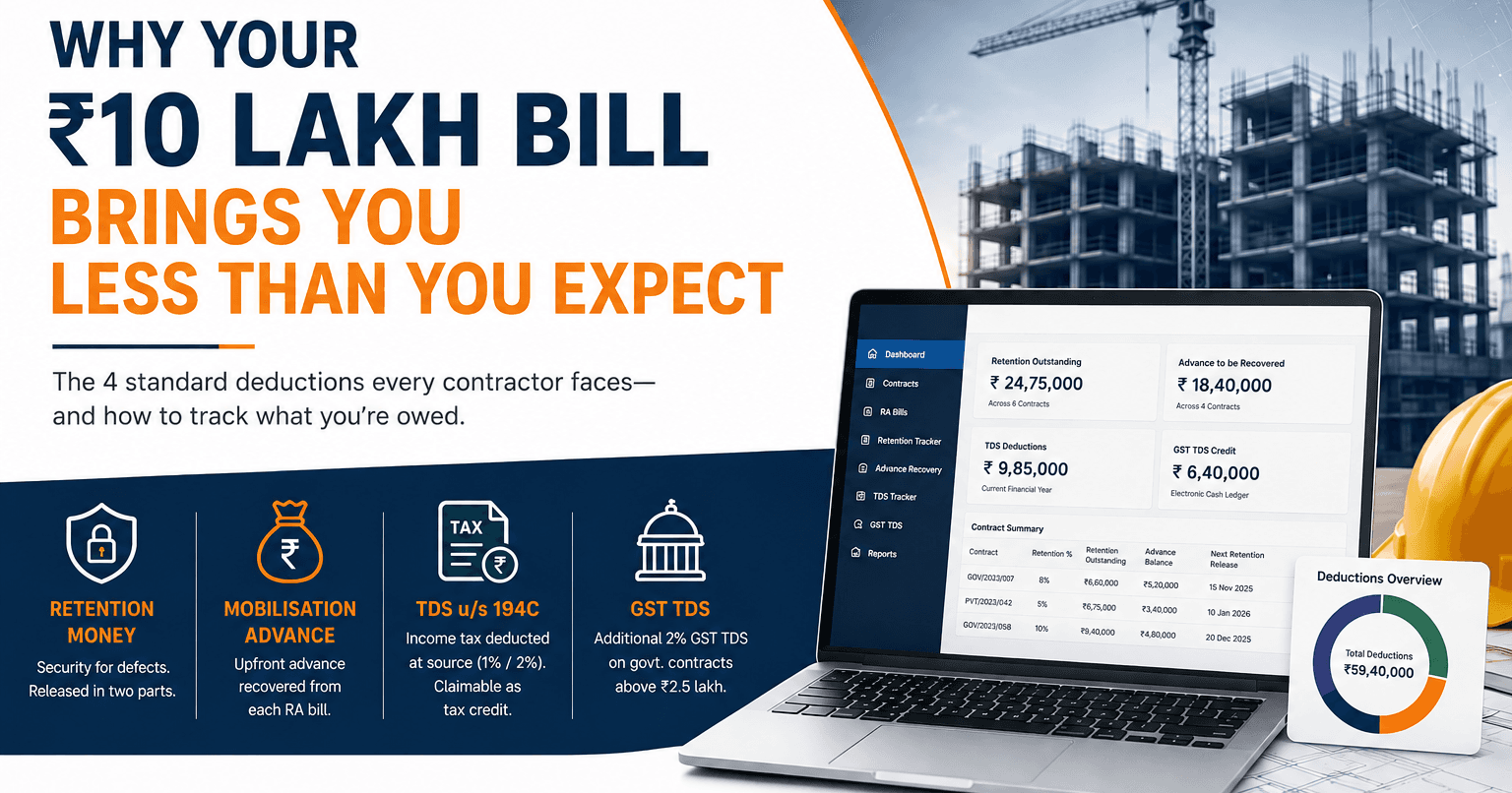
- Retention money and advances. How much is held, when it is released and how advances are recovered. See retention money, advances and TDS.
- Taxes. TDS on contractor payments applies to labour-only and other contractor payments alike. See TDS on contractor payments. GST treatment depends on the contract and the parties, so confirm it with your CA.
- Payment timelines and defect liability. When bills are paid and who fixes defects.
Common Mistakes
- A lump sum with a vague scope. It invites disputes over what was included.
- An item rate that doesn't say what it covers. Contractors and owners interpret it differently.
- A labour-only contract without a material control process. Wastage and shortages end up on the owner's account.
- A cost-plus contract with no cap or audit rights. The cost has no limit.
- Mixing contract types without saying so. A project can combine them, for example item rate for civil work and lump sum for finishing, but each package must be clearly separated.
- Poor records. Whatever the contract type, you need measured quantities, bills and payments tied to the right package.
Tracking Bills Across Contract Types
Real projects often run several contract types at once: item rate for civil work, labour-only for finishing, lump sum for services. Tracking each package's bills, advances, retention and balances in separate spreadsheets gets hard quickly.
ARC PEM's expense and finance tracking keeps vendor, labour and GST records organised project by project, with contractor bills tracked against your BOQ. Start with the free GST Contractor Bill Generator to prepare a bill, and see how a project moves from BOQ to final bill. You can also view pricing or book a free demo.