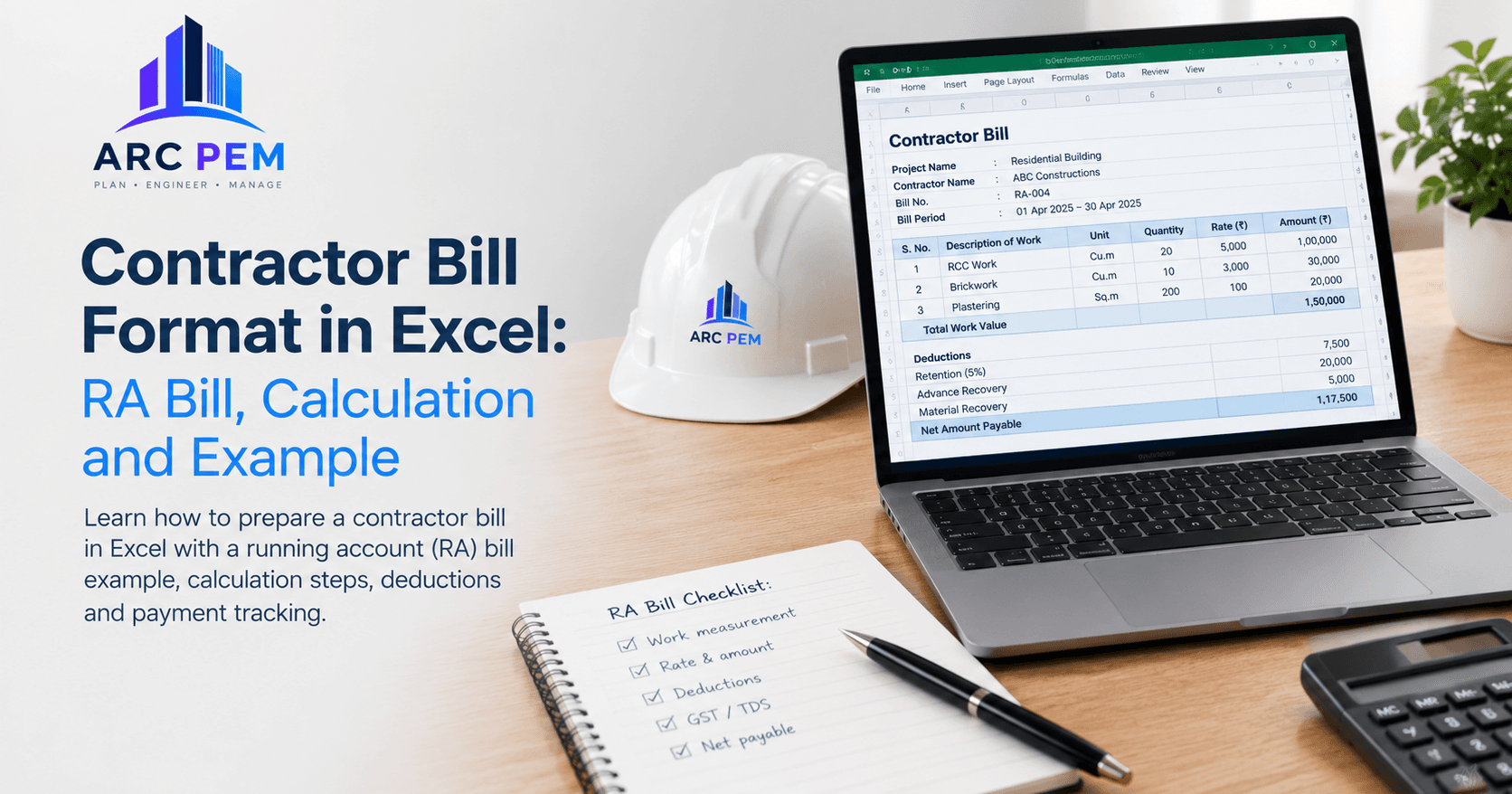
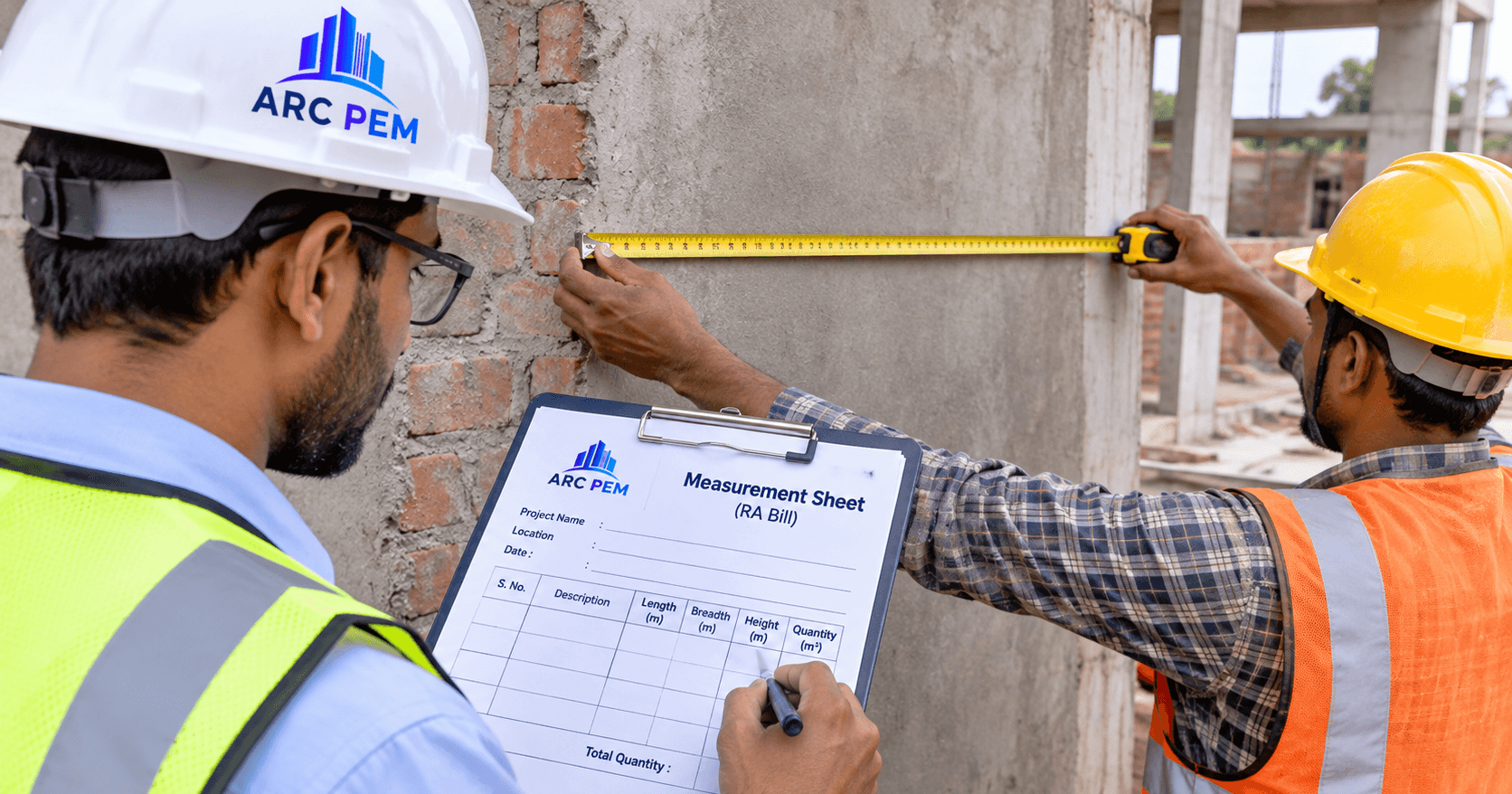
A measurement sheet format for contractor bills is a table in which the quantity of each completed work item is recorded as number × length × breadth × height, with deductions, so that the running account (RA) bill is based on measured work and not on estimates. It is the document behind every quantity in a contractor's bill, and the first thing checked when a bill is disputed.
Quick answer: for each work item, record a description, the number of units (Nos.), the length, breadth and depth or height, and the quantity, which is Nos. × L × B × D. Enter openings and other omissions as negative lines. Then work out the quantity for the current bill as the cumulative quantity measured to date minus the quantity already billed. Both parties sign the sheet before the bill is raised.
This guide gives a format you can copy, the formulas, a worked example that continues into an RA bill, and the mistakes to avoid. It is general information, and your contract's measurement rules always come first.
What Is a Measurement Sheet?
A measurement sheet is a record of the work actually executed, measured on site and written down in a standard format. In government and public works, the same record is kept in a bound Measurement Book (MB), where each entry is dated, signed and checked. In private projects, it is usually a measurement sheet signed jointly by the contractor and the site engineer.
It serves three purposes:
- It supports the bill. Every quantity in an RA bill should trace back to a measurement entry.
- It prevents disputes. A signed sheet shows what was measured, when and by whom.
- It stops double billing. Comparing cumulative quantities with earlier bills shows what has already been paid for.
Measurement Sheet Format: The Columns You Need
| Column | What to enter |
|---|---|
| Sr. No. | A running number for each entry |
| BOQ item no. | The BOQ or work order item the entry belongs to |
| Description | The work, location and grid or floor, for example "RCC footing F1 to F4, Block A" |
| Nos. | The number of identical units |
| Length (L) | In metres |
| Breadth (B) | In metres |
| Depth or height (D/H) | In metres |
| Quantity | Nos. × L × B × D/H, in the unit of the BOQ item |
| Remarks | Deductions, drawing reference, date measured |
| Signatures | The contractor and the engineer, with the date |
In Excel, if Nos. is in column C, L in D, B in E and D/H in F, the quantity in column G is:
=C2*D2*E2*F2
and the total for an item is =SUM(G2:G10). For a wall measured in square metres, leave the depth cell empty or use 1.
Rules for Taking Measurements
- Measure in the unit of the BOQ item. Volume items in m³, area items in m², length items in running metres, and counted items in numbers.
- Follow the contract's method of measurement. Standards such as IS 1200 set the rules for what is measured and what is deducted, including the minimum size of an opening below which no deduction is made. Check which rule your contract names.
- Enter deductions as negative lines, so the net quantity is easy to audit.
- Describe the location. "Footing F1 to F4" is better than "footings", because it shows what has been measured.
- Record the date and the measuring parties.
- Measure completed work only, and measure it before it is covered up, for example before backfilling or plastering.
Worked Example: A Measurement Sheet
The dimensions below are hypothetical and are the same ones used in our guide to preparing a BOQ.
| Sr. | BOQ item | Description | Nos. | L (m) | B (m) | D/H (m) | Quantity (m³) |
|---|---|---|---|---|---|---|---|
| 1 | Excavation | Footings F1 to F4 | 4 | 1.50 | 1.50 | 1.20 | 10.80 |
| 2 | PCC | Bed under footings | 4 | 1.60 | 1.60 | 0.10 | 1.02 |
| 3 | RCC M20 | Footings F1 to F4 | 4 | 1.50 | 1.50 | 0.40 | 3.60 |
| 4 | Brickwork | Wall, gridline A | 1 | 10.00 | 0.23 | 3.00 | 6.90 |
| 4a | Brickwork | Less: door opening | −1 | 1.00 | 0.23 | 2.10 | −0.48 |
| Net brickwork | 6.42 |
Two things to notice. The brickwork has a deduction line for the door, so the net quantity is 6.90 − 0.48 = 6.42 m³. And the PCC quantity of 1.024 is rounded to 1.02 m³, so state the rounding rule your contract uses and apply it everywhere.
From the Measurement Sheet to the RA Bill
An RA bill is paid on what was done since the last bill, so you need three columns: the quantity measured up to the previous bill, the cumulative quantity measured to date, and the difference.
RA Bill No. 2. Assume the work completed to date is as follows, with the rates from the BOQ. The rates are hypothetical.
| Item | Rate (₹) | Up to previous bill | Cumulative to date | This bill | Amount (₹) |
|---|---|---|---|---|---|
| Excavation, m³ | 500 | 10.80 | 10.80 | 0.00 | 0 |
| PCC, m³ | 5,500 | 1.02 | 1.02 | 0.00 | 0 |
| RCC M20 in footings, m³ | 8,000 | 1.80 | 3.60 | 1.80 | 14,400 |
| Brickwork, m³ | 7,000 | 0.00 | 3.00 | 3.00 | 21,000 |
| Gross value of this bill | 35,400 |
Check the result against the cumulative values. The cumulative value to date is ₹60,810 and the value billed earlier is ₹25,410, so this bill is ₹60,810 − ₹25,410 = ₹35,400, the same figure.
From here, the bill continues as in our guide to the contractor bill format in Excel. For example, with a 5% retention (illustrative) the amount after retention is 35,400 − 1,770 = ₹33,630, before taxes and other adjustments. See the GST-compliant RA bill guide for the tax side, and retention money, advances and TDS for the deductions.
Joint Measurement: A Checklist
- Fix the measurement date with the contractor, and measure together.
- Bring the drawings and the BOQ, and check the dimensions against both.
- Measure and record on the spot, not from memory later.
- Photograph hidden work before it is covered, with the location marked.
- Sign and date the sheet, and give the contractor a copy.
- Cross-check with the previous bill so nothing is billed twice.
Common Mistakes in Measurement Sheets
- Billing from the estimate or the drawings. A bill should follow work actually measured.
- Missing deductions. Openings, voids and overlaps overstate the quantity.
- Double counting at junctions. Where walls, columns and beams meet, the same volume can be measured twice.
- Mixing units. Metres and millimetres, or m² and sq ft, in the same line.
- No location or date. A quantity with no location can't be checked.
- Not carrying forward the previous quantity. This is how work is billed twice.
- Measuring covered work late. If it has been buried or plastered, it can't be verified.
- Unsigned sheets. A bill without a signed measurement is the first thing questioned.
Keep Measurements, Bills and Payments Together
A measurement sheet, an RA bill and a payment are three steps of one chain. Keeping them in separate files is where mismatches begin. Link each measured item to its BOQ line, and each bill to the measurement behind it, so that billed, paid and balance quantities are always visible.
ARC PEM's expense and finance tracking keeps vendor, labour and GST records organised project by project, with contractor bills tracked against your BOQ. Prepare a bill with the free GST Contractor Bill Generator, read how a project moves from BOQ to final bill, or view pricing.