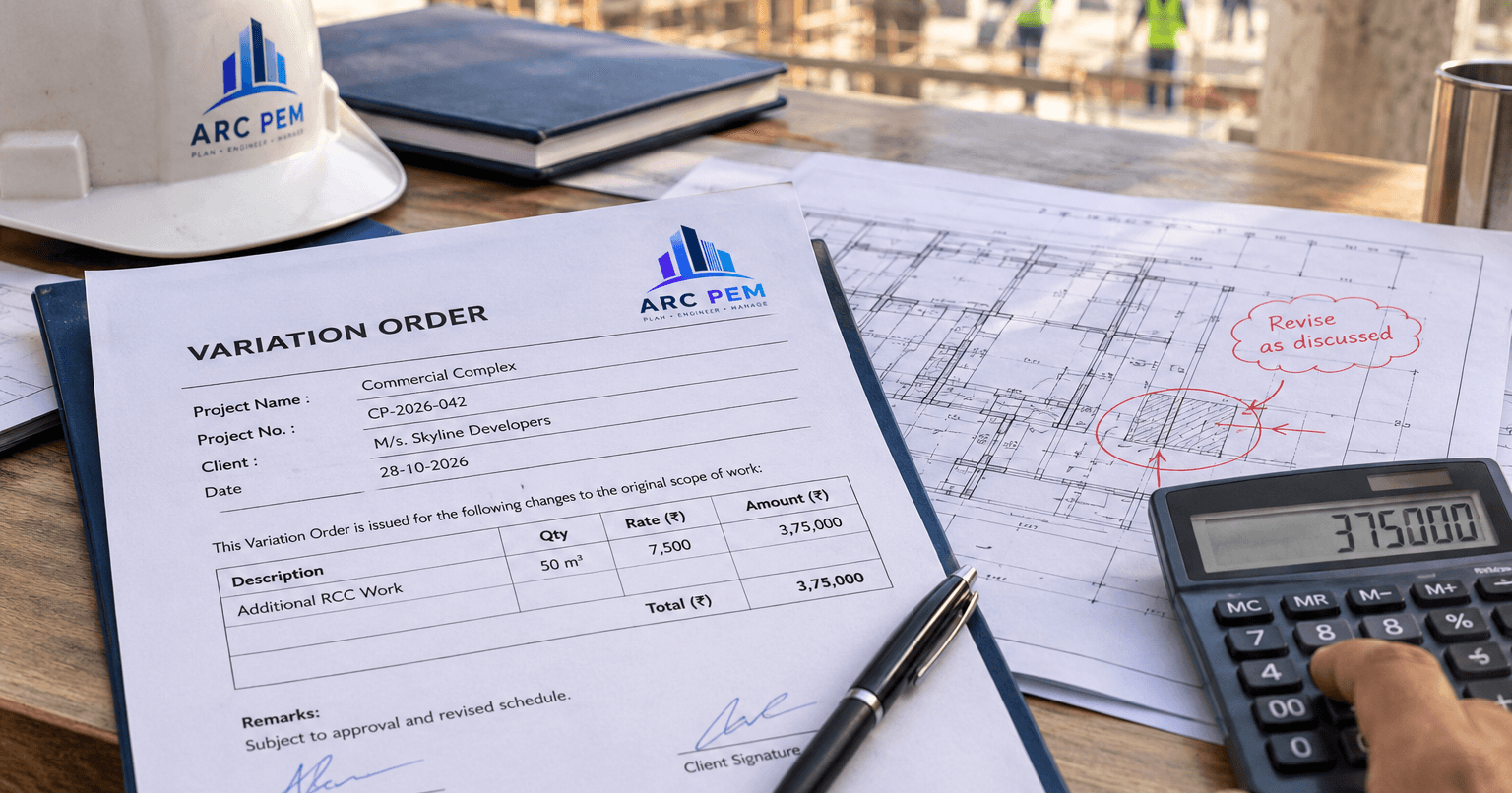
A variation order (VO), also called a change order, is a written instruction and agreement that changes the scope, quantity, specification or time of a construction contract, together with the price and time effect of that change. It is how a contract stays accurate when the work on site differs from what was originally agreed.
Quick answer: record every change in writing before the work starts. State what is being added, omitted or substituted, price it using the contract rates where they apply or an agreed new rate where they don't, state the effect on time, get it approved by the person with authority, give it a number, and bill it as a separate line in the running bill. Track approved and pending variations in a register, so the revised contract value is always known.
This guide covers what a variation order is, a format you can copy, how to price a variation, a worked example, and the mistakes that cause disputes. Contract terms always come first, and this is general information, not legal advice.
Why Variations Happen
- Client changes. A bigger room, an extra staircase, a different finish.
- Design changes. Revised drawings after the work was priced.
- Site conditions. Unexpected soil, existing services or access limits.
- Quantity differences. Measured quantities differ from the BOQ quantities in an item rate contract.
- Regulatory changes. Approval conditions that require extra work.
- Contractor proposals. A cheaper or faster method suggested by the contractor.
Variations are normal. The problem is not the change but an undocumented change, because that is where disputes over price and time begin.
Types of Variation
| Type | What changes | Example |
|---|---|---|
| Addition | Extra work is added | An external staircase is added to the building |
| Omission | Work is removed | A partition wall is deleted |
| Substitution | One item is replaced by another | Vitrified tiles replace ceramic tiles |
| Change in specification or quantity | The same item, but different | Concrete grade raised from M20 to M25 |
| Change in time or sequence | The programme changes | Work is held back while the owner decides |
Variation Order Format
A variation order should be short and complete. Include these fields.
| Field | What to enter |
|---|---|
| VO number and date | A running number, for example VO-01 |
| Project and contract reference | The work order or contract number |
| Description of the change | What is added, omitted or substituted, with the drawing reference |
| Reason | Client request, design change, site condition and so on |
| Instructed by | The person who authorised it |
| Quantities and rates | Item-wise, with the basis of each rate |
| Value | Addition, omission and the net total |
| Time effect | Any extension of the completion date, or none |
| Approval | Signatures of the owner or their representative and the contractor, with the date |
How to Price a Variation
Use the first method that fits, in this order. It is common practice, but your contract sets the rule.
- Contract rate. If the BOQ has the same item under similar conditions, use its rate.
- Derived rate. If the item is similar but not identical, adjust the contract rate for the difference.
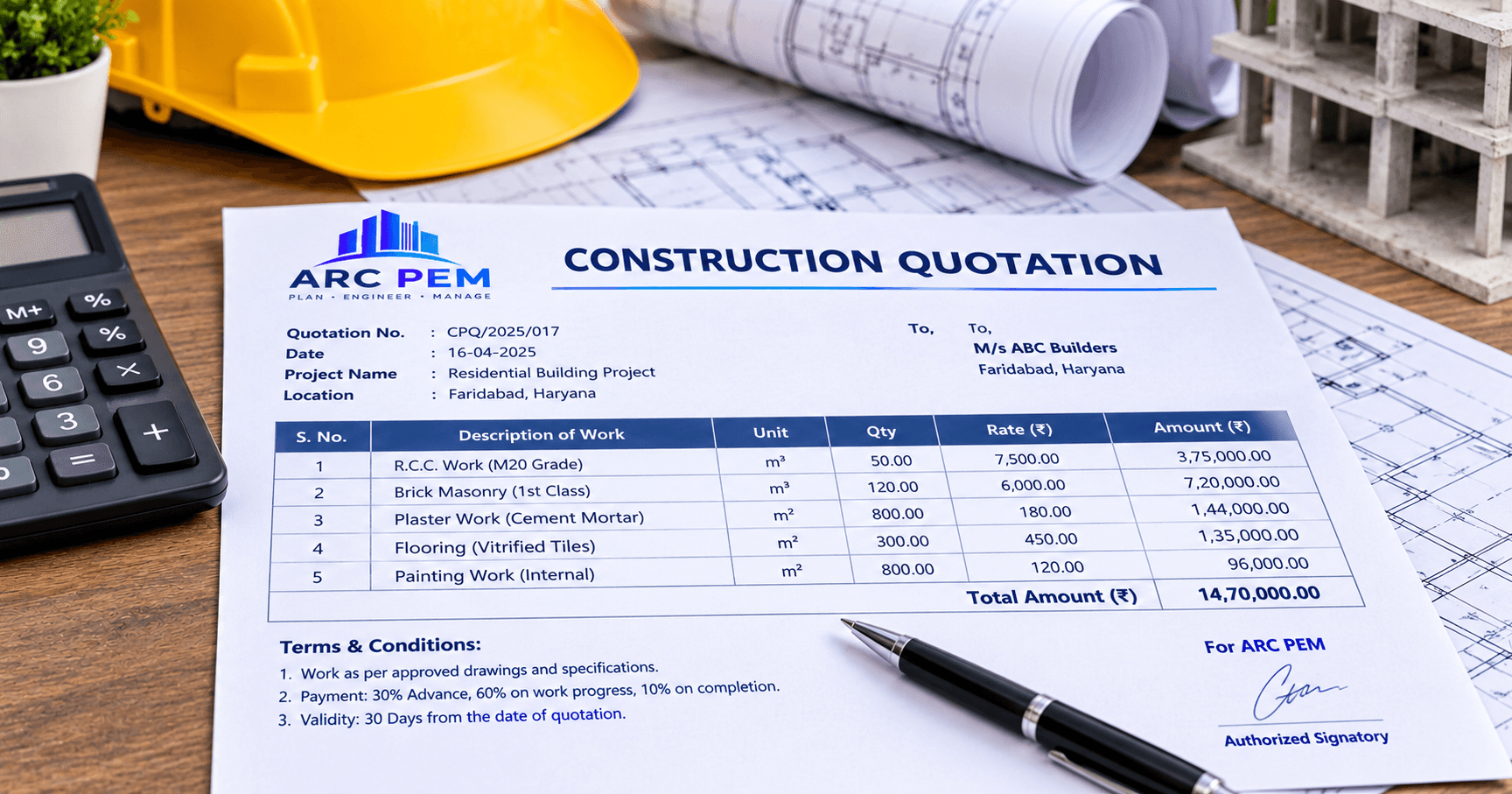
- New rate. If there is no similar item, agree a rate before the work starts, using a rate analysis: materials, labour and equipment, plus an agreed percentage for overheads and profit. See how rates are built in our quotation format guide.
- Daywork or cost record. For small or urgent changes, record labour, materials and equipment used, and agree the amount against those records.
Whatever the method, agree the rate in writing first. A rate agreed after the work is built is a negotiation from a weak position, usually for the owner.
Worked Example: One Variation Order
All figures are hypothetical and for teaching only. The contract value is ₹40,00,000.
VO-01 contains three changes.
| Sr. | Change | Type | Qty | Rate (₹) | Value (₹) |
|---|---|---|---|---|---|
| A | RCC M20 for an external staircase | Addition | 4.0 m³ | 8,000 (BOQ rate) | +32,000 |
| B | Brickwork in a deleted wall on gridline B | Omission | 3.0 m³ | 7,000 (BOQ rate) | −21,000 |
| C | Waterproofing to the bathroom floor, not in the BOQ | New item | 60 sq ft | 46 (new rate) | +2,760 |
| Net value of VO-01 | +13,760 |
Pricing the new item. The waterproofing is not in the BOQ, so a rate is agreed first. Materials cost ₹28 and labour ₹12 per sq ft, so the direct cost is ₹40. Adding an agreed 15% for overheads and profit gives 40 × 1.15 = ₹46 per sq ft, and 60 sq ft × ₹46 = ₹2,760.
Revised contract value = 40,00,000 + 13,760 = ₹40,13,760
Net variation and gross variation
The net value of VO-01 is ₹13,760, which is 0.34% of the contract. But the gross value, counting additions and omissions as positive, is 32,000 + 21,000 + 2,760 = ₹55,760, which is 1.39%. Some contracts limit variations by the net value, and others by the gross value or by quantity changes per item, so check which basis your contract uses.
Variation Order Register
Keep a register so the total effect of all variations is always visible.
| VO no. | Description | Status | Value (₹) | Time effect |
|---|---|---|---|---|
| VO-01 | Staircase added, wall omitted, waterproofing | Approved | +13,760 | None |
| VO-02 | Change of flooring specification | Pending | +45,000 | 3 days |
| Total approved | +13,760 | |||
| Total pending | +45,000 |
The contract value with approved variations is ₹40,13,760. If VO-02 is also approved, it becomes 40,00,000 + 13,760 + 45,000 = ₹40,58,760. Showing the pending amount tells the owner what the final cost may be before the decision is made.
How Variations Flow Into the Bill
- Bill only approved variations, as separate lines with the VO number, so they are not mixed with the original items.
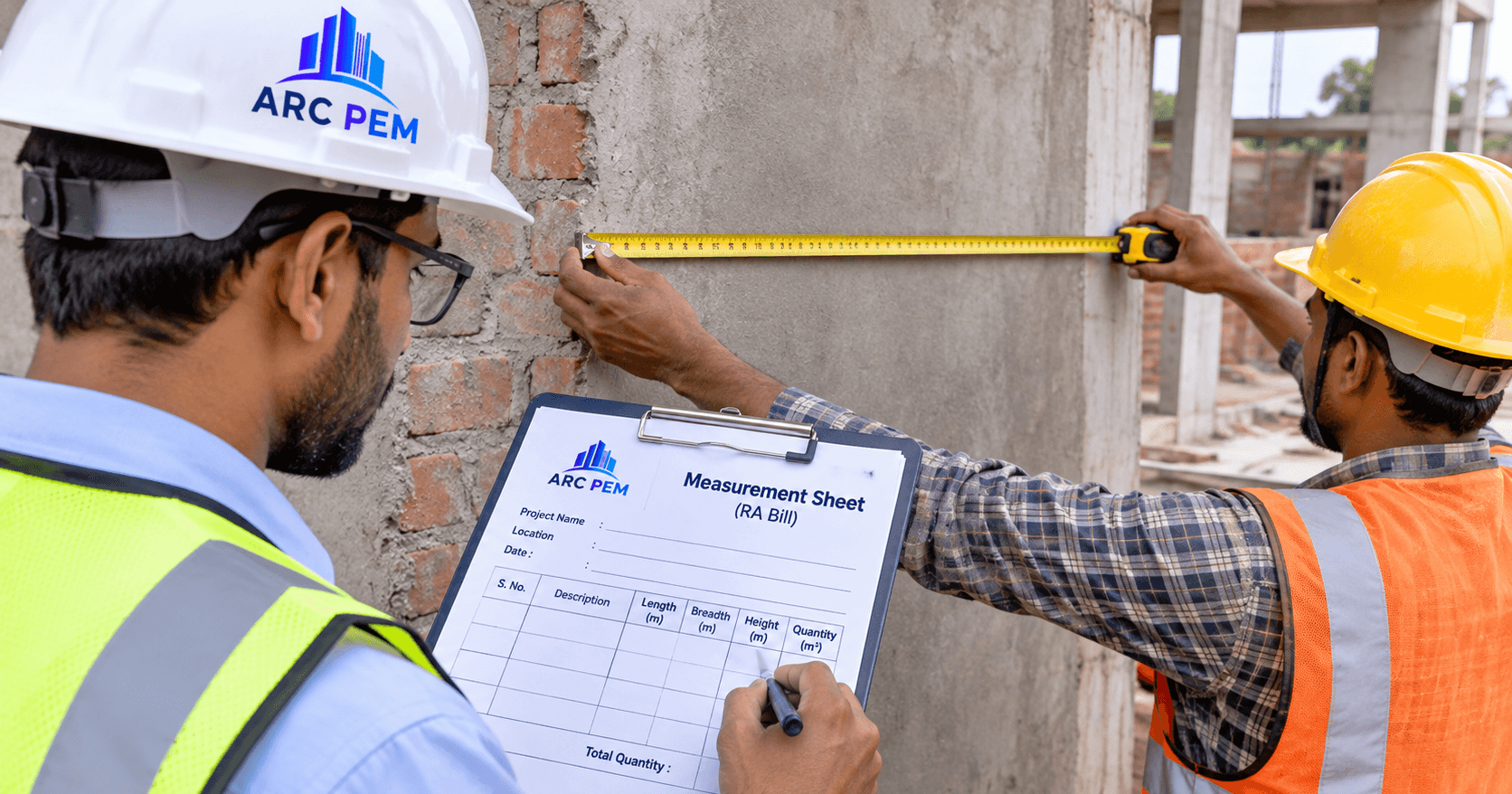
- Measure the varied work like any other work. See how to take measurements for an RA bill.
- Apply retention and other deductions as the contract says. See retention money, advances and TDS.
- Apply GST and TDS to the additional work in the same way as the contract work, as confirmed with your CA. See the GST-compliant RA bill guide.
- Update the BOQ and payment plan to the revised value.
For a lump sum contract, an approved variation adjusts the fixed price. For an item rate contract, quantity changes are paid at the contract rates without a separate order unless the contract says otherwise. See types of construction contracts.
The Approval Process
- Identify the change and describe it with the drawing reference.
- Contractor submits a quotation for the cost and time effect.
- Check the pricing against the contract rates or a rate analysis.
- Approve in writing, by the person with authority under the contract.
- Issue the VO with a number, and record it in the register.
- Execute and measure the varied work, and include it in the next bill.
Common Mistakes With Variations
- Starting work on a verbal instruction. There is no record of what was agreed.
- Agreeing the price after the work is done. The contractor has the stronger hand.
- No time effect stated. A late finish then becomes a dispute.
- Mixing variations with the original BOQ. The revised contract value becomes unclear.
- Not tracking pending variations. The owner is surprised by the final cost.
- Ignoring the knock-on effect. A change in one item can change quantities of others, such as extra concrete needing more steel.
- No authority check. An instruction from someone without authority may not bind the owner.
- Forgetting tax and retention. Additional work is billed like the original work.
Keep Variations Next to the Budget
A variation changes the budget, the schedule and the bills at once. If these live in three files, the numbers drift apart. Keep the original contract, the approved variations and the pending ones separate but visible, and compare them with actual costs, as in job costing.
ARC PEM's expense and finance tracking keeps vendor, labour and GST records organised project by project, with contractor bills tracked against your BOQ. Prepare each bill with the free GST Contractor Bill Generator, read how a project moves from BOQ to final bill, or view pricing.