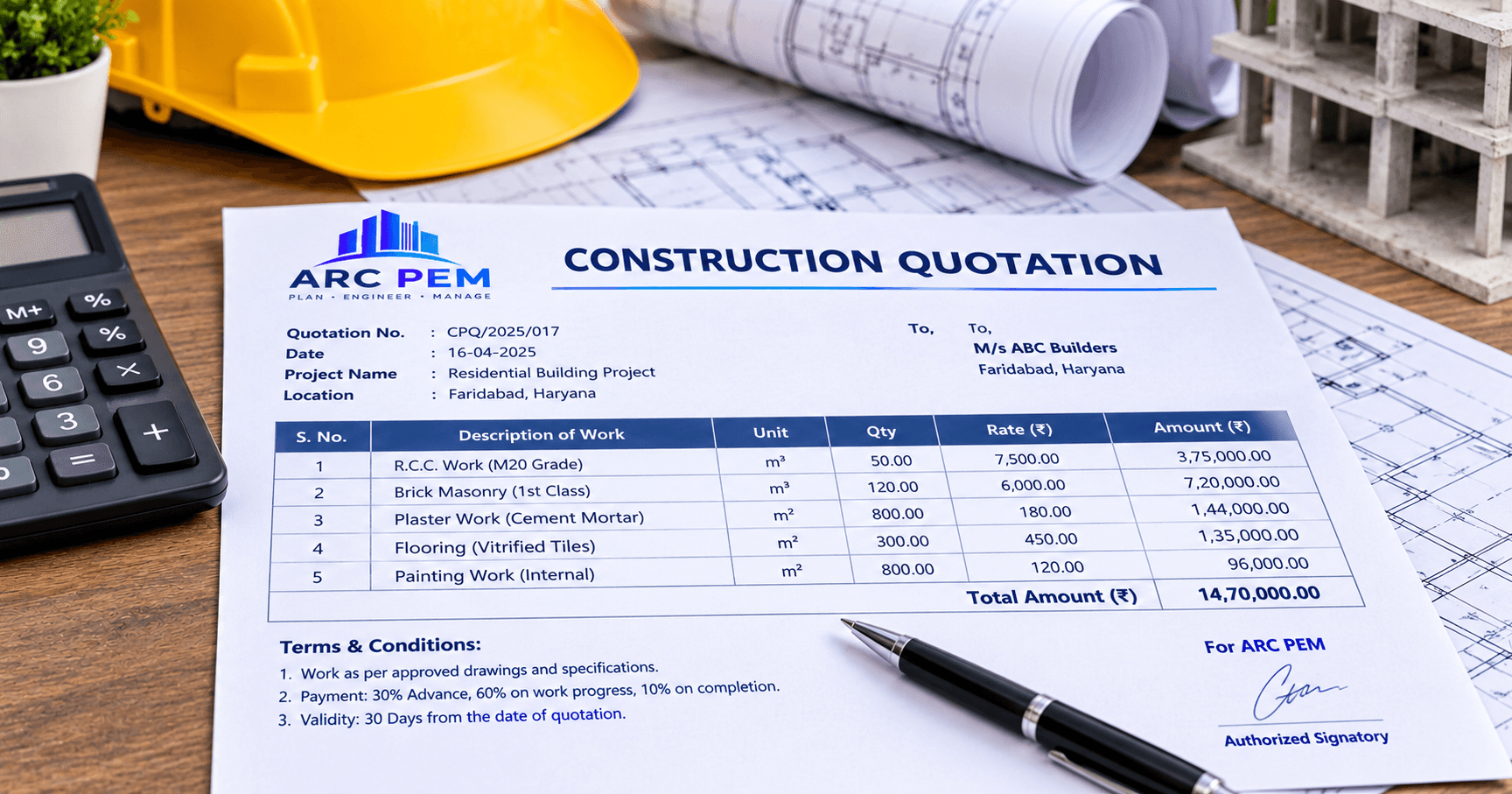
A quotation format for construction work is the layout in which a contractor tells a client what work will be done, at what rate, for what total price and on what terms, so the client can compare offers and accept one. A clear format wins work and prevents arguments later, because everything that was agreed is in writing.
Quick answer: a construction quotation should carry the quotation number, date and validity period, the client and site details, a scope of work, item-wise quantity, unit, rate and amount, the GST treatment, the total, payment terms, a timeline, exclusions, a variation clause and a space for the client to accept. A quotation is an offer, not a tax invoice.
This guide gives the fields, a sample quotation with numbers, a simple way to price rates with overheads and profit, and Excel formulas. It is general information, not legal or tax advice.
Quotation vs Estimate vs Proposal vs Invoice
These documents are often mixed up.
| Document | Who prepares it | Purpose |
|---|---|---|
| Estimate | Contractor, consultant or owner | Forecasts the likely cost, often for planning. See the construction estimate template |
| Quotation | Contractor | A priced offer to do defined work, valid for a period |
| Proposal | Contractor | A longer document with the quotation plus methods, team, schedule and references |
| Work order or contract | Client, once the quotation is accepted | The binding agreement. See types of construction contracts |
| Tax invoice or RA bill | Contractor | Requests payment for work done. See the contractor bill format |
What to Include in a Construction Quotation
| Field | Why it matters |
|---|---|
| Quotation number and date | A unique reference you and the client can quote |
| Validity period | Rates change, so say how long the offer holds |
| Contractor details, with GSTIN if registered | Identifies the supplier of the work |
| Client name, address and site | Shows who and where the work is |
| Scope of work | A short description of what is covered |
| Item-wise table | Description, quantity, unit, rate and amount for each item |
| Specifications and brands | Grade, make and finish, so the price matches the quality |
| GST | Whether GST is added, and at what rate |
| Total price | The sum, with GST shown separately |
| Payment terms | Advance, stage payments, and final payment |
| Timeline | Start date and duration |
| Inclusions and exclusions | What the price covers and what it doesn't |
| Variation clause | How changes to the scope are priced and approved |
| Acceptance | Space for the client's signature and date |
Sample Quotation
All quantities and rates are hypothetical and for teaching only. They are not market rates.
Quotation No. Q-021 | Date: 12 Oct | Valid for 15 days | Work: Renovation of a 12 ft × 10 ft room
| Sr. | Description | Unit | Qty | Rate (₹) | Amount (₹) |
|---|---|---|---|---|---|
| 1 | Dismantling old flooring and removing debris | sq ft | 120 | 40 | 4,800 |
| 2 | Floor tiling, labour and adhesive (tiles supplied by client) | sq ft | 120 | 70 | 8,400 |
| 3 | Plaster repairs and finishing to internal walls | sq ft | 400 | 35 | 14,000 |
| 4 | Painting, two coats, walls and ceiling, material and labour | sq ft | 520 | 30 | 15,600 |
| Subtotal | 42,800 | ||||
| CGST at 9% | 3,852 | ||||
| SGST at 9% | 3,852 | ||||
| Total | 50,504 |
The 18% GST is assumed for illustration. Confirm whether GST applies to your work, and the correct rate, with your CA, because it depends on your registration and the type of work.
Terms in the sample: 30% advance on acceptance, 50% on completion of plastering and tiling, and 20% on completion. Work to start within 5 days of the advance. Debris removal is included, and electrical and plumbing changes are excluded. Any additional work is priced and approved in writing before it starts.
How to Price the Rates in a Quotation
A rate is not a guess. It is the cost of the materials, labour and equipment needed for one unit of work, plus an allowance for overheads and profit.
Rate = (materials + labour + equipment) × (1 + overhead and profit %)
Example: plaster at ₹35 per sq ft. Suppose materials cost ₹18 and labour ₹12 per sq ft, so the direct cost is ₹30. Adding 15% for overheads and profit gives 30 × 1.15 = ₹34.5, rounded to ₹35.
For reference, the CPWD analysis of rates, which government departments use, adds 15% to the direct cost for the contractor's profit and overheads, made up of 7.5% for profit and 7.5% for overheads in its DAR 2007. A private contractor sets their own percentage based on their site costs, office costs and the risk of the job.
Markup is not margin
A 15% markup on cost is not a 15% margin on the price. If the direct cost is ₹100, a 15% markup gives a price of ₹115, and the profit and overheads of ₹15 are 15 ÷ 115 = 13.0% of the price. If you want a true 15% share of the price, the price must be 100 ÷ (1 − 0.15) = ₹117.65. Be clear which you mean, or you will under-price the work.
Quotation Format in Excel
A simple Excel quotation needs one row per item and a few formulas. Use these columns:
| Column | Field |
|---|---|
| A | Sr. No. |
| B | Description |
| C | Unit |
| D | Quantity |
| E | Rate (₹) |
| F | Amount (₹) |
In row 2, enter these formulas and copy them down:
- Amount:
=D2*E2 - Subtotal:
=SUM(F2:F20) - GST:
=Subtotal*18%, with the rate you have confirmed - Total:
=Subtotal+GST
For the sample above, the subtotal is ₹42,800, the GST is ₹7,704 and the total is ₹50,504. Keep a separate sheet for terms, number your quotations in sequence, and save every issued quotation, so you can show what the client accepted.
Terms and Clauses Worth Adding
- Validity. The date until which the rates hold.
- Scope. What is included, and an exclusions list.
- Material responsibility. Who supplies what, such as tiles by the client and adhesive by you.
- Variations. Additional work is priced and approved in writing before it starts. See types of construction contracts for how billing differs by contract type.
- Payment schedule. Advance, stages and final payment, and any retention. See retention money, advances and TDS.
- Taxes. Whether GST is included or extra.
- Timeline and delays. The start date, the duration, and what happens if the client delays access.
- Defects. The period during which you will fix defects.
Common Mistakes in Construction Quotations
- No scope or exclusions. The client assumes everything is included.
- A lump sum with no breakdown. It is hard to compare and hard to revise.
- Forgetting overheads. Site supervision, transport and office costs are real costs.
- Confusing markup with margin. It leaves you with less profit than you planned.
- No validity date. Material rates move, so an open-ended offer is a risk.
- Charging GST without checking. Confirm applicability and rate with your CA.
- Verbal changes. Any change in scope should be agreed in writing.
- No acceptance. A signed or written acceptance turns the offer into an agreement.
From Quotation to BOQ and Billing
Once a client accepts, the quotation becomes the baseline for the job. Convert its items into a priced BOQ, raise running bills against it as shown in the GST-compliant RA bill guide, and compare actual costs with the quote using job costing. That is how you find out whether your rates really made the profit you expected.
ARC PEM tracks material purchases and vendor bills against your BOQ, project by project, so estimated versus actual cost is always one report away. Prepare the bill with the free GST Contractor Bill Generator, start from the BOQ templates, or view pricing.