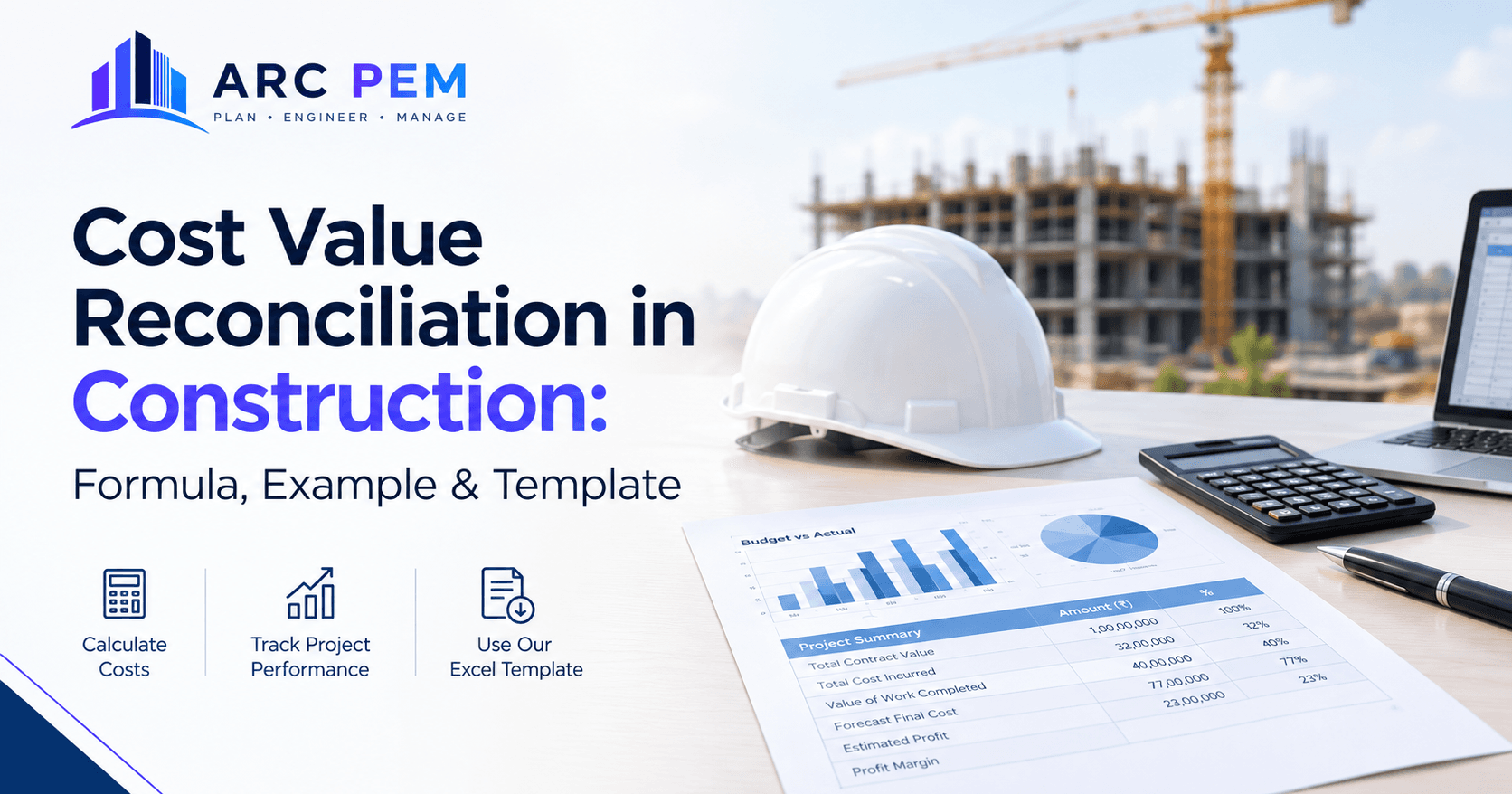
Cost value reconciliation (CVR) in construction is a financial review that compares the value of work completed with the cost of completing it, then forecasts the project's final cost and profit. Contractors typically prepare it every month to see whether a project is still on track to make the profit they expected.
A construction project can look profitable on paper but still lose money by the time it is completed.
Material prices may increase, labour costs may exceed estimates, additional work may remain unbilled, and supplier invoices may arrive later than expected. If these changes are not tracked regularly, a contractor may discover the actual financial position only when the project is nearly finished.
For builders and contractors in India, regular CVR reporting can help answer three important questions:
- Are we making the profit we originally expected?
- Are actual project costs higher than the value of work completed?
- Based on current performance, how much profit or loss can we expect at completion?
In this guide, we explain cost value reconciliation with a practical example in Indian rupees, the basic formulas, a monthly reporting process and ways to improve cost visibility using ARC PEM. If you want a ready-made file, you can download the free CVR Excel template from the ARC PEM portal.
What Is Cost Value Reconciliation in Construction?
Cost value reconciliation is a method of reviewing a construction project's financial performance by comparing the value of work completed against the cost of completing that work.
It helps project teams understand how the project is performing financially at a particular point in time and whether the expected final profit is changing.
For example, a contractor may estimate that completing a particular stage of a building project will cost ₹30 lakh. If the completed work is worth ₹36 lakh but the actual cost is already ₹33 lakh, the project is still showing a positive difference. However, the contractor needs to investigate why costs are higher than planned and whether the remaining work can be delivered within budget.
A CVR report brings these figures together so the team can make decisions using recorded project data rather than assumptions.
What does a CVR report usually include?
A practical construction CVR report may include:
- Contract value and approved variations
- Value of work completed
- Actual costs incurred
- Accrued costs for work already performed but not yet invoiced
- Committed costs, such as outstanding purchase orders
- Estimated cost to complete the remaining work
- Forecast final project cost
- Forecast final profit or loss
The exact reporting method depends on the contractor's accounting practices, contract terms and project controls. The figures should be defined consistently so that different reporting periods can be compared.
CVR vs. Budgeting vs. Actual Cost Tracking
These terms are related, but they serve different purposes.
| Method | Main purpose | Question it answers |
|---|---|---|
| Budgeting | Estimate costs before or during project planning | What should the project cost? |
| Actual cost tracking | Record costs incurred as the project progresses | How much have we spent? |
| Cost value reconciliation | Compare completed work value with costs and forecast the final financial result | Are we on track to achieve the expected profit? |
For example, an initial construction budget might estimate total costs of ₹80 lakh. Actual spending may currently be ₹32 lakh, but that figure alone does not show whether the project is performing well. The team also needs to understand the value of completed work and the likely cost of finishing the remaining work.
That broader financial view is what makes CVR useful. If you are setting up the cost-recording side first, read our guide to construction job costing.
Cost Value Reconciliation Formula
There is no single universal CVR formula used by every construction business. The reporting definitions must be consistent, especially when distinguishing work value, revenue recognised, invoiced amounts and cash received.
For a simple project-level review, the following calculations provide a useful starting point.
1. Current cost-value difference
Formula:
Cost-value difference = Value of completed work − Cost incurred for that work
A positive result means the assessed value of completed work exceeds its associated cost. A negative result indicates that the cost is higher than the assessed value.
This difference should not automatically be treated as cash received or final accounting profit.
2. Forecast final project cost
Formula:
Forecast final cost = Cost incurred to date + Estimated cost to complete
Include appropriate accrued costs and assess outstanding commitments to avoid overlooking expenses that have not yet appeared in supplier invoices.
3. Forecast final profit
Formula:
Forecast final profit = Forecast final project revenue − Forecast final project cost
Forecast final revenue should reflect the contract value and approved changes, with appropriate treatment of variations, claims and other uncertain amounts.
4. Forecast profit margin
Formula:
Forecast profit margin (%) = (Forecast final profit ÷ Forecast final project revenue) × 100
This percentage helps the contractor understand how much of the forecast revenue is expected to remain as profit before any costs excluded from the calculation.
Cost Value Reconciliation Example for a Construction Project
Let's take a hypothetical building project in India.
A contractor has a contract worth ₹1 crore. Work is progressing, and the project team wants to understand the financial position before the next monthly review.
The following figures are illustrative and assume that the work value and costs are measured consistently.
Project details
| Particular | Amount |
|---|---|
| Contract value | ₹1,00,00,000 |
| Value of work completed to date | ₹40,00,000 |
| Cost incurred for completed work | ₹32,00,000 |
| Estimated cost to complete the remaining work | ₹45,00,000 |
Step 1: Calculate the current cost-value difference
Value of completed work = ₹40,00,000
Cost incurred for that work = ₹32,00,000
Cost-value difference = ₹40,00,000 − ₹32,00,000
Current cost-value difference = ₹8,00,000
The assessed value of the completed work exceeds its associated cost by ₹8 lakh.
This is a useful performance indicator, but it is not necessarily the same as recognised accounting profit or cash collected.
Step 2: Calculate forecast final project cost
Cost incurred to date = ₹32,00,000
Estimated cost to complete = ₹45,00,000
Forecast final cost = ₹32,00,000 + ₹45,00,000
Forecast final project cost = ₹77,00,000
The contractor currently expects to spend ₹77 lakh to complete the project, assuming the estimate includes all relevant remaining costs and no material changes occur.
Step 3: Calculate forecast final profit
Contract value = ₹1,00,00,000
Forecast final cost = ₹77,00,000
Forecast final profit = ₹1,00,00,000 − ₹77,00,000
Forecast final profit = ₹23,00,000
Step 4: Calculate forecast profit margin
Forecast profit margin = (₹23,00,000 ÷ ₹1,00,00,000) × 100
Forecast profit margin = 23%
The current forecast suggests a final profit of ₹23 lakh, or 23% of the contract value, before any costs or adjustments excluded from this simplified example.
The important point is that this is a forecast, not a guarantee. If material prices increase or additional labour and rework costs arise, the final result can change.
Check the assumption behind the forecast
Look closely at what the forecast assumes. The work completed so far earned ₹8 lakh on ₹40 lakh of value, a 20% margin. The remaining work has ₹60 lakh of contract value (₹1 crore less ₹40 lakh) and an estimated cost of ₹45 lakh, a 25% margin. In other words, the forecast expects the remaining work to be more profitable than the work already done. That can be true, for example if the expensive foundation work is finished. But if it is not, the ₹45 lakh estimate may be too optimistic. Always test whether your cost-to-complete is consistent with how the project has actually performed so far.
Sample CVR summary
A monthly summary for this example can be laid out as follows. If you'd rather have this layout as a ready-to-use spreadsheet, download the Excel template.
| Item | Amount |
|---|---|
| Contract value | ₹1,00,00,000 |
| Value of work completed | ₹40,00,000 |
| Cost incurred | ₹32,00,000 |
| Cost-value difference | ₹8,00,000 |
| Estimated cost to complete | ₹45,00,000 |
| Forecast final cost | ₹77,00,000 |
| Forecast final profit | ₹23,00,000 |
| Forecast profit margin | 23% |
What should the contractor do next?
The contractor should compare actual costs against the original estimate, review outstanding purchase orders, confirm the cost of remaining work and investigate any unexpected increases.
If the forecast cost rises from ₹77 lakh to ₹85 lakh, for example, the forecast profit would fall from ₹23 lakh to ₹15 lakh, assuming the contract revenue remains ₹1 crore.
Regular CVR reviews help identify that change early enough for the project team to investigate its causes.
How to Prepare a Monthly CVR Report
A monthly CVR report does not need to be complicated. What matters is that the figures are complete, consistently defined and reviewed on time.
Step 1: Establish the original budget
Start with the approved project estimate or budget. Break it into meaningful cost categories, such as:
- Cement, steel and other construction materials
- Labour and subcontractors
- Equipment and machinery
- Transportation and logistics
- Site overheads
- Other project-specific expenses
A clear baseline makes it easier to identify where the project is moving away from the original plan.
If you are preparing the initial project estimate, read our guide: Construction Estimate Template: Free Download.
Step 2: Calculate the value of work completed
Determine the value of work completed up to the reporting date using a consistent measurement method.
Depending on the contract, this may involve measured quantities, agreed rates, certified work or other contract-specific valuation rules.
Do not automatically use the amount invoiced or the amount received from the client as the value of work completed. Billing, certification, revenue recognition and cash collection can occur at different times.
Step 3: Record actual and accrued costs
Gather the costs associated with work performed during the reporting period.
These may include supplier invoices, labour payments, subcontractor bills, equipment costs and site expenses.
Also consider costs for work already performed where the invoice has not yet arrived. Otherwise, the project may appear more profitable than it really is.
Step 4: Review committed costs
Committed costs are amounts the business expects to pay under existing purchase orders, subcontract agreements or other commitments.
Review them alongside actual costs to understand the likely cost of the remaining work. Avoid double-counting amounts that are already included in recorded costs.
For example, if steel has been ordered but not fully delivered or invoiced, the team should check how much of that commitment remains outstanding and how it affects the forecast.
Step 5: Estimate the cost to complete
Review all remaining work and estimate the resources required to finish it.
Consider quantities still to be installed, labour requirements, pending material purchases, subcontract work, site overheads and known risks.
Do not simply subtract actual spending from the original budget and assume the remaining amount will be sufficient. The cost to complete should reflect the latest site conditions and current rates.
Step 6: Forecast the final financial result
Combine costs to date with the estimated cost to complete. Then compare the forecast total with expected project revenue.
The report should clearly show:
- Original budget
- Actual and accrued costs to date
- Remaining committed costs
- Estimated cost to complete
- Forecast final cost
- Forecast final profit and margin
- Key reasons for any significant changes
Step 7: Assign corrective actions
A CVR report is useful only when the team acts on what it reveals.
If steel costs are increasing, review consumption, wastage and purchase rates, and see our guide to controlling steel wastage on site. If labour costs are higher than expected, examine productivity and rework. If additional work has been completed but its value has not been agreed, review the contract and documentation.
Assign each action to a responsible person and review its progress in the next reporting cycle.
Common CVR Mistakes in Construction
Even a well-designed report can give a misleading picture if important costs or project changes are overlooked.
1. Counting only paid invoices
A payment-based view can miss costs for work already performed or bills that have not yet arrived. Record appropriate accrued costs so the report reflects the work done during the period.
2. Ignoring purchase commitments
Materials and subcontract work may already be committed even when no payment has been made. Review outstanding commitments when forecasting the final cost.
3. Using billed amounts as completed work value
An invoice may be delayed, disputed or based on a different milestone. Keep completed-work valuation separate from invoicing and cash collection.
4. Leaving the original estimate unchanged
Project costs can change due to design revisions, material rates, wastage, delays and scope changes. Update forecasts using the latest available information while retaining the original baseline for comparison.
5. Reviewing costs only at project completion
Waiting until the end of a project limits the time available to address overspending. Monthly reviews, or more frequent reviews for fast-moving or high-risk projects, can help identify issues earlier.
6. Mixing costs across projects
When the same contractor manages several sites, shared labour, equipment, transport and purchases can be assigned to the wrong project. Use clear project identifiers and consistent allocation rules.
How ARC PEM Can Help Improve Construction Cost Visibility
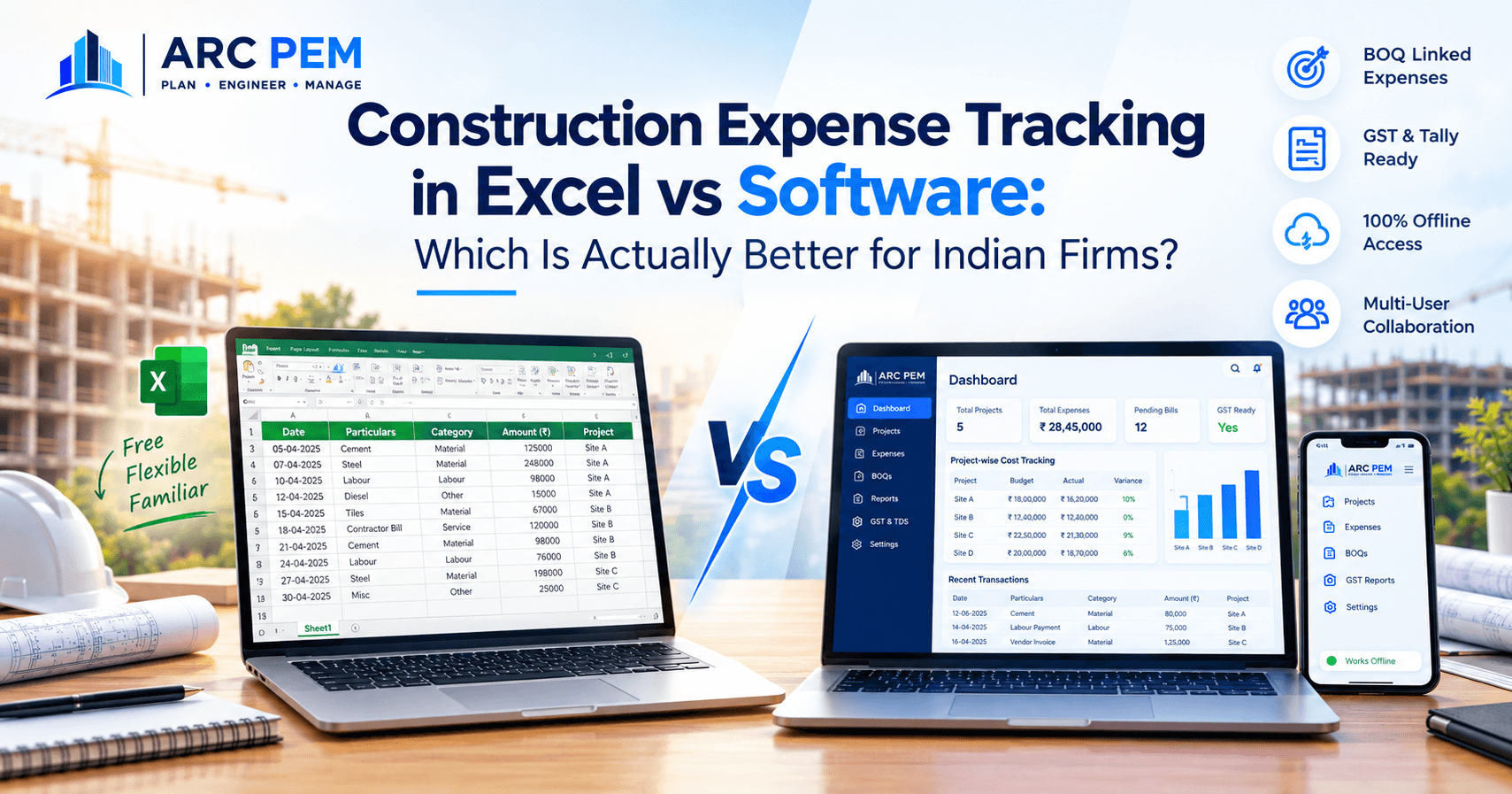
Preparing a CVR report depends on having reliable project cost information. When estimates, purchase records, supplier bills, labour expenses and payments are scattered across spreadsheets and messages, it becomes harder to understand the actual financial position of each site. We compare the two approaches in Excel vs software for construction expense tracking.
ARC PEM helps construction businesses organise project-related financial information and track expenses against project estimates.
With a more structured workflow, teams can work towards:
- Comparing estimated costs with recorded project expenses.
- Reviewing project spending by category.
- Keeping vendor bills and payments organised.
- Identifying cost overruns that need investigation.
- Maintaining clearer financial records for project reviews.
ARC PEM should be used as part of a consistent reporting process: the project team still needs to validate completed-work value, accrued costs, outstanding commitments and cost-to-complete forecasts before finalising a CVR report.
To understand how project financial information fits together, read From BOQ to Bill: How ARC PEM Tracks a Project's Money End to End, or explore expense and finance tracking.
Want better visibility into your construction project expenses? Explore ARC PEM and see how structured expense tracking can support better project cost control, or view pricing.
Conclusion
Cost value reconciliation gives construction businesses a clearer view of whether a project is performing financially as expected. It brings completed-work value, project costs and the forecast final result into one review process.
For Indian builders and contractors, the benefit is not simply knowing how much has been spent. It is understanding what that spending means for the project's final cost and profitability.
By reviewing CVR regularly, validating costs, monitoring commitments and updating the forecast, project teams can identify potential problems earlier and make better-informed decisions.
ARC PEM helps bring project expense information into a more organised workflow, supporting the cost visibility needed for better construction project control.
Editorial note: The figures in the worked example are illustrative. CVR definitions and accounting treatment may differ by contract and organisation. Confirm the applicable revenue-recognition and accounting treatment with your finance professional.