Steel is usually 15–20% of a project's total construction cost — and on most sites, 5–8% of that steel is lost before it ever becomes part of the structure. Nobody signs off on that loss; it just accumulates in offcuts, over-ordering, and site handling, one bar at a time. This piece breaks down where that wastage actually comes from, what "normal" wastage really is, and how to bring it back under control.
What "Normal" Wastage Actually Means
Most estimators add a flat 3% wastage allowance to their steel BOQ, treating it as an unavoidable cost of doing business. That 3% figure isn't arbitrary — it's a reasonable allowance for genuine, unavoidable loss: standard bar lengths (usually 12m) that don't divide evenly into every cutting length, and small handling losses during fabrication.
The problem is that most sites don't actually run at 3%. Studies and site audits across Indian construction projects commonly find actual wastage between 5% and 10% — sometimes higher on projects with poor detailing or loose site control. That gap between the budgeted 3% and the real 5–10% is pure margin loss, and it's almost always traceable to a handful of specific, fixable causes.
Where the Extra Wastage Actually Comes From
1. Inaccurate or missing Bar Bending Schedule. This is the single biggest cause. When cutting lengths aren't calculated correctly — bend deductions ignored, hooks miscounted, laps not accounted for — bars get cut to the wrong length. Either they're too short and get scrapped, or they're cut long "to be safe," which quietly inflates every single piece across an entire member. On a project with hundreds of stirrups, a 20–30mm miscalculation per piece adds up to real tonnage. (We've written a full breakdown of how BBS calculations actually work, and why bend deduction and hook allowances exist, here.)
2. Poor cutting-length optimisation against stock length. Bars come in standard 12m lengths. If cutting lengths aren't planned against that stock length, you end up with awkward leftover pieces too short to reuse for anything — a 1.5m offcut from every 12m bar, repeated hundreds of times, is a lot of scrap steel sitting in a corner of the site.
3. Over-ordering as a buffer. Without a reliable BBS, site engineers often over-order "to be safe," padding orders by 5–10% beyond what's actually needed. This isn't wastage in the cutting sense, but it's wastage in the budget sense — steel purchased that never gets used, and often never gets returned or credited.
4. Site handling and storage losses. Steel left exposed to weather develops surface rust that has to be wire-brushed or wasted at the ends before use. Bars dragged across rough ground get bent out of tolerance and re-cut. Poor stacking leads to bars getting buried, lost, or damaged before they're even installed.
5. Lap and splice inefficiency. Every lap joint uses more steel than a single continuous bar would — that's inherent to how bond stress works (see the mechanism post linked above). But laps placed carelessly, or lap lengths padded beyond what code requires "just in case," add avoidable tonnage on top of the unavoidable lap allowance.
6. Pilferage. On larger or less-supervised sites, steel is one of the most commonly diverted materials, precisely because it has resale value as scrap. This is a site-control problem, not a calculation problem, but it shows up in the same place: your actual consumption exceeding your BBS-predicted consumption.
How to Bring Wastage Back Toward 3%
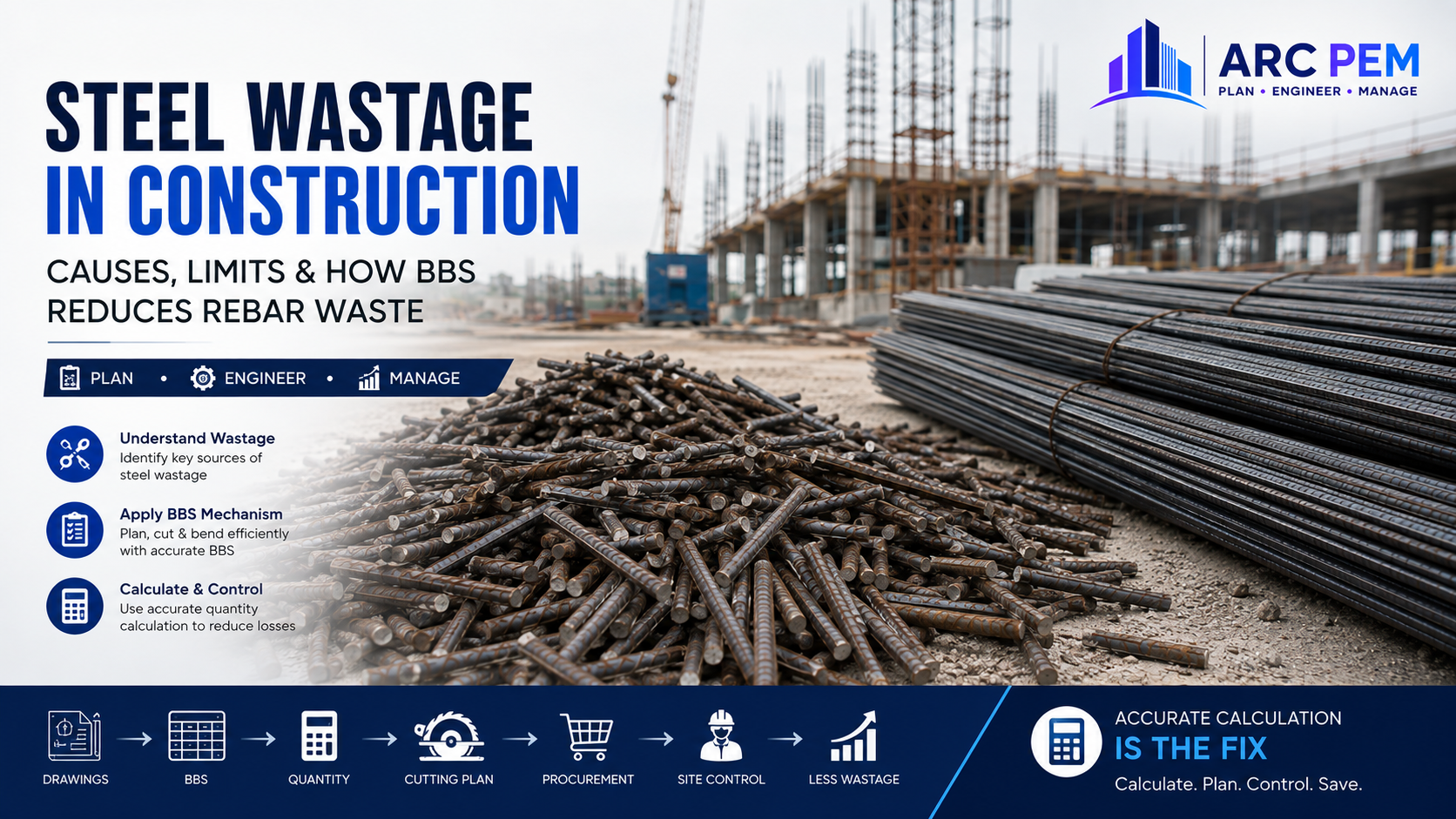
Start every steel estimate from an accurate BBS, not a rule of thumb. The 3% allowance only holds if the underlying cutting lengths are correct. If bend deductions, hooks, and laps are calculated properly for every bar in a member, you eliminate the single largest source of excess wastage before a single bar is cut. Running your beams, columns, slabs, and footings through our free Bar Bending Schedule Calculator applies this mechanism consistently across every member, so your BOQ steel line reflects what the structure actually needs — not a padded guess.
Plan cutting lengths against 12m stock length before fabrication. A good BBS output should be checked against standard bar length so cutting patterns minimise leftover offcuts — this is a scheduling step, not just a calculation step.
Order against the BBS, not against a buffer percentage. If your cutting lengths are trustworthy, you don't need a 10% padding buffer on top of them — that padding is where a lot of "phantom" steel cost hides.
Store and stack steel properly. Keep bars off the ground on wooden sleepers, cover them from rain, and stack by diameter and length so fabrication crews aren't hunting through mixed piles (which itself causes handling damage and mis-cuts).
Reconcile actual consumption against the BBS regularly, not just at project close. If a site is consuming meaningfully more steel than the schedule predicts partway through a slab or floor, that gap is worth investigating immediately — before it repeats across every remaining floor.
Why This Is a Budget Problem, Not Just a Site Problem
A 5% steel wastage on a mid-sized residential project, at current rebar prices, can easily run into several lakhs of rupees — money that never shows up as a single suspicious transaction, just as a slightly-too-high steel consumption that nobody flagged. Tracking wastage as a real line item — budgeted BBS quantity vs. actual site consumption — turns an invisible leak into a visible, manageable number in your project's cost tracking.