Quick answer: several GST changes started on 1 November 2026, and the one that matters most to contractors and builders is the new treatment of post-sale discounts. When a supplier such as a cement or steel dealer gives you a year-end or target rebate through a GST credit note, you now have to reverse the related input tax credit (ITC). Other changes are coming later: e-invoicing for certain reverse charge self-invoices from 1 January 2027, and new return forms from 1 April 2027. There is no broad change in GST rates, and cement stays at 18%.
This article is based on the notifications and reports available on 4 November 2026. Rules change often and apply differently to different businesses, so confirm your position with your CA and check the official sources, the GST portal news page and CBIC. This is general information, not tax advice.
What Changed and What Is Still Pending
| Change | Status | Does it matter to contractors and builders? |
|---|---|---|
| Post-sale discounts reduce taxable value if a credit note is issued and the recipient reverses ITC (Sections 15 and 34) | In force from 1 Nov 2026 | Yes, for supplier rebates and discounts you give or receive |
| Revised GST registration form and amendment procedure (Notification 05/2026-Central Tax) | In force from 1 Nov 2026, with further rules from 1 Apr 2027 | Yes, if you add sites, partners or places of business |
| E-invoicing extended to specified reverse charge self-invoices and import of services (Notification 04/2026-Central Tax) | From 1 Jan 2027 | Yes, if you are an e-invoicing taxpayer and pay GST under reverse charge |
| Reverse charge rate in Entry 17 raised from 12% to 18% (Notification 08/2026-Integrated Tax (Rate)) | In force from 1 Nov 2026 | Check whether your reverse charge purchases fall under that entry |
| 90% provisional refund for inverted duty claims | In force from 1 Nov 2026 | Rarely |
| Revised GSTR-1, GSTR-1A and IFF forms | Drafts out for public comment from 1 to 30 Nov 2026, proposed from 1 Apr 2027 | Not yet in force |
| Automated refunds, arrest powers and show-cause notice changes | Recommended or targeted for 2027 | Not yet in force |
| Broad GST rate changes | No | Cement remains at 18% after the 22 Sep 2025 cut |
Change 1: Supplier Rebates Now Need a Credit Note and an ITC Reversal
Dealers often give builders year-end rebates or target discounts, agreed after the supplies were made. Earlier, such a discount reduced the taxable value only if it was agreed at or before the supply and linked to specific invoices. Most schemes didn't meet that test, so tax was paid on the full value and the rebate was settled through a commercial credit note without GST.
From 1 November 2026, the two conditions are gone. A discount given after the supply is left out of the value of supply if:
- the supplier issues a GST credit note under Section 34, and
- the recipient reverses the ITC that relates to the discount.
Worked example: a cement dealer's rebate
All figures are hypothetical and for teaching only. The 18% is the current rate on cement.
A builder buys cement through the year and the dealer gives a ₹1,00,000 year-end rebate on the taxable value.
- Rebate on taxable value = ₹1,00,000
- GST on the rebate at 18% = ₹18,000
- GST credit note value = 1,00,000 + 18,000 = ₹1,18,000
- The dealer's output tax falls by ₹18,000.
- The builder reverses ₹18,000 of ITC, because the tax on those purchases is no longer payable.
- The builder's purchase cost falls by ₹1,00,000.
If the builder simply took the ₹1,18,000 and kept the ITC, the builder would be claiming credit for tax that was never paid. Under the new rules, the reversal is the condition for the dealer's tax reduction.
If you give discounts to clients
The same logic applies when you give a post-supply discount. A GST credit note can reduce your taxable value, and your client must reverse any ITC they claimed on the discounted part. Many homeowners don't claim ITC, but businesses do. A commercial credit note without GST remains possible, but it does not reduce your tax.
The time limit
The Section 34(2) time limit still applies. A credit note must be declared in your return by 30 November following the end of the financial year, or the date of the annual return, whichever is earlier. Don't leave rebate credit notes until year end.
Change 2: Registration Amendments
From 1 November 2026, a revised GST registration form (REG-01) and new amendment rules apply under Notification 05/2026-Central Tax. As reported, most amendments, such as a change in name or partners, can now be completed through online validation, while changes to the principal place of business still need examination by the proper officer. Further changes, including new rules on suspension and cancellation, are set to start on 1 April 2027.
For a contractor, this is relevant when you add a site office or godown, change a partner or move your principal place of business. Check the portal's current requirements before filing an amendment.
Change 3: E-Invoicing for Reverse Charge Self-Invoices From 1 January 2027
Notification 04/2026-Central Tax extends e-invoicing from 1 January 2027 to specified supplies received from unregistered persons on which the recipient pays tax under reverse charge, and to imports of services. As reported, it applies to businesses that are already e-invoicing taxpayers, with aggregate turnover above ₹5 crore.
If that is you, the self-invoice you prepare for those reverse charge purchases may need an invoice reference number (IRN) from 1 January 2027. The facility is currently in a test environment on the portal, and it is not yet mandatory. Check your turnover, check which of your purchases are under reverse charge, and ask your CA whether the rule will apply to you.
Change 4: Return Forms Are Still to Come
The Finance Ministry's draft GSTR-1, GSTR-1A and IFF forms are open for public comment from 1 to 30 November 2026, and the revised forms are proposed from 1 April 2027. They are not in force yet, so there is nothing to change in your returns today. Small suppliers that file quarterly should watch the IFF, because the invoices they report show up in your GSTR-2B. See our guide to GSTR-2B reconciliation for contractors.
What Did Not Change
- GST rates on construction materials. The reports describe no broad rate rationalisation. Cement was cut from 28% to 18% from 22 September 2025, and steel generally attracts 18%. See our guide to the GST 2.0 rate cut on cement and building materials.
- Section 17(5) blocked credits. The relaxation reported in the Council's recommendations concerns items such as outdoor catering and health insurance, and it is a recommendation, not law. Whether ITC is available on construction-related purchases for your business is a separate question for your CA.
- Your GSTR-2B check. ITC still needs to match what suppliers have reported.
Checklist for Contractors and Builders
- List your supplier rebates and schemes. Cement, steel, tiles and paint dealers often give year-end or target discounts.
- Ask suppliers how they will issue the discount, whether as a GST credit note or a commercial credit note.
- Reverse ITC on any discount covered by a GST credit note, in the period your CA advises.
- Record credit notes against the original bills, so purchases, rebates and ITC reversals tie back to each other.
- Track the Section 34(2) deadline for credit notes you issue to clients.
- Check your e-invoicing status. If your turnover is above ₹5 crore, ask your CA whether reverse charge self-invoices will need an IRN from 1 January 2027.
- Review reverse charge purchases against Entry 17 and the other notified entries, since the rate in Entry 17 moved to 18%.
- Review your registration details if you have added sites, partners or premises.
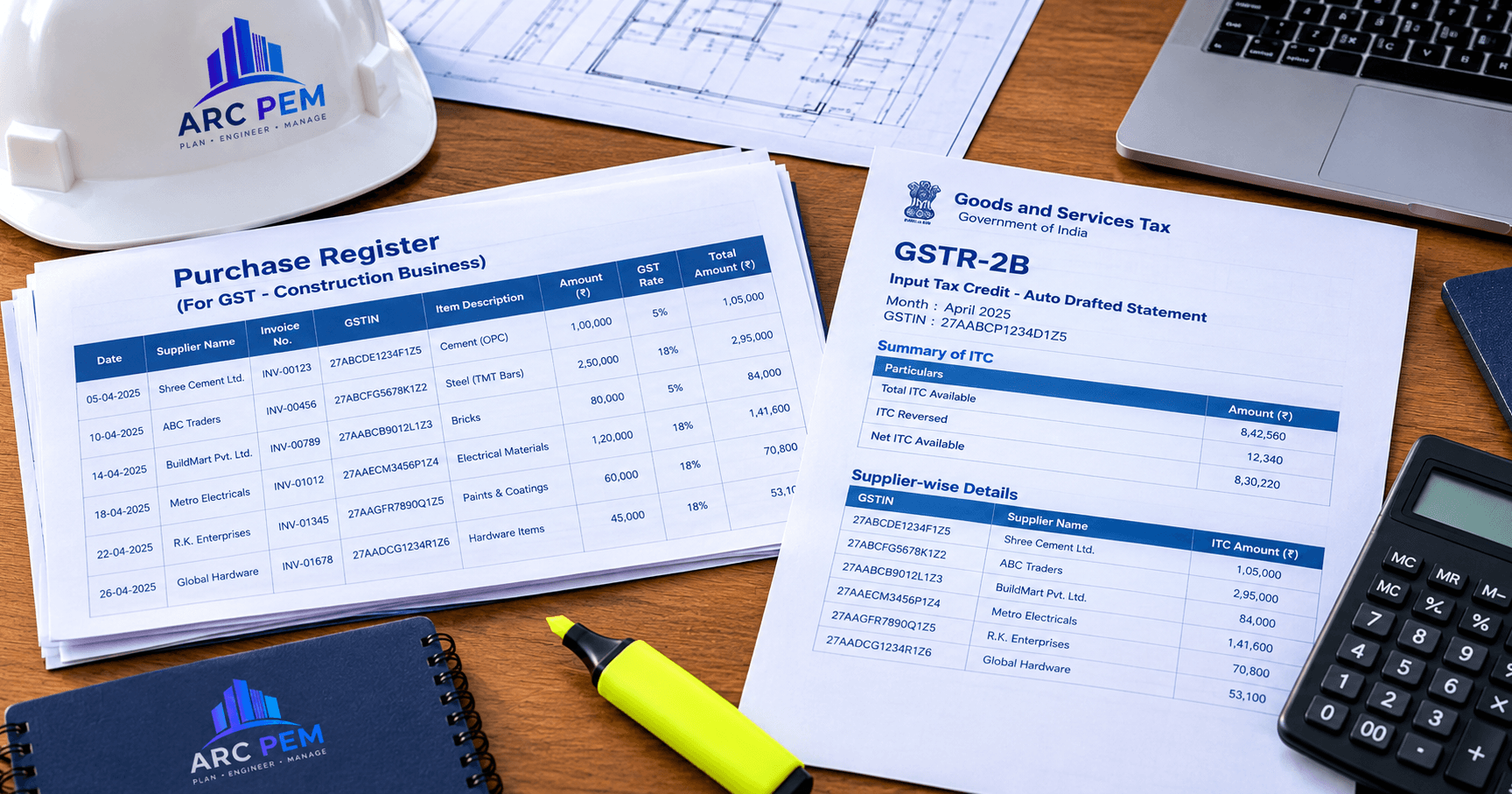
- Keep reconciling your purchase register with GSTR-2B every month.
Keep Rebates, Credit Notes and Bills Together
These changes make supplier credit notes a compliance item, not just a price adjustment. If bills, rebates and credit notes sit in different files, ITC reversals get missed. Keep each project's vendor bills, credit notes and payments together, and review them every month.
ARC PEM's GST purchase reporting helps organise purchase information for review and accounting workflows, and its expense and finance tracking keeps vendor, labour and GST records organised project by project. See how bills, payments and GST fit together in how a project moves from BOQ to final bill, or view pricing. For the billing side, read the GST-compliant RA bill guide and our guide to TDS on contractor payments.