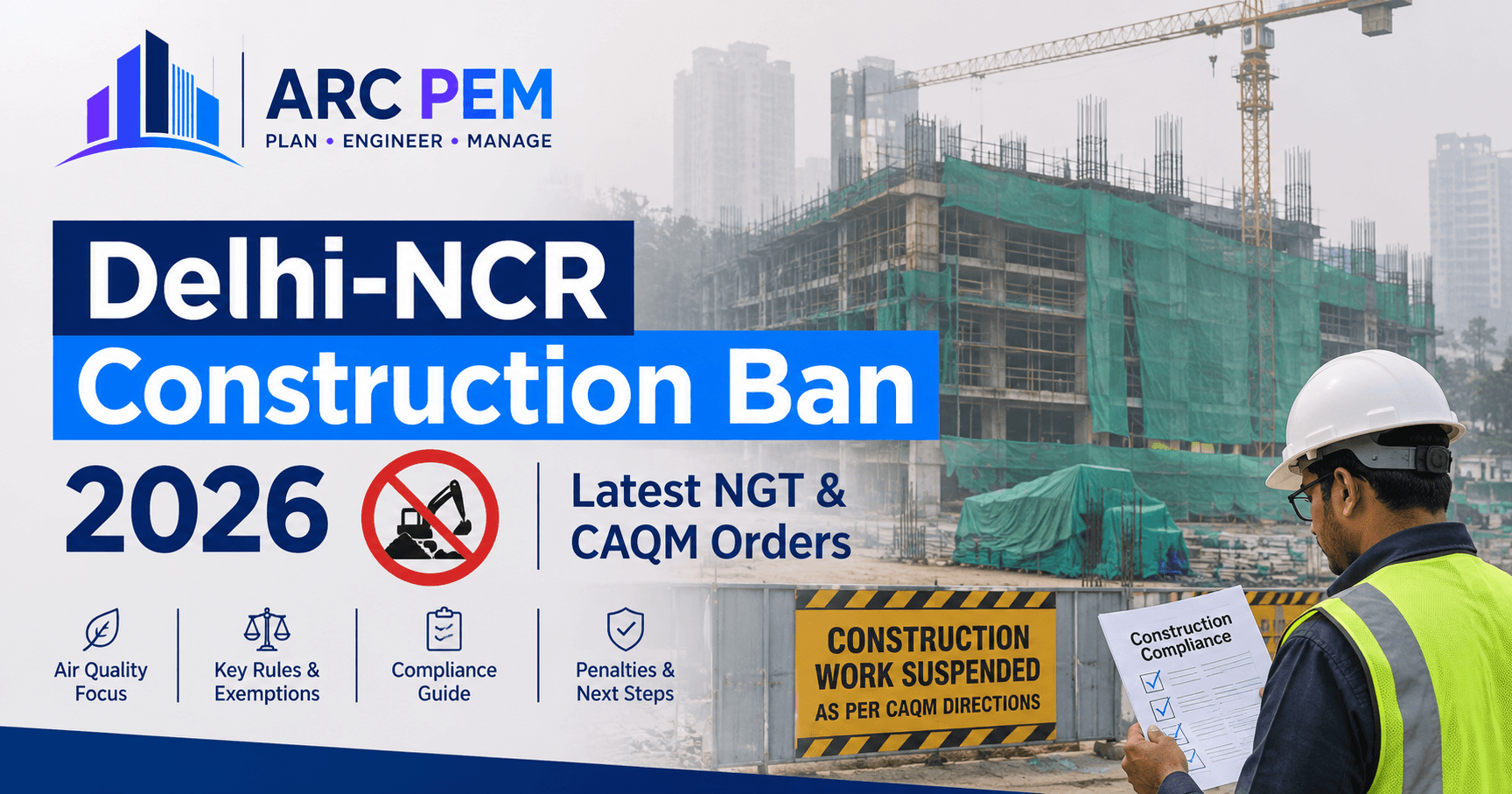
Status as of 14 November 2026: Dust-generating construction and demolition is restricted across Delhi-NCR under two overlapping measures. A CAQM order restricts it from 5 to 20 November 2026, and GRAP Stage III has been in force since 6 November 2026. Stage III stays until CAQM revokes it, so it can outlast the 20 November date.
If you run sites in the region, this affects your schedule, your labour costs and your contract position. This guide sets out what the orders say, who is exempt, what the penalties are and what to do on site this week.
Check the source before you act. Orders change quickly, sometimes within a day. Read the current text on the CAQM website and check your state or municipal notices. This article is general information, not legal advice.
What is in force right now
| Measure | Dates | What it does |
|---|---|---|
| CAQM special order (dated 30 Oct 2026, under Section 12 of the CAQM Act, 2021) | 5 to 20 Nov 2026 | Restricts dust-generating demolition and outdoor construction across the NCR, whatever the GRAP stage |
| GRAP Stage III ("Severe", AQI 401 to 450) | Invoked 6 Nov 2026, still in force on 13 Nov | Stops non-essential, dust-generating construction and demolition across Delhi-NCR |
| Stage I and II measures | Stage I from about 21 Oct, Stage II from about 2 Nov (as reported) | Continue alongside Stage III |
| Revised GRAP schedule | Dated 29 Sep 2026 | The framework behind the stages: 48 actions, with 25 in Stage I, 8 in Stage II, 10 in Stage III and 5 in Stage IV |
Delhi's AQI crossed 400 on 13 November (403 on one dashboard that morning, 394 on the CPCB portal in the afternoon). Stage IV applies only when the AQI moves above 450. I found no report of Stage IV being invoked this season.
What is restricted
Under the 5 to 20 November order
- Dust-generating demolition
- Outdoor construction activity
- Linear public projects, including highways, roads, flyovers, overbridges, power transmission, pipelines and telecom works
Under GRAP Stage III (as reported)
- Earthwork, excavation, piling and trenching
- Demolition and other non-essential, dust-generating construction
- Ready-mix concrete plants (restricted)
- Stone crushers and mining (closed), and hot-mix plants not running on approved clean fuel
What sites commonly continue under Stage III (per contractor guides, so confirm against the official schedule): non-dusty indoor work such as electrical fitting, plumbing without open trenches, carpentry and small indoor repairs, with dust norms still followed. Loading and unloading of dusty material such as cement, sand and bricks is reported as banned. When in doubt, ask the enforcing agency in writing.
Stage IV adds more. Reports say linear public projects stop and goods-vehicle entry into Delhi is restricted. Last winter Stage IV ran from 13 to 24 December 2025 and was invoked again in January 2026, so a Stage IV order is possible if the AQI gets worse.
Exemptions
The 30 October order exempts:
- Railways and Metro services
- Airports and Inter-State Bus Terminals
- Hospitals
- Water supply and sanitation
- National security and defence work
- Projects of national importance
The reports I reviewed on Stage III did not list exemptions. A Stage III order in 2025 exempted essential public projects, subject to dust and waste compliance. Treat any exemption as conditional and carry a copy of the order text on site.
Which areas are covered
The construction restriction applies across the entire National Capital Region, which includes the NCT of Delhi and the NCR districts of Haryana, Uttar Pradesh and Rajasthan. The order's 50% office-attendance direction names Delhi, Gurugram, Faridabad, Sonipat, Ghaziabad and Gautam Buddha Nagar. Check your state government's list for your district.
Delhi also has seasonal curbs of its own. They are reported to run from 1 November to 31 January, so confirm the current Delhi government notice. Some property websites mention a full construction ban from 10 December 2026 to 20 January 2027. I could not find an official order for those dates, so do not plan around them until one is published.
Penalties: what the law says
- CAQM Act, 2021, Section 14: Not following the Act or a Commission direction is a punishable offence. The Act provides for imprisonment of up to five years, a fine of up to ₹1 crore, or both. The offence is non-cognizable and is tried by a judicial magistrate of the first class, on a complaint by the Commission or an authorised officer.
- Environmental compensation: The C&D Waste Management Rules, 2025 carry an environmental compensation regime for waste violations.
- Fine amounts for ban violations: The orders I reviewed did not state them. In practice, enforcement is carried out by state and municipal agencies, so expect inspections and stop-work notices at site level.
The standing dust rules that apply all year
The ban is on top of the permanent compliance rules. CAQM Direction 97 (issued 20 February 2026) tightens dust control at C&D sites and has applied since 1 April 2026. Reported requirements:
- Registration: Projects on a plot of 500 sq m or more must register on the state or Delhi government portal.
- On-site controls: Dust screens, wind barriers, regular sprinkling or misting, covered material and debris, and low-cost air-quality sensors.
- Anti-smog guns: In proportion to the construction area.
- Transport: Construction material and waste moved only in covered vehicles.
- Demolition waste (200 sq m and above): A declaration before plan approval, deposit at a designated facility and a receipt that is checked when the completion or occupation certificate is issued.
- New waste rules: The C&D Waste Management Rules, 2025 replace the 2016 Rules from 1 April 2026.
What about NGT?
I found no new NGT order imposing a construction ban in Delhi-NCR for 2026. The binding restrictions above come from CAQM. The NGT works case by case. For example, CPCB filed its dust-mitigation guidelines for construction in pending NGT matters (OA 114/2026 and OA 102/2026), and the tribunal can direct action against individual projects. If your site is named in an NGT matter, follow that order in addition to the CAQM rules.
What builders and contractors should do now
- Get the order text. Download the CAQM order and the GRAP schedule and keep copies at the site office.
- Sort your work into allowed and restricted. Mark each activity on your schedule. Move indoor, non-dusty work forward and park excavation, piling, demolition and masonry.
- Keep a stoppage register. Record the date, the order reference, the activities halted, labour and equipment idle and the extra costs. You will need this for a claim.
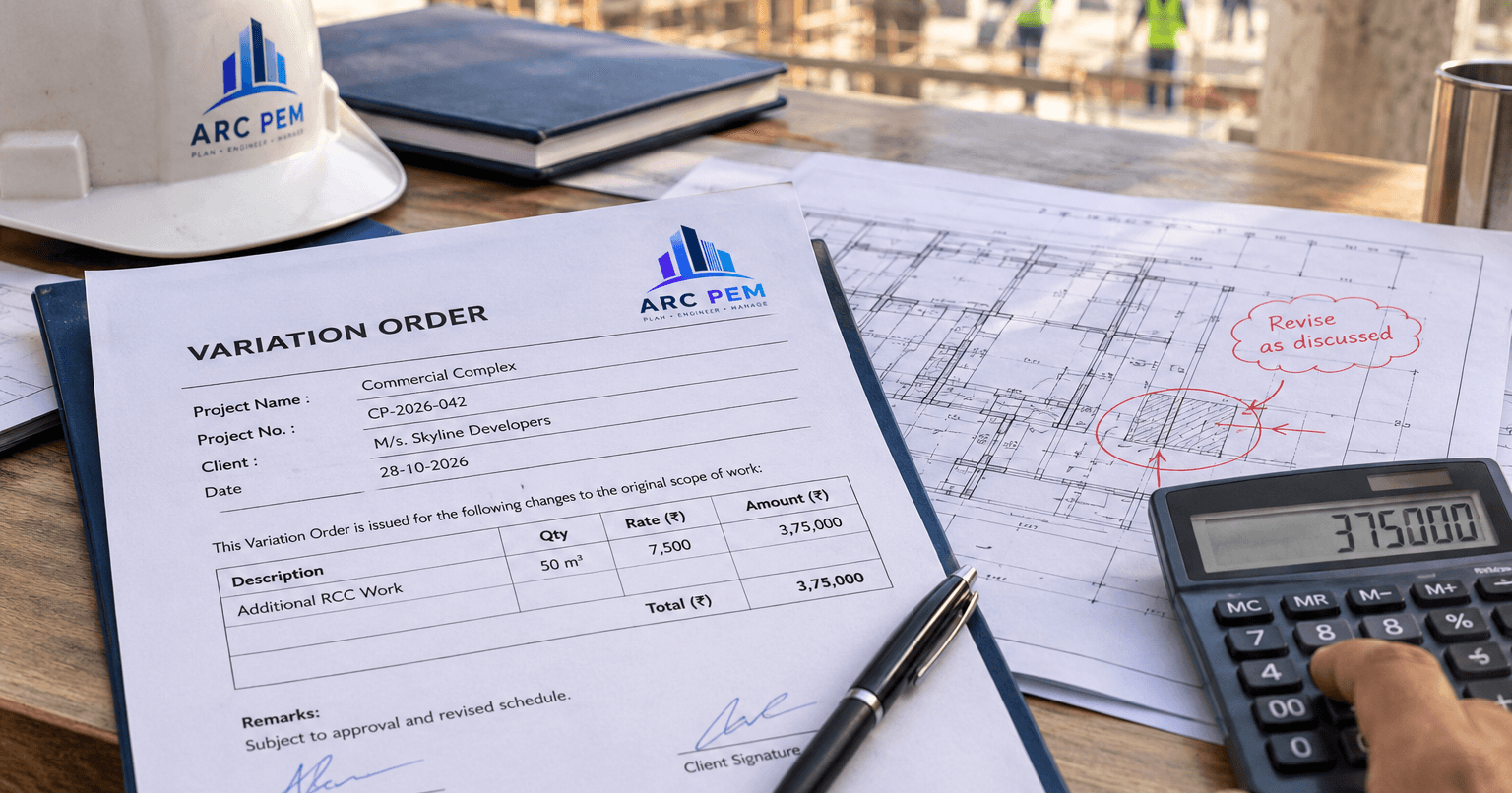
- Check your contract. Look at the force majeure, change-in-law and extension-of-time clauses, and at who bears idle labour and equipment. See types of construction contracts in India and variation orders.
- Write to the client or main contractor the day the order applies. Cite the order and ask for an extension of time in writing. Whether a pollution ban counts as force majeure depends on the wording of your contract, so take legal advice on large claims.
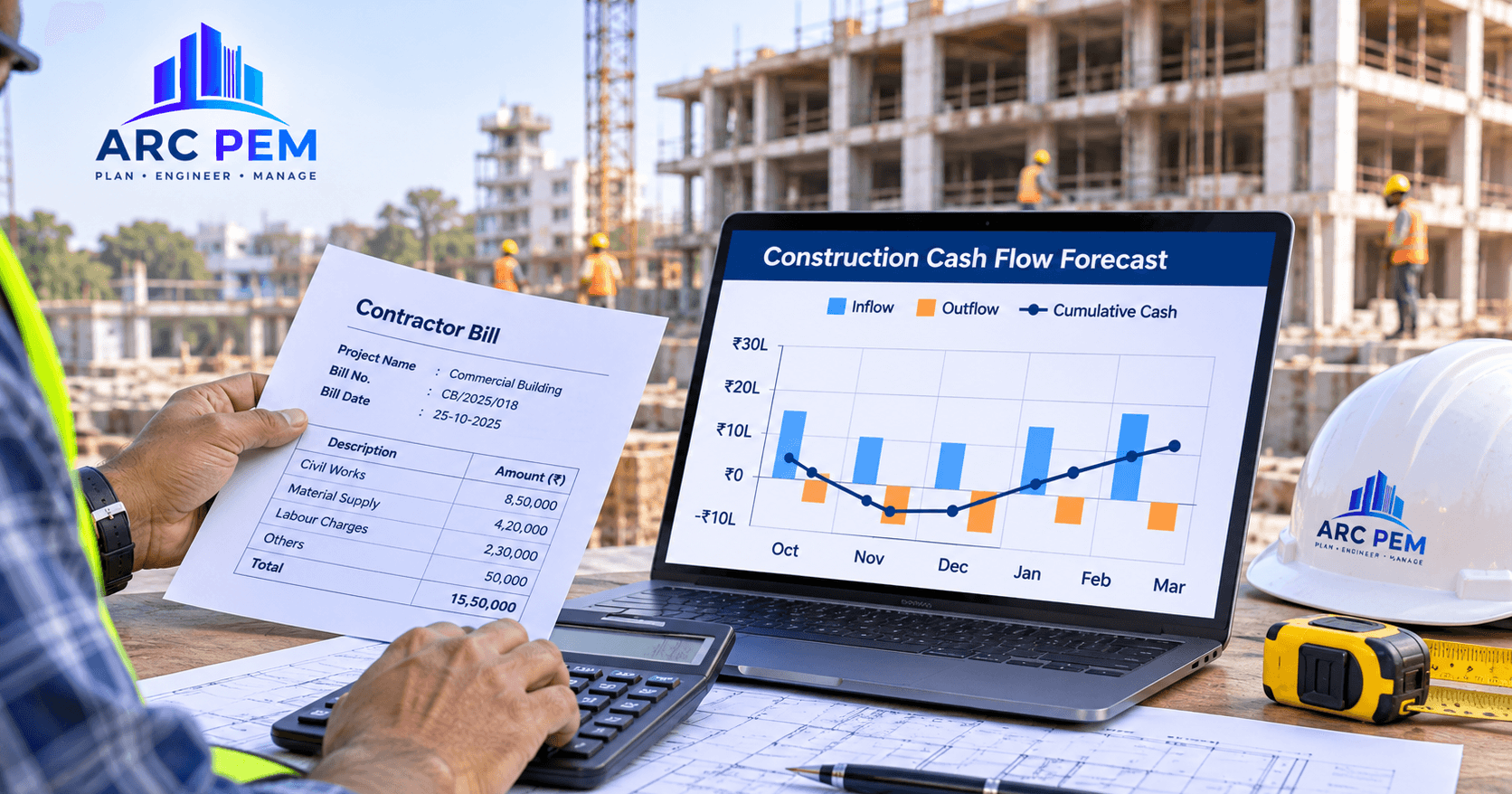
- Protect cash flow. Idle days still cost wages and rent. Rework your forecast with a two-to-three-week pause. See the construction cash flow forecast and retention money, advances and TDS.
- Look after your workers. Check whether the Delhi BOCW Board announces any relief for registered workers. I found no 2026 announcement. For the cess side, see BOCW labour cess and labour cost calculation.
- Fix your dust compliance now. Screens, sprinklers, covered stockpiles, sensors and covered trucks. Inspectors check these first.
- Plan the restart. Stage the material, labour and approvals so work resumes the day the restriction lifts.
Track the cost of every stoppage
A ban turns into a dispute when nobody can show what it cost. Log idle labour, standing equipment, extra security and site overheads against each project, per day. ARC PEM keeps project-wise expenses so your extension-of-time and cost claims have numbers behind them. See construction job costing and how ARC PEM tracks a project's money end to end.
Key takeaways
- A CAQM order restricts dust-generating demolition and outdoor construction across the NCR from 5 to 20 November 2026.
- GRAP Stage III has been in force since 6 November and can continue past 20 November.
- Exemptions cover railways, Metro, airports, hospitals, water supply, defence and projects of national importance.
- Section 14 of the CAQM Act allows up to five years' imprisonment, a fine up to ₹1 crore, or both.
- Direction 97's dust rules apply all year, from 1 April 2026.
- Record every stoppage and notify the client in writing the same day.
Sources
- Commission for Air Quality Management: GRAP schedule, orders and directions
- CAQM press release on Direction 97 (20 Feb 2026)
- PIB: CAQM approves revised GRAP schedule
- All India Radio: CAQM restricts construction across NCR, 5 to 20 November
- SCC Online: CAQM construction curbs, 4 Nov 2026
- Business Today: CAQM invokes GRAP Stage III, 6 Nov 2026
- The Wire: Delhi's air quality turns severe, 13 Nov 2026
- Legal500: dust pollution from C&D activities under the CAQM Act
Updated 14 November 2026. General information only, not legal advice. Confirm current orders with CAQM and your state authority.