Construction labour cost calculation is the process of working out what workers cost a project over a day, a week, a work activity or the whole job, and comparing that cost with the budget and with the work completed. The basic formula is number of workers × daily wage rate × days worked, with overtime and other applicable labour charges added.
Labour costs can quietly reduce a construction project's profit.
A contractor may estimate the number of masons, helpers and electricians required for a job. But when attendance changes, work extends beyond schedule, overtime increases or completed work falls behind plan, the actual labour cost can be very different from the original estimate.
Consider a simple example: a team of 10 workers costs ₹7,000 per day. If the project requires five extra working days, that means another ₹35,000 in labour expense, before considering any additional supervision, equipment or site overheads.
The problem is not always high wages. Sometimes it is poor attendance tracking, low productivity, rework, unplanned overtime or a mismatch between labour deployed and work completed.
Labour cost calculation helps contractors understand how much they spend on labour, what each work activity costs and whether the project is using its labour budget efficiently.
In this guide, we explain the formulas, work through a practical Indian construction example, provide a labour register format and show how to compare estimated labour costs with actual spending.
What Is Construction Labour Cost Calculation?
Construction labour cost calculation is the process of measuring the cost of workers engaged in a construction project over a specific period or for a specific activity.
It can be calculated for a day, week, month, work item or entire project.
A contractor may calculate labour costs for:
- Masonry and brickwork
- Excavation and earthwork
- Concrete and shuttering
- Steel reinforcement and bar bending
- Plastering and painting
- Electrical and plumbing work
- Flooring and finishing
- Site supervision and other project-specific labour
The purpose is not simply to calculate wages. It is to connect labour spending with the project budget and the work actually completed.
For example, knowing that a site spent ₹80,000 on labour last week tells you how much was spent. Knowing that the team completed 1,000 square metres of plastering for that amount tells you considerably more about cost and productivity.
Construction Labour Cost Formula
The formula depends on whether you are calculating daily wages, total labour expenditure or the labour cost of completed work.
1. Daily labour cost calculation formula
Daily Labour Cost = Number of Workers × Daily Wage Rate × Days Worked
For example, if 5 masons earn ₹900 per day and each works for 1 day:
5 × ₹900 × 1 = ₹4,500
The daily wage cost for the five masons is ₹4,500.
Use the actual number of workers and days worked, not simply the number originally planned.
2. Total construction labour cost formula
For a project with different worker categories:
Total Labour Cost = Skilled Labour Cost + Semi-Skilled Labour Cost + Unskilled Labour Cost + Other Applicable Labour Expenses
A more detailed calculation is:
Total Labour Cost = Regular Wages + Overtime + Applicable Allowances + Other Labour Charges
Depending on the project, the total may also need to account for employer-borne statutory contributions, welfare-related expenses, accommodation, transport or labour subcontractor charges.
Include only costs relevant to your project and accounting method. Avoid counting a cost twice if it is already included in a subcontractor's rate or another expense category.
3. Labour cost per unit of work
To understand the cost of completing a particular activity:
Labour Cost per Unit = Labour Cost Attributable to the Activity ÷ Quantity of Work Completed
For example, if a team incurs ₹24,000 in labour cost to complete 300 m² of plastering:
₹24,000 ÷ 300 = ₹80 per m²
This is the labour cost per square metre for that activity.
It is not the total plastering rate. Materials, equipment, overheads and other applicable costs must be considered separately.
4. Labour cost variance formula
Labour Cost Variance = Actual Labour Cost − Budgeted Labour Cost
- A positive result means the actual labour cost exceeded the budget.
- A negative result means the actual labour cost was below the budget.
- Zero means the two amounts are equal.
A cost variance should be investigated alongside work progress. Spending less than budget is not necessarily a good result if the project is also behind schedule.
5. Labour cost overrun percentage
Labour Cost Overrun % = (Actual Labour Cost − Budgeted Labour Cost) ÷ Budgeted Labour Cost × 100
This measures how far actual labour spending is above or below the planned amount.
Use comparable figures for the same scope and reporting period.
Construction Labour Cost Calculation: Worked Example
Let us consider a hypothetical residential construction project in India.
The contractor employs masons, helpers and electricians. The team works different numbers of days, and overtime is recorded separately.
The following rates are illustrative only. Actual wage rates vary by location, skill, contract terms and project conditions.
Step 1: Calculate regular wages
| Labour category | Workers | Daily rate | Days worked | Total cost |
|---|---|---|---|---|
| Masons | 4 | ₹900 | 24 | ₹86,400 |
| Helpers | 6 | ₹650 | 24 | ₹93,600 |
| Electricians | 2 | ₹1,000 | 8 | ₹16,000 |
| Total regular wages | ₹1,96,000 |
Calculation:
- Masons: 4 × ₹900 × 24 = ₹86,400
- Helpers: 6 × ₹650 × 24 = ₹93,600
- Electricians: 2 × ₹1,000 × 8 = ₹16,000
Total regular wages:
₹86,400 + ₹93,600 + ₹16,000 = ₹1,96,000
Step 2: Add overtime and other applicable expenses
Assume the approved overtime cost for this period is ₹12,000.
| Cost component | Amount |
|---|---|
| Regular wages | ₹1,96,000 |
| Overtime | ₹12,000 |
| Other applicable labour expenses | ₹0 |
| Total labour cost | ₹2,08,000 |
Therefore:
Total Labour Cost = ₹1,96,000 + ₹12,000 = ₹2,08,000
The project incurred ₹2.08 lakh in labour cost for the reporting period, based on the stated assumptions.
If the contractor also bears additional labour-related costs, those should be added where applicable.
Step 3: Compare actual spending with the budget
Suppose the approved labour budget for the same period and scope was ₹2,00,000.
Actual labour cost = ₹2,08,000
Budgeted labour cost = ₹2,00,000
Labour cost variance:
₹2,08,000 − ₹2,00,000 = ₹8,000 over budget
Labour cost overrun percentage:
₹8,000 ÷ ₹2,00,000 × 100 = 4%
The project has exceeded its labour budget by 4%.
However, the calculation alone does not explain why. The contractor should check whether overtime was planned, the scope changed, productivity declined, work was repeated or additional workers were required.
Important: Compare actual and budgeted costs for the same work scope and period. Comparing a full-project budget with only the wages paid so far can lead to misleading conclusions.
Labour Cost per Square Foot: Is It a Reliable Measure?
Labour cost per square foot can be useful for an early estimate or a broad comparison between similar projects.
The formula is:
Labour Cost per Sq Ft = Total Labour Cost ÷ Relevant Construction Area
For example, assume a project's attributable labour cost is ₹6,00,000 and the relevant measured area is 2,000 sq ft.
₹6,00,000 ÷ 2,000 = ₹300 per sq ft
This is the labour cost per square foot under the stated assumptions.
But the figure should not be treated as a universal construction rate.
Labour cost per square foot can change with:
- Structural design and building layout
- Number of floors and site accessibility
- Finishing quality and specifications
- Local wage rates and worker availability
- Amount of electrical, plumbing and finishing work included
- Construction method and equipment availability
- Whether the calculation includes supervision or subcontractors
For better cost control, use the per-square-foot figure alongside item-wise labour costs and actual work progress. For whole-project benchmarks, see our city-wise construction cost per sq ft guide.
A project-level average can hide an expensive work activity. For example, a low overall labour cost per square foot may conceal high rework costs in plastering or slow progress in flooring.
Construction Labour Register Format
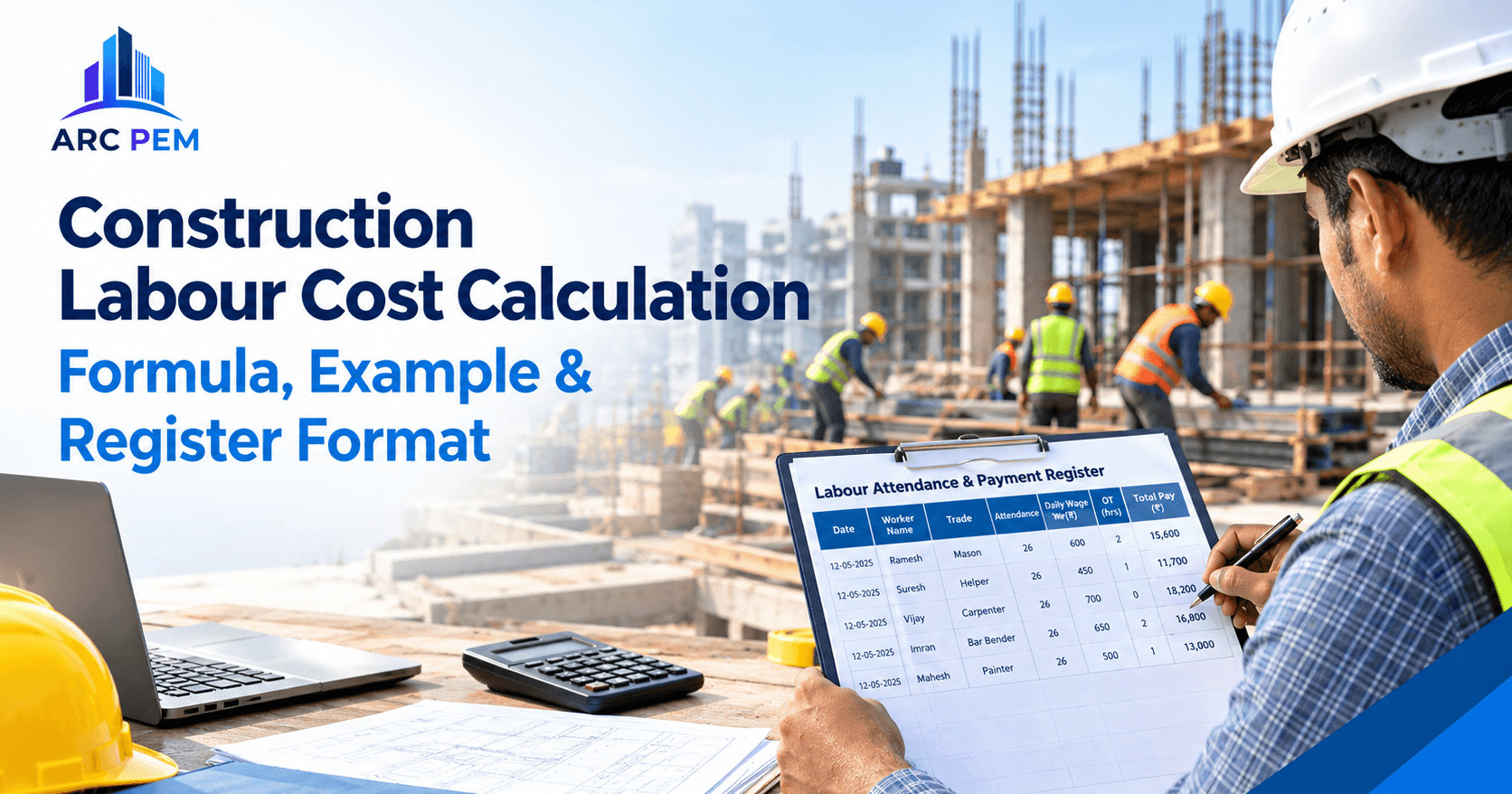
A labour register, sometimes called a labour payment register, records who worked, what work they performed, how much they earned and what payment was made.
For project cost tracking, it should also connect each worker or labour team to the correct site and activity.
Use the following practical format as a starting point.
| Date | Project | Worker name / team | Trade | Days or units worked | Rate (₹) | Overtime (₹) | Gross wages (₹) | Advance / deduction (₹) | Net payable (₹) |
|---|---|---|---|---|---|---|---|---|---|
| 01 Oct | Site A | Ramesh | Mason | 1 | 900 | 0 | 900 | 0 | 900 |
| 01 Oct | Site A | Suresh | Helper | 1 | 650 | 0 | 650 | 100 | 550 |
| 01 Oct | Site A | Electrician team | Electrical | 1 | 1,000 | 150 | 1,150 | 0 | 1,150 |
Illustrative records only. These entries demonstrate a costing format and are not a substitute for the wage and attendance records required for a particular establishment.
For a more complete register, consider adding:
- Worker or contractor identification reference
- Attendance by date
- Work item or activity code
- Approved overtime hours and calculation
- Wage period and payment date
- Payment method and transaction reference
- Supporting attendance or work-completion approval
- Authorised reviewer
- Applicable statutory wage and deduction details
For legal or statutory recordkeeping, confirm the requirements applicable to your establishment, location, workforce and contract arrangement. A project cost register alone may not satisfy every labour-record requirement. Official wage-register and muster-roll formats, for example, include worker, attendance, wage and payment information. See the Chief Labour Commissioner's contract-labour record formats and the Delhi Labour Department's construction-worker register formats.
How to Calculate Labour Cost in Excel
Excel can help contractors calculate wages, total labour expenditure and the difference between budgeted and actual costs.
A basic spreadsheet might use the following columns:
| Column | Field |
|---|---|
| A | Date |
| B | Project name |
| C | Worker / team |
| D | Trade |
| E | Days worked |
| F | Daily rate |
| G | Overtime and other included charges |
| H | Gross labour cost |
| I | Advance or permitted deduction |
| J | Net payable |
Formula 1: Regular wage cost
If days worked are in column E and the daily rate is in column F, enter this in H2:
=E2*F2+G2
This calculates regular wages plus the overtime and other included charges recorded in G2. If overtime is calculated using hours and a rate, calculate that amount separately before adding it to the total.
Formula 2: Net payable
If gross labour cost is in H2 and advances or deductions are in I2:
=H2-I2
Apply only valid and authorised deductions, following the applicable rules and contract terms.
Formula 3: Total labour cost
If the gross labour costs are recorded in H2 through H100:
=SUM(H2:H100)
This adds the gross labour cost entries in the specified range.
Formula 4: Labour cost variance
If the budget is in L2 and actual labour cost is in M2:
=M2-L2
A positive result indicates an overrun; a negative result indicates spending below budget.
Formula 5: Labour cost overrun percentage
=IF(L2=0,"N/A",(M2-L2)/L2*100)
Format the result as a percentage. This formula returns "N/A" when the budget is zero to avoid division by zero.
Excel tip: Keep worker attendance, wage calculation, payment status and project-cost reporting logically connected, but do not mix cash paid with costs incurred. Wages may be due before payment is made, and advances may relate to a different wage period.
Why Labour Cost Increases on Construction Sites
When labour spending exceeds the estimate, simply asking workers to finish faster rarely solves the underlying problem.
Start by identifying the cause.
1. Attendance and deployment gaps
The planned team may differ from the team that actually attends. Missing workers can delay an activity, while excess deployment can increase cost without improving output.
What to track: Planned workers, actual attendance, trade, hours or days worked, and activity completed.
2. Low productivity
A team may be present for a full shift but complete less work than planned because of poor coordination, unavailable materials, access constraints or unsuitable work sequencing.
What to track: Labour hours or days against completed quantities.
3. Rework
Incorrect measurements, poor workmanship, coordination errors or changes made after work is completed can require the same activity to be performed again.
What to track: Original work, rework quantity, additional labour days and the reason for rework.
4. Unplanned overtime
Overtime may be necessary to meet a genuine deadline, but repeated overtime can indicate weak scheduling or an avoidable bottleneck.
What to track: Approved overtime, reason, cost and the extra work completed.
5. Poor activity-level costing
A project may appear to be within its overall labour budget while one activity is overspending.
For example, savings in excavation may hide excess spending on plastering. Reviewing labour costs by activity helps identify the difference.
What to track: Budget, actual cost, completed quantity and cost per unit for each work item.
6. Incomplete records
If attendance, advances, overtime and payments are recorded in separate notebooks or messages, the project team may not have a reliable view of the actual cost.
What to track: A consistent register with supporting approvals, dates, project references and payment status.
How to Control Construction Labour Costs
The objective is not to minimise wages at any cost. It is to complete the required work safely, to the expected quality and within a realistic labour budget.
Step 1: Prepare a labour budget by activity
Estimate the labour required for individual work items rather than using only one overall project allowance.
Include the expected workforce, duration, wage assumptions and scope.
Step 2: Record attendance daily
Record attendance at the site and identify the relevant project and trade. Reconcile attendance with the supervisor's records before calculating wages.
Step 3: Track completed quantities
Record measurable work completed wherever practical: square metres plastered, cubic metres excavated, or another suitable unit.
This helps explain whether increased labour spending corresponds to additional output.
Step 4: Compare planned and actual labour costs
Review the difference regularly, preferably at a frequency suited to the project's activity and transaction volume.
Investigate significant variances while there is still time to correct the cause.
Step 5: Monitor labour productivity
Use a consistent measure for the same type of work.
For example:
Labour Productivity = Quantity of Work Completed ÷ Labour Hours Used
If a team completes 120 m² of plastering in 60 labour-hours, its measured productivity is 2 m² per labour-hour.
This is an illustrative productivity calculation, not a benchmark for every plastering job. Compare like-for-like work, quality requirements and site conditions.
Step 6: Review overtime and rework separately
Keep overtime and rework costs visible instead of burying them in a single wage total. Their causes and corrective actions are different.
Step 7: Link labour records to overall project costing
Labour is only one part of construction expenditure. Review it alongside materials, subcontractor bills, equipment expenses and other project costs.
If you need to establish the broader tracking process, read our guide to Construction Job Costing: Formula, Example and Free Template.
For planned quantities and rates, refer to the Construction Estimate Template. To understand how current cost information contributes to a wider forecast, see Cost Value Reconciliation in Construction.
Labour Cost Calculation vs. Labour Productivity
These two measures are related, but they answer different questions.
| Measure | What it tells you | Example |
|---|---|---|
| Labour cost | How much was spent on labour | ₹24,000 |
| Labour productivity | How much work was completed per labour hour | 2 m² per labour-hour |
| Labour cost per unit | How much labour cost was incurred per unit of work | ₹80 per m² |
| Labour cost variance | How actual cost compares with budget | ₹8,000 over budget |
A higher labour cost does not automatically mean poor performance. The team may have completed more work, handled a more difficult area or worked on a changed scope.
Likewise, a lower labour cost does not necessarily mean better performance if the work is incomplete or fails the required quality checks.
The best review considers cost, output, quality and progress together.
Common Mistakes in Construction Labour Cost Calculation
Avoid these errors when preparing labour reports:
- Using planned attendance instead of actual attendance: Calculate wages using verified days or units worked.
- Ignoring overtime: Record and calculate overtime separately so its effect is visible.
- Mixing different trades: Track masons, helpers, electricians and other teams separately where their rates or work differ.
- Counting advances as additional wages: An advance is generally a payment against an amount due, not an extra labour cost. Record it separately and reconcile it with the relevant wage period.
- Comparing different scopes: Ensure the budget and actual costs refer to comparable work and time periods.
- Ignoring rework: Identify additional labour caused by repeated work rather than treating it as normal progress.
- Using one rate for every project: Labour rates and productivity vary by location, activity, specifications and working conditions.
- Confusing wages paid with wages incurred: Unpaid wages may still be an expense for the relevant period.
- Tracking cost without measuring output: Labour spending is easier to interpret when compared with completed work.
- Leaving records until month-end: Delayed entries make it harder to identify errors and investigate overruns while the details are fresh.
How ARC PEM Can Help With Construction Cost Tracking
A labour register helps establish the labour cost. Project-level expense tracking helps put that figure into context.
For contractors managing multiple sites, the next challenge is connecting labour expenditure with the rest of the project financial picture. Spreadsheets and notebooks get harder to reconcile as sites multiply, which we compare in Excel vs software for construction expense tracking.
ARC PEM's expense and finance tracking keeps vendor, labour and GST records organised project by project, so labour spend sits alongside materials and subcontractor bills instead of in a separate wage sheet.
A practical process is to:
- Establish the project estimate and approved cost baseline.
- Record labour expenses against the correct project.
- Track materials, subcontractor costs and other relevant expenses.
- Review actual spending against the budget.
- Investigate cost overruns and update forecasts when assumptions change.
Labour cost tracking works best when it is part of the overall project-cost process, not an isolated wage sheet. See how a project moves from BOQ to final bill in ARC PEM.
Final Thoughts
Construction labour cost calculation is more than multiplying a worker's daily rate by the number of days worked.
It connects attendance, wages, overtime, productivity and completed work to the project's financial performance. A well-maintained labour register gives contractors a reliable starting point; comparing those records with the budget helps them understand where costs are rising and why.
Start with three practical habits: record attendance daily, track work completed and compare actual labour costs with the budget regularly.
When these records are connected to material expenses, subcontractor bills and the wider project budget, it becomes easier to spot overruns before they become expensive surprises.
Managing a construction project? Explore ARC PEM to learn more about organising project expenses and improving cost visibility across your projects, or view pricing.