Ask five contractors what construction costs per square foot in your city, and you'll likely get five different numbers — sometimes ₹1,000 apart. That's not because anyone's lying to you; it's because "cost per sq ft" means different things depending on quality tier, what's included, and which city you're building in. This breaks down realistic 2026 ranges by city and quality level, and — more importantly — what's actually driving the difference so you can tell a fair quote from an inflated one.
Why the Same City Gives You Wildly Different Quotes
Before comparing cities, it's worth understanding why quotes vary so much even within one city. A per-sq-ft rate typically bundles:
- Structure (RCC framework, brickwork, foundation) — usually the largest single share, around 35–40% of total cost
- Finishing (flooring, plastering, painting, doors/windows) — roughly 20–25%
- MEP (electrical, plumbing, basic HVAC) — around 12–15%
- Interiors (basic woodwork, fixtures) — 10–12%
- Overheads and approvals (site office, contingency, permits) — the remainder
Two quotes for the "same" house can differ sharply depending on whether interiors and MEP are included in the per-sq-ft figure, or quoted separately. Always ask a contractor explicitly what's bundled into their number before comparing it to anyone else's.
City-Wise Rates for 2026 (Standard-Quality Construction)
These are indicative ranges gathered across current industry estimates for standard-quality construction — vitrified tiles, branded sanitary fittings, standard electrical and plumbing, plain plaster and paint. Actual quotes will vary based on design complexity, site conditions, and the specific contractor.
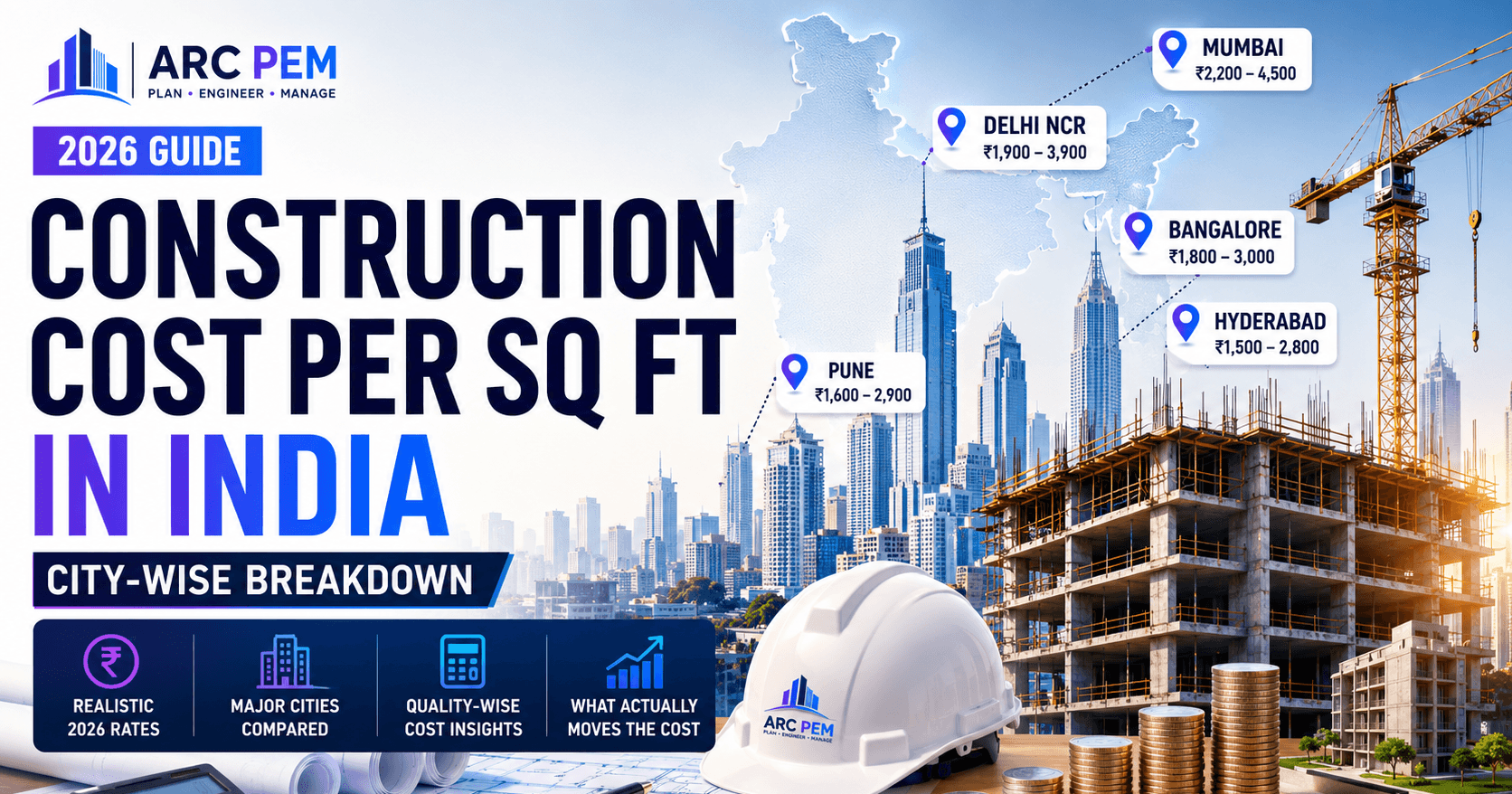
| City | Standard Quality (₹/sq ft) | Notes |
|---|---|---|
| Mumbai | 2,200 – 4,500 | Highest in the country — driven by land scarcity, strict BMC regulations, and material transport costs |
| Delhi NCR | 1,900 – 3,900 | Varies significantly between South Delhi, Gurgaon/Noida, and peripheral areas |
| Bangalore | 1,800 – 3,000 | IT-hub demand and stricter building codes push rates above most peer cities |
| Pune | 1,600 – 2,900 | Generally 10-15% below Mumbai/Bangalore for comparable quality |
| Hyderabad | 1,500 – 2,800 | Slightly more moderate than other Tier-1 cities |
| Chennai | 1,500 – 2,700 | Competitive material availability keeps rates in check |
| Kolkata | 1,400 – 2,600 | Among the more affordable metro markets |
| Ahmedabad / Jaipur / Tier-2 cities | 1,200 – 2,200 | Often 20-30% below metro rates, though skilled-labour availability can be more limited |
For basic-quality construction (plain cement plaster, ceramic tiles, standard fittings), subtract roughly 25-30% from these figures. For premium/luxury builds (Italian marble, imported fittings, home automation), add 40-60% or more — premium projects in Mumbai and Delhi commonly cross ₹5,000/sq ft.
What Actually Moves the Number (Beyond City)
City is the headline factor, but within any single city, these variables routinely swing your rate by 20-40%:
Design complexity. Simple rectangular layouts are cheaper to build than curved walls, cantilevers, or non-standard shapes — complex architectural designs can add 15-25% over a standard footprint.
Floor count. Multi-storey buildings share foundation and roof costs across more built-up area, which can lower the per-sq-ft rate by 5-10% compared to a single-storey build of the same total area. Beyond G+2, though, deeper foundations and stronger columns can partially offset that saving.
Material grade. Swapping standard vitrified tiles for imported marble, or basic fittings for premium sanitaryware, is one of the single biggest swing factors in any budget — often a bigger driver than city choice itself.
Site conditions. Rocky soil, high water tables, or the need for piling can add a meaningful percentage to foundation costs before the superstructure even begins — this varies by plot, not just by city.
Labour availability. Skilled labour costs vary by region — broadly higher in western and northern metros, more moderate in eastern and central India — and directly affects the labour share of your per-sq-ft rate, which typically runs 25-35% of total cost.
Why "Per Sq Ft" Alone Isn't Enough to Budget On
A per-sq-ft rate is a useful starting benchmark, but it rarely captures everything a project actually costs. Commonly excluded items worth budgeting separately:
- Land cost and registration charges
- Architect and structural consultant fees (typically 3-8% of construction cost)
- Municipal approvals, plan sanctions, and utility NOCs (often 3-5% of total project cost)
- Boundary wall, compound paving, and landscaping
- Premium interior furnishing beyond basic fixtures
A quote that looks unusually low compared to the ranges above is worth a second look — it may simply be excluding items another contractor has bundled in, rather than being a genuinely better price.
Get a Number Specific to Your Project
City-wise averages are a useful sanity check, but they can't account for your specific plot, floor count, and finish preferences. Our free Construction Cost Calculator lets you plug in your city, built-up area, number of floors, and quality tier to get a realistic estimate — and a starting BOQ structure — tailored to your actual project rather than a citywide average.
These figures are indicative, gathered from current industry estimates as of 2026, and intended for early-stage budgeting. Always validate against local contractor quotes before finalising a project budget — rates can shift with material price movements and regional demand.