
In short: The CAQM order of 30 October 2026 stopped outdoor construction across Delhi-NCR from 5 to 20 November 2026. Most contractors are entitled to an extension of time (EOT) for that stoppage. Whether you can also recover idle costs depends on your contract's wording. Either way, you need three things: a written notice, a hindrance record and a costed claim. This guide gives you all three.
For the current status of the ban, exemptions and GRAP stages, see our Delhi-NCR Construction Ban 2026 guide. This article covers what to do after the stoppage, when you need to get the time and money back.
What happened, and why it matters for your contract
- 30 October 2026: CAQM issued an order restricting dust-generating demolition and outdoor construction across NCR from 5 to 20 November, including linear projects such as roads, flyovers and pipelines. Railways, Metro, airports, hospitals, water and sanitation, defence and projects of national importance were exempt.
- 6 November: GRAP Stage III was invoked. It was revoked on 17 November, but the 30 October order stayed in force.
- 21 November: Outdoor work resumed across NCR.
That is 16 calendar days of lost outdoor work. Many sites lost more, because labour went home and had to be brought back. In Forbes India's coverage, one Delhi-NCR developer estimated that the curbs can cut site workforces by 40–50%. Another expert summed it up: "The site stops, but interest, salaries and equipment costs don't."
If your contract has liquidated damages (LD) for late completion, an unclaimed 16–20 day delay can cost you far more than the stoppage did. That is why the EOT claim matters.
Time vs money: two separate claims
Contractors often mix these up. Keep them separate.
| Extension of Time (EOT) | Idle / Prolongation Cost | |
|---|---|---|
| What you get | More days to finish; protection from LD | Reimbursement of costs incurred during the stoppage |
| How likely | Usually granted for a government stoppage order that genuinely stops the work | Depends on contract wording; often not payable for a pure force majeure event |
| Main basis | Force majeure, change-in-law or act-of-government clause; EOT clause | Change-in-law clause, a clause allowing costs for employer or government hindrance, or negotiation |
| Evidence | Order copy, hindrance register, revised programme | Wage registers, rent invoices, staff salaries, remobilisation bills |
Rule of thumb: Always claim EOT. Claim idle costs too, with evidence, and let the contract decide. Many standard forms treat a force majeure event as time only, no money, so read your clause before you promise a client or subcontractor anything.
Does a GRAP ban count as force majeure?
There is no single answer, because it depends on your contract's wording. These are the points that usually decide it:
- Does the clause name government orders? Most force majeure clauses list "acts of government", "orders of any statutory authority" or "change in law". A CAQM order under the CAQM Act, 2021 fits most such wording.
- Did it actually stop your work? If your project was exempt, or only part of the work was outdoor, you can claim only for the activities that were stopped. Indoor finishing that continued is not a delay.
- Was it foreseeable? GRAP is invoked almost every winter, so an employer may argue the stoppage was foreseeable. A specific order with fixed dates still strengthens your position, but courts and arbitrators read force majeure narrowly.
- Did you give notice on time? Many contracts make notice within a fixed period (often 7, 14 or 28 days) a condition of relief. A late notice can wipe out an otherwise valid claim.
If there is no force majeure clause at all, Indian law falls back on the Indian Contract Act, 1872. Section 56 (frustration) applies only where performance becomes impossible, and a 16-day pause rarely meets that test. In practice, you negotiate the EOT under the contract's general extension clause.
For large claims or disputed LD, get a lawyer to review the clause. This article is practical guidance, not legal advice.
Step 1: Send the delay notice (format)
Send it as soon as possible. Ideally you sent it the day work stopped. If you didn't, send it now and give the dates. Use email plus a signed letter.
To: [Client / Employer / Main Contractor name] Project: [Project name, address] Contract ref: [Agreement no. and date] Date: [DD Month YYYY]
Subject: Notice of delay and claim for extension of time — CAQM order dated 30.10.2026
Dear Sir/Madam,
- Under Clause [__] (Force Majeure / Extension of Time) of the above contract, we notify you that outdoor construction on this project was stopped from 05.11.2026 to 20.11.2026 as required by the Commission for Air Quality Management order dated 30.10.2026. GRAP Stage III was also in force from 06.11.2026 to 17.11.2026.
- The following activities were affected: [excavation / RCC / masonry / external plaster / material unloading etc.].
- Work resumed on 21.11.2026. Full productivity is expected by [date], because labour has to be remobilised.
- We request an extension of time of [__] days, revising the completion date from [old date] to [new date]. A hindrance statement and revised programme are attached.
- We reserve our right to claim additional costs incurred during the stoppage, with supporting records, under Clause [__].
Enclosures: CAQM order copy, hindrance register extract, site photographs, revised programme.
For [Company name] [Authorised signatory, designation]
Attach a copy of the order itself, downloaded from the CAQM website (caqm.nic.in). Saying only "as per news reports" weakens your claim.
Step 2: Record the hindrance
Government contracts (CPWD and similar) expect a hindrance register. Private clients rarely ask for one, but keeping one makes any claim stronger.
| Sr | Hindrance | Activities affected | Start | End | Days | Overlap | Net days | Remarks |
|---|---|---|---|---|---|---|---|---|
| 1 | CAQM order dated 30.10.2026 | Excavation, RCC, external works | 05.11.2026 | 20.11.2026 | 16 | GRAP III (06–17 Nov) falls inside | 16 | Order copy attached |
| 2 | Labour remobilisation | All | 21.11.2026 | 24.11.2026 | 4 | — | 4 | Attendance register attached |
Don't double-count overlaps. Stage III (6–17 November) fell entirely within the 5–20 November order, so it adds no extra days.
Back the register with your Daily Progress Report for each day: workers present, activities done, and "work stopped — CAQM order" on the stoppage days.
Step 3: Calculate idle cost
Idle cost = Σ (daily cost of each idle resource × idle days) + remobilisation cost
Include only costs you actually incurred and can prove:
- Retained staff: site engineer, supervisor, storekeeper (monthly salary ÷ 30 × days)
- Watch and ward: security for the idle site
- Retained labour: the core crew you kept on wages so they wouldn't leave
- Hired plant and equipment: mixers, hoists, shuttering and scaffolding on rent
- Site overheads: site office, power, water, temporary facilities
- Remobilisation: travel advances to bring labour back, re-erection and restart costs
Leave out profit on idle days, costs you avoided (for example, labour you released), and anything without a bill or register entry.
Related reading: Construction Labour Cost Calculation.
Worked example: a 16-day stoppage on a G+3 residential project
Project: G+3 residential building, Noida. Contract value ₹2.40 crore. Item-rate contract with a 300-day completion period. LD at 0.5% of the contract value per week of delay.
Idle cost claim (5–20 November, 16 days):
| Resource | Rate | Days | Amount (₹) |
|---|---|---|---|
| Site engineer (₹45,000/month) | ₹1,500/day | 16 | 24,000 |
| Supervisor (₹30,000/month) | ₹1,000/day | 16 | 16,000 |
| Watchmen × 2 | ₹700/day each | 16 | 22,400 |
| Retained core crew × 10 | ₹750/day each | 16 | 1,20,000 |
| Mixer + hoist on hire | ₹1,200/day | 16 | 19,200 |
| Shuttering and scaffolding rent | ₹2,500/day | 16 | 40,000 |
| Site office, power, water | ₹600/day | 16 | 9,600 |
| Labour remobilisation (travel advances, restart) | Lump sum | — | 25,000 |
| Total idle cost claim | 2,76,200 |
EOT claim: 16 days (stoppage) + 4 days (remobilisation) = 20 days.
Why the EOT matters more than the money:
- LD = 0.5% × ₹2.40 crore = ₹1,20,000 per week
- 20 days ≈ 2.86 weeks, which is ₹3,42,857 of LD exposure if the EOT is not granted
Even if the client refuses every rupee of idle cost, the 20-day EOT protects you from about ₹3.4 lakh of deductions. Claim both, but make sure the EOT is properly documented.
Step 4: Pass it down (and up) the chain
- Main contractors: Your subcontractors will send you their own notices. You can only pass on time you also get from the client, so don't grant subcontractors costs you can't recover yourself.
- Subcontractors: Send notice to the main contractor, not the client, unless your contract says otherwise.
- Architects and PMCs: You will be asked to certify the EOT. Keep the order copy, DPRs and hindrance register on the project file. Recommend days based on the activities that were actually stopped, not the calendar.
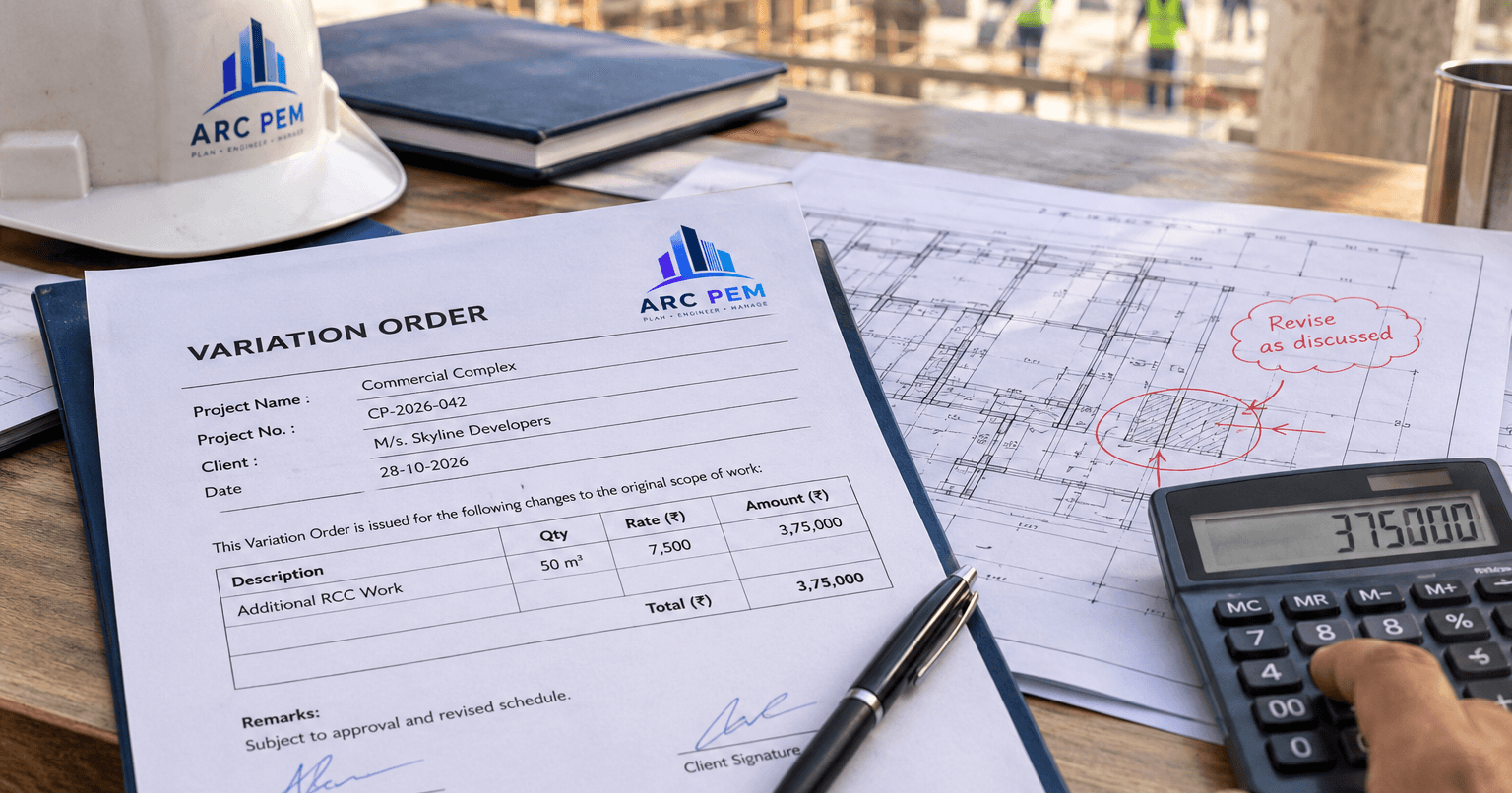
If the client agrees to pay idle costs, raise them as a variation with its own approval. See Variation Order in Construction. If the payment schedule moves, update your construction cash flow forecast.
Common mistakes that kill a delay claim
- No written notice. Phone calls and WhatsApp voice notes aren't notice. Send a letter and an email.
- Claiming the whole calendar. Exempt or indoor work that continued doesn't count as delay.
- Double-counting GRAP stages that overlap with the CAQM order.
- No cost evidence. "Approx ₹50,000/day loss" without registers and invoices gets rejected.
- Accepting LD silently. If the client deducts LD in the next RA bill, object in writing immediately and refer to your EOT notice.
- Ignoring the next stoppage. GRAP is often invoked again in December and January. Keep the register open.
Track every stoppage day in ARC PEM
Most idle-cost claims fail because the costs can't be separated from normal project spend. In ARC PEM you can tag labour, equipment rent and overhead entries to a "GRAP stoppage" cost head for the affected project. You then get a claim-ready statement of dates, amounts and bills, ready to attach to your notice or RA bill.
Try ARC PEM free → · Or make your next claim bill with the free GST Contractor Bill Generator.
Key takeaways
- The CAQM order stopped outdoor NCR construction from 5 to 20 November 2026 (16 days). Work resumed on 21 November.
- EOT for this stoppage is usually available. Idle costs depend on your contract's force majeure or change-in-law wording.
- Send a written notice quickly, citing the order and the contract clause.
- Keep a hindrance register and DPRs, and don't double-count overlapping GRAP stages.
- Cost your claim from actual records. In our example, a ₹2.76 lakh idle cost claim sits alongside a 20-day EOT that avoids about ₹3.4 lakh of LD.
- Keep tracking, because more GRAP stoppages are likely this winter.
Sources
- CAQM order dated 30 October 2026 and GRAP notices: caqm.nic.in
- SCC Online, "CAQM curbs construction… 5 to 20 November" (4 November 2026)
- Forbes India, "Delhi-NCR construction curbs: Developers, workers count the cost" (5 November 2026)
- Reports of the GRAP Stage III revocation, 17 November 2026 (IANS)
- Indian Contract Act, 1872 (Sections 32, 56 and 73)
- Khaitan & Co, "Delhi High Court deals with the force majeure clause in construction contracts"