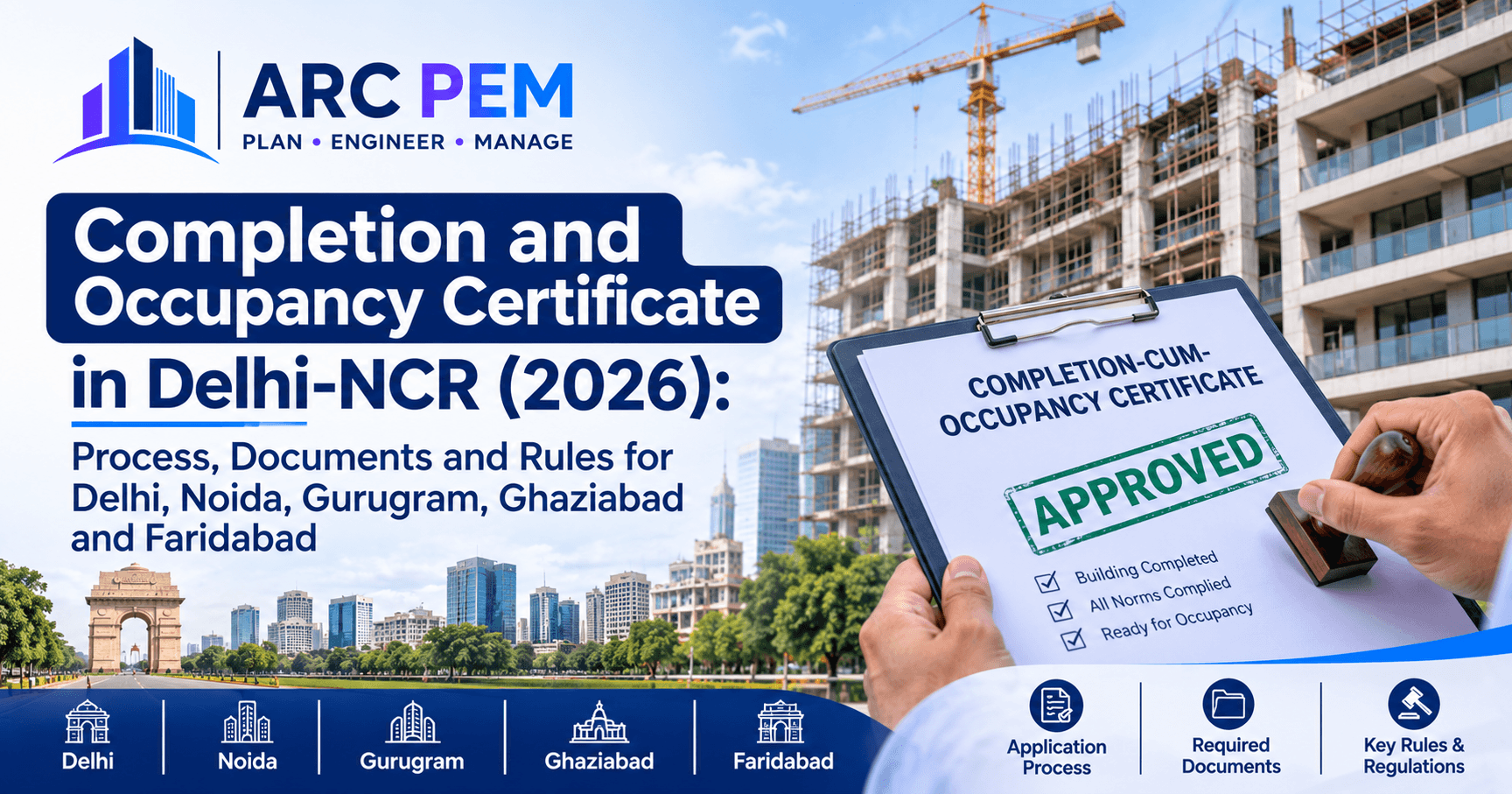
A completion certificate (CC) confirms a building was built as per the sanctioned plan. An occupancy certificate (OC) is the authority's permission to occupy it. In Delhi-NCR you need these before you hand over a building, connect utilities or let a buyer move in. Two Supreme Court rulings, one in December 2024 and one in February 2026, have made this stricter.
This guide is for architects, builders and contractors. It covers what each certificate is, who issues it in each part of the NCR, the documents you usually need and what to do before you apply.
Check the current rules. Forms, fees and timelines differ by authority and change often. I could not confirm official timelines for several authorities, so the sections below say so. Confirm with the authority or an empanelled architect before you file. This article is general information, not legal advice.
Completion certificate vs occupancy certificate
| Completion certificate (CC) | Occupancy certificate (OC) | |
|---|---|---|
| What it says | The building was built as per the sanctioned plan | The building is fit to be occupied, with the required safety and civic services |
| Who issues it | The local authority or development authority | The same authority |
| Needed for | Showing that you built what was approved | Occupation, utility connections, registry and bank loans |
| When | After construction is complete | After completion, once the safety and compliance checks are done |
In Delhi, the MCD's approval portal lists "Completion and Occupancy Certificate" as one stage: you apply after construction, the authority checks FAR, setbacks and fire safety, and issues the certificate if the building complies. Elsewhere the two are sometimes issued as separate documents. Check what your authority issues and what it calls it.
Under RERA, Section 11(4)(b) makes the promoter responsible for obtaining the OC, the CC or both and giving copies to the allottees or their association.
Why it matters more now
Supreme Court, 17 December 2024 (Rajendra Kumar Barjatya v UP Avas Evam Vikas Parishad). The Court directed, among other things, that:
- Power, water and sewerage connections be given only after a completion certificate is produced.
- Banks sanction loans against a building only after the completion or occupation certificate is verified.
- Officials personally inspect the building before issuing a certificate, and defer it if there are deviations.
- Officials who certify a building that violates the sanctioned plan can face contempt and departmental action.
- Builders give an undertaking that they will hand over only after getting a completion certificate.
- Appeals against refusal of a certificate be decided within 90 days.
Supreme Court, 20 February 2026 (Parsvnath Developers v Mohit Khirbat). The Court held that a developer cannot force a buyer to take possession without an OC, and called the OC a statutory pre-condition to lawful delivery of possession. The dispute was about a project in Sector 53, Gurugram. Failing to obtain the OC was treated as a deficiency in service.
For you, this means three things: no certificate means no utility connection, no loan against the building and a weak position in any buyer dispute.
Who issues the certificate in Delhi-NCR
| Area | Authority | Notes |
|---|---|---|
| Delhi | MCD (NDMC and DDA for their areas) | Portal lists the completion and occupancy stage. It states no timeline or fee. Structural stability certificate reportedly needs an MCD-empanelled structural engineer. |
| Noida | Noida Authority | Online completion certificates open to all allottees since 2021, digitally signed. The Authority also publishes project-wise OC/CC status for group housing. |
| Greater Noida | Greater Noida Authority | Reported to let Council of Architecture registered architects handle plans and OCs on individual residential plots. Check the current scope. |
| Gurugram, Faridabad | HSVP, DTCP or the municipal body, depending on the land | Governed by the Haryana Building Code 2017 (Code 4.10). HSVP sectors file on the HSVP OBPAS portal. |
| Ghaziabad | GDA | Governed by the GDA building byelaws. GDA has refused certificates over pending development, FAR and other dues. |
If your land is in a licensed colony, a sector or an industrial area, the issuing body may differ. Confirm which authority holds the file for your plot, as you did at the plan-approval stage. See Building Plan Approval in Delhi-NCR.
Documents usually asked for
No authority publishes a single complete checklist that I could confirm. Applications commonly include:
- Sanctioned building plan and permit letter
- As-built drawings showing any deviations from the sanctioned plan
- Architect's completion certificate (in Haryana, a prescribed form)
- Structural stability certificate from a qualified structural engineer
- Fire NOC or fire safety clearance, where the building needs one
- Photographs of the completed building
- Proof of dues paid, including property tax, development charges and any compounding charges
- Receipt for demolition waste deposited at a designated facility, where demolition was part of the project (see below)
- Other NOCs and certificates for larger buildings. In Noida, non-residential plots were reported to need 30 to 35 documents, including pollution board and fire NOCs, an elevator safety certificate, a rainwater harvesting certificate and labour cess registration.
The step-by-step process
- Finish the building as sanctioned. Complete all work and carry out any rectification.
- List deviations. Compare the building with the sanctioned plan. Where the authority allows compounding, you can pay it. Noida lets allottees self-assess breaches and pay compounding charges online.
- Collect the certificates. Get the structural, fire and architect's certificates and clear any pending dues.
- File on the authority's portal or at its office, with the documents above.
- Site inspection. An officer or team visits to check the building against the plan. After the 2024 ruling, expect inspections to be real, not paper-only.
- Answer objections. Correct any deficiency and resubmit.
- Receive the certificate. Keep the original with the project file and give copies to the owner or association.
How long does it take?
I could not find an official timeline for Delhi. The MCD portal doesn't state one. Reports I found range from about 15 days to 60 days or more for Haryana and Delhi, and a Noida official quoted a maximum of 90 days in 2021. Treat all of these as unconfirmed, and build a buffer into your handover plan. Files with deviations or pending dues take longer.
Demolition waste and the winter restrictions
If your project involved demolition on a plot of 200 sq m or more, CAQM's directions (in force from 1 April 2026) require you to deposit the waste at a designated facility and obtain a receipt. Reports say this receipt is checked when the completion or occupancy certificate is issued. Keep it with your file. See Delhi-NCR construction ban 2026 for the current dust and waste rules.
What happens if you occupy or hand over without the certificate
- No utility connection. The Supreme Court's December 2024 directions say connections follow the certificate.
- No bank loan against the building as security.
- Trade licences. Under the same ruling, local bodies cannot give a business licence for an unauthorised building.
- Buyer disputes. After the February 2026 ruling, a buyer can refuse possession and claim compensation.
- Action against officials, which means authorities will be stricter with you.
- Collection delays. If your payment schedule or retention release depends on completion, delay costs you cash. See construction payment schedule and retention money.
For architects: build the certificate stage into your fee
Completion work takes real time: as-built drawings, inspection visits, replies to objections. Put the completion stage into your proposal with a clear scope and number of site visits. See architect fee proposal format and architect fees in India.
For builders and contractors: a pre-application checklist
- Work matches the sanctioned plan, or deviations are listed and compoundable
- Structural stability certificate signed
- Fire clearance in hand, where required
- Labour cess registered and paid. See BOCW labour cess
- All authority dues cleared
- Demolition waste receipt on file
- As-built drawings and photographs ready
- Daily records and site reports saved. See daily progress report format
Track the cost of getting to handover
Compounding charges, consultant fees, rectification work and delay all hit your margin at the end of the project. Log them against each project so the final account is accurate. ARC PEM keeps project-wise expenses. See how ARC PEM tracks a project's money end to end.
Key takeaways
- A completion certificate confirms the building matches the plan. An occupancy certificate permits occupation. Delhi's MCD lists them as one stage.
- Supreme Court rulings in December 2024 and February 2026 tie utilities, loans and possession to the certificate.
- The issuing authority depends on your land: MCD, Noida, Greater Noida, HSVP/DTCP or GDA.
- Timelines are not officially confirmed for most authorities, so plan a buffer.
- Prepare as-built drawings, structural and fire certificates, dues and waste receipts before you file.
Sources
- Supreme Court, 17 Dec 2024, directions on completion certificates (ThePrint)
- Supreme Court order, 17 Dec 2024
- Parsvnath Developers v Mohit Khirbat, 20 Feb 2026 (LiveLaw)
- MCD: stages of approval
- Noida: allottees can apply for completion certificates online (Construction World, Aug 2021)
- Noida: OC/CC details of housing projects online (ThePrint)
- Haryana Building Code 2017
- Haryana: architects can issue OCs in plotted colonies (Realty Quarter, Nov 2022)
- Legal500: dust and waste rules under the CAQM Act
Updated 17 November 2026. General information only, not legal advice. Confirm current rules with the issuing authority.