
If you owe money to a micro or small vendor for longer than the legal limit, two things can happen. You can be charged compound interest under the MSMED Act, and you can lose the tax deduction for that expense in the year you booked it. Both rules apply to contractors and builders every day, because most of your material suppliers, fabricators, labour contractors and transporters are small businesses.
This guide explains the 45-day rule in plain terms: who it covers, the deadlines, what late payment costs and what to put in place before 31 March.
Check with your CA. Parts of this rule are still unsettled for construction work, and the tax law was re-numbered from 1 April 2026. This article is general information, not tax or legal advice.
The rule in one minute
Two laws work together:
- MSMED Act, 2006 (Section 15): A buyer must pay a micro or small supplier within the agreed period, which cannot be more than 45 days from the day the goods or services are accepted (or deemed accepted). If there is no written agreement, the limit is 15 days.
- Income-tax Act, Section 43B(h): If you do not pay within that period, the amount is not allowed as a deduction in that year. You can claim it only in the year you actually pay. The provision was added by the Finance Act 2023 and has applied since 1 April 2024.
Under the new Income-tax Act, 2025 (in force from 1 April 2026), reports say the same rule continues as Section 37(2)(g), with no change in substance. For the year ended 31 March 2026, the old Section 43B(h) still applies.
Who is covered
| Supplier type | Covered? |
|---|---|
| Micro enterprise registered on Udyam (manufacturer or service provider) | Yes |
| Small enterprise registered on Udyam | Yes |
| Medium enterprise | No |
| Supplier without Udyam registration | No |
| Traders | Generally treated as outside this rule, but check your case |
For a contractor or builder, the suppliers most likely to be covered are small manufacturers and service providers, such as ready-mix concrete plants, fabricators, shuttering and scaffolding suppliers, transporters and manpower or labour contractors. Dealers who only resell goods may fall outside the rule.
Always ask for the vendor's Udyam certificate. If you don't know whether a vendor is registered, you can't tell whether the rule applies.
Deadlines
| Situation | Deadline |
|---|---|
| Written agreement with a payment period | The agreed date, never more than 45 days from acceptance |
| No written agreement | 15 days from acceptance |
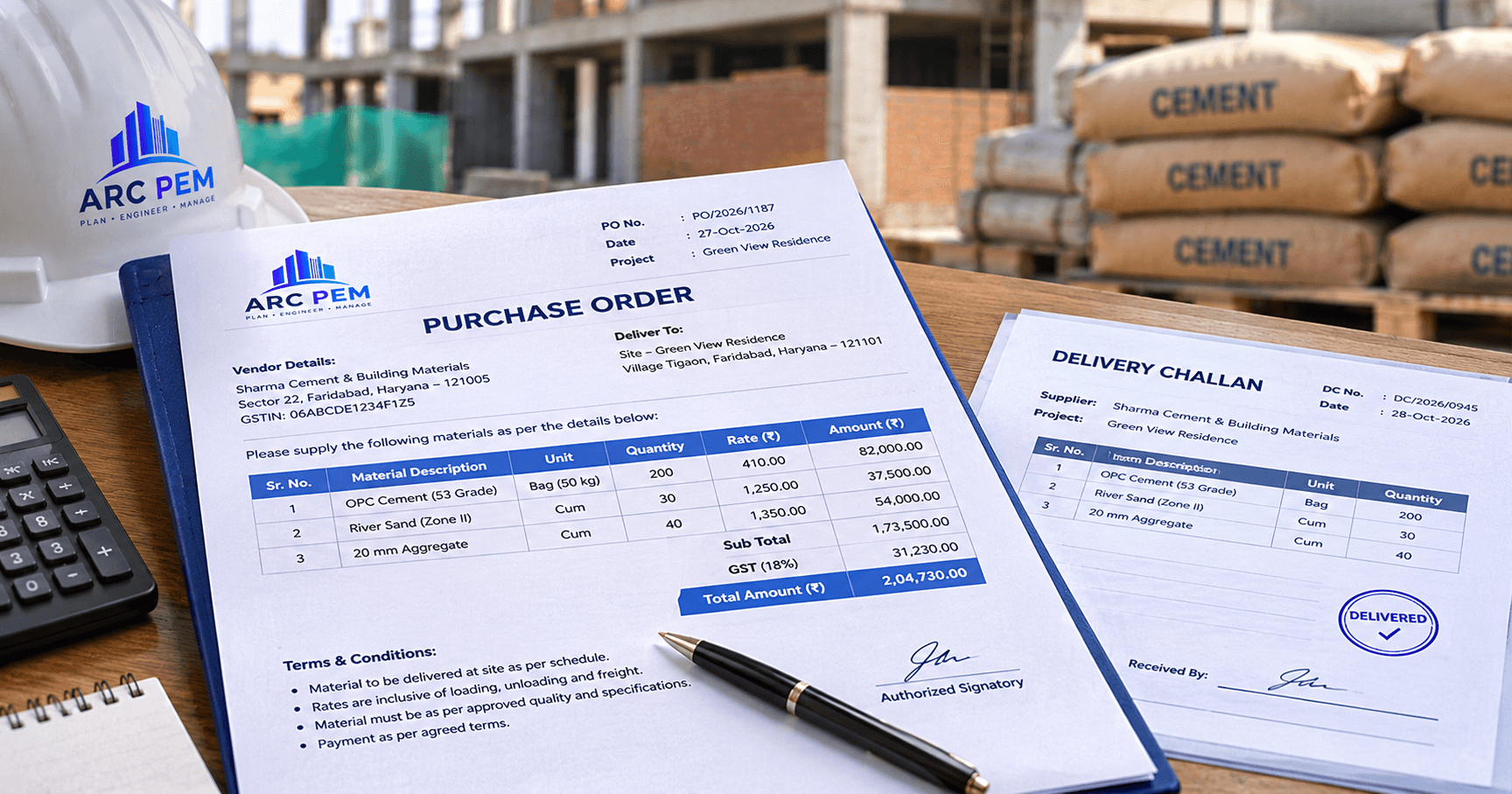
A longer payment period in your purchase order or contract (60 or 90 days, for example) does not extend the 45-day limit for this purpose. Put the real limit in writing. See purchase order format for construction.
Worked example
You buy fabricated steel work worth ₹10,00,000 from a small Udyam-registered vendor. The work is accepted on 10 January 2026, and your purchase order says payment within 45 days, so the due date is 24 February 2026.
Case 1: you pay on 20 February. No issue. The expense is deductible in FY 2025-26.
Case 2: you pay on 15 April. The amount was unpaid on 31 March and past the deadline.
- Tax: The ₹10,00,000 is disallowed in FY 2025-26 and becomes deductible in the year you pay. This raises that year's taxable income by ₹10,00,000, and the item must be reported in the tax audit (Clause 22 of Form 3CD).
- Interest: The vendor can claim interest from the day after the due date. Interest is compounded with monthly rests at three times the RBI bank rate. As an illustration only, if that worked out to 19.5% a year, about two months of delay on ₹10,00,000 would cost about ₹32,800. Check the current bank rate for the real figure.
When you are the supplier
If your own firm is a registered micro or small enterprise, the rule works for you:
- Put your Udyam number on every invoice and quotation, and add a note that interest applies on late payment.
- Agree payment terms in writing, no longer than 45 days.
- Send a written reminder when a payment is late and keep a dated record of the acceptance date.
- Use the formal route if needed. A micro or small supplier can approach the state MSME Facilitation Council, and the MSME Samadhaan portal is the usual online entry point. Medium enterprises are generally not eligible.
Where the rule is still unclear for construction
I found no source that settles these points. Ask your CA before you rely on any one reading:
- Composite contracts: When supply and installation are bundled, does the 45-day clock start at supply or at completion? A leading law firm article flags this as an open question and notes that both views can be argued.
- Continuing services: When does acceptance happen for services that run for months?
- Retention money: How amounts held back under a contract are treated is not clearly covered in the sources I reviewed. See retention money, advances and TDS.
- Running bills: Whether each RA bill has its own acceptance date.
A separate clock: GST input credit
Don't confuse this with the GST rule that you must pay a vendor within 180 days of the invoice date to keep the input tax credit. The 45-day rule is an income-tax and MSMED Act rule. The 180-day rule is a GST rule. You can breach one without the other. See GSTR-2B reconciliation.
A payment checklist for contractors and builders
- Collect Udyam certificates from vendors and mark them in your vendor list
- Add a payment period of 45 days or less to every PO and contract with a covered vendor
- Record the acceptance date for every delivery or work completion
- Run a weekly ageing report of payables by acceptance date, with the due date next to each
- Review all unpaid covered dues in the last four to six weeks of the financial year
- Pay covered vendors before 31 March
- Keep payment proof and your agreements for the tax audit
Plan your cash around the rule
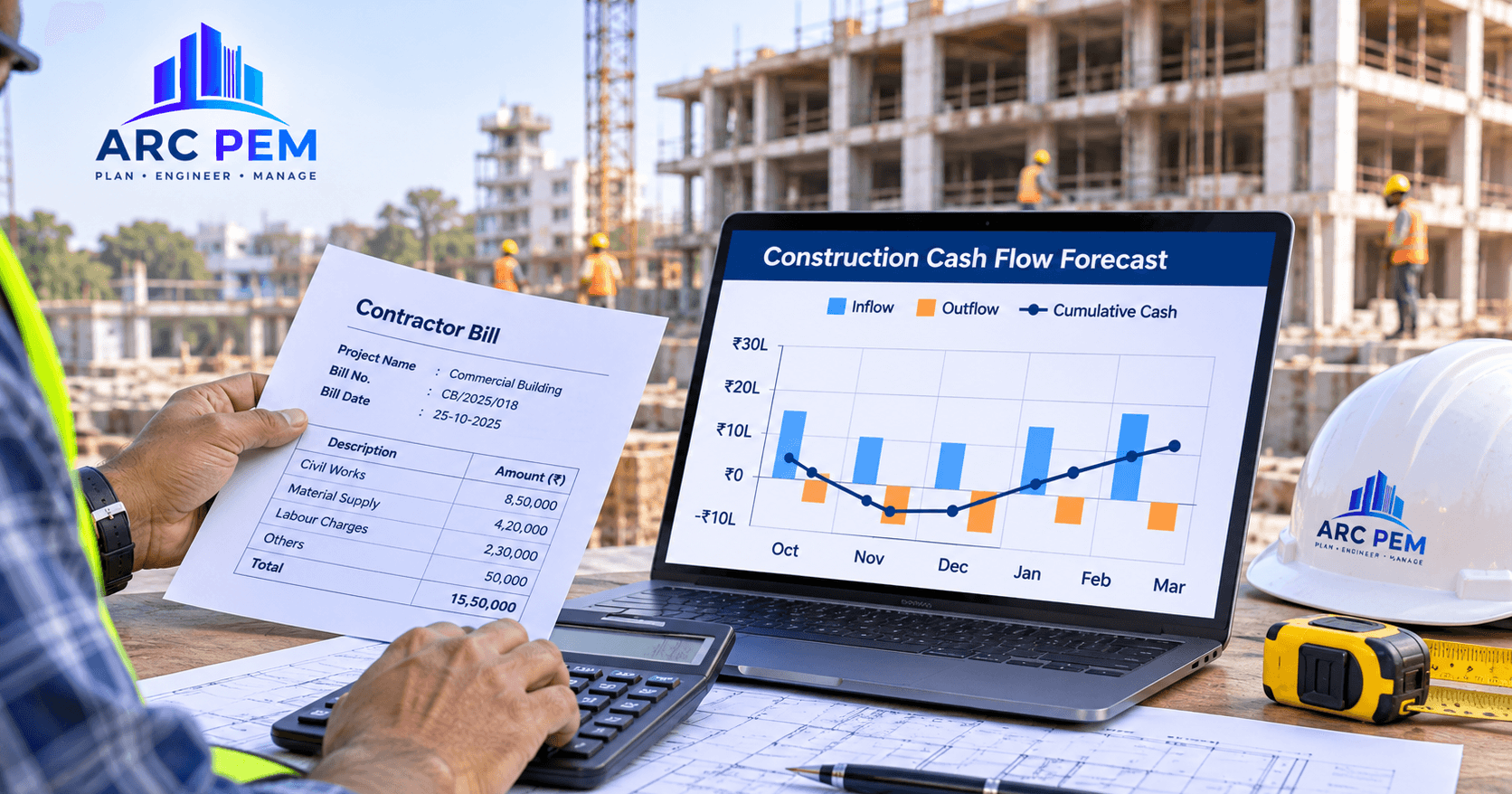
The hard part for most contractors is cash flow. Clients pay RA bills late, and vendors must be paid in 45 days. Build the 45-day limit into your forecast so you aren't surprised. See construction cash flow forecast and types of construction contracts for how payment terms differ by contract.
Track vendor dues by project
A vendor ageing report by project tells you what is due, when, and which project is paying. ARC PEM records vendor bills and payments project by project, so you can see covered dues before the deadline. See how ARC PEM tracks a project's money end to end.
Key takeaways
- Micro and small Udyam vendors must be paid within the agreed period (45 days at most), or 15 days with no written agreement.
- Late payment can bring compound interest under the MSMED Act and loss of the tax deduction until you pay.
- The rule has applied since 1 April 2024, and reports say it continues as Section 37(2)(g) under the Income-tax Act, 2025.
- Collect Udyam certificates, put terms in writing and pay before 31 March.
- For composite contracts and retention, the position isn't settled, so ask your CA.
Sources
- Section 43B(h) and the Income-tax Act 2025 (TaxUpdate.in, summary of the CBDT FAQ)
- Timely payments to MSMEs (Lakshmikumaran & Sridharan)
- Interest under the MSMED Act (LiveLaw)
- When is interest under Section 16 of the MSMED Act applicable (SCC Online)
- MSMED Act legal framework (Office of the DC MSME)
Updated 18 November 2026. General information only, not tax or legal advice. Confirm with your CA.