Quick answer: the paint you need, in litres, is the net paintable area divided by the coverage of the paint for the number of coats you plan. With a premium emulsion that covers about 150 sq ft per litre for two coats, 1,000 sq ft of wall needs about 6.7 litres, or 7 to 7.5 litres with 5% to 10% wastage. Add about 4 litres of primer, which covers about 240 sq ft per litre in one coat.
The most common reason two paint calculators disagree is a simple one: some give coverage per coat and others give it for two coats, and those numbers differ by a factor of two. This guide shows how to avoid that mistake, with a quantity table, a formula and a worked room example.
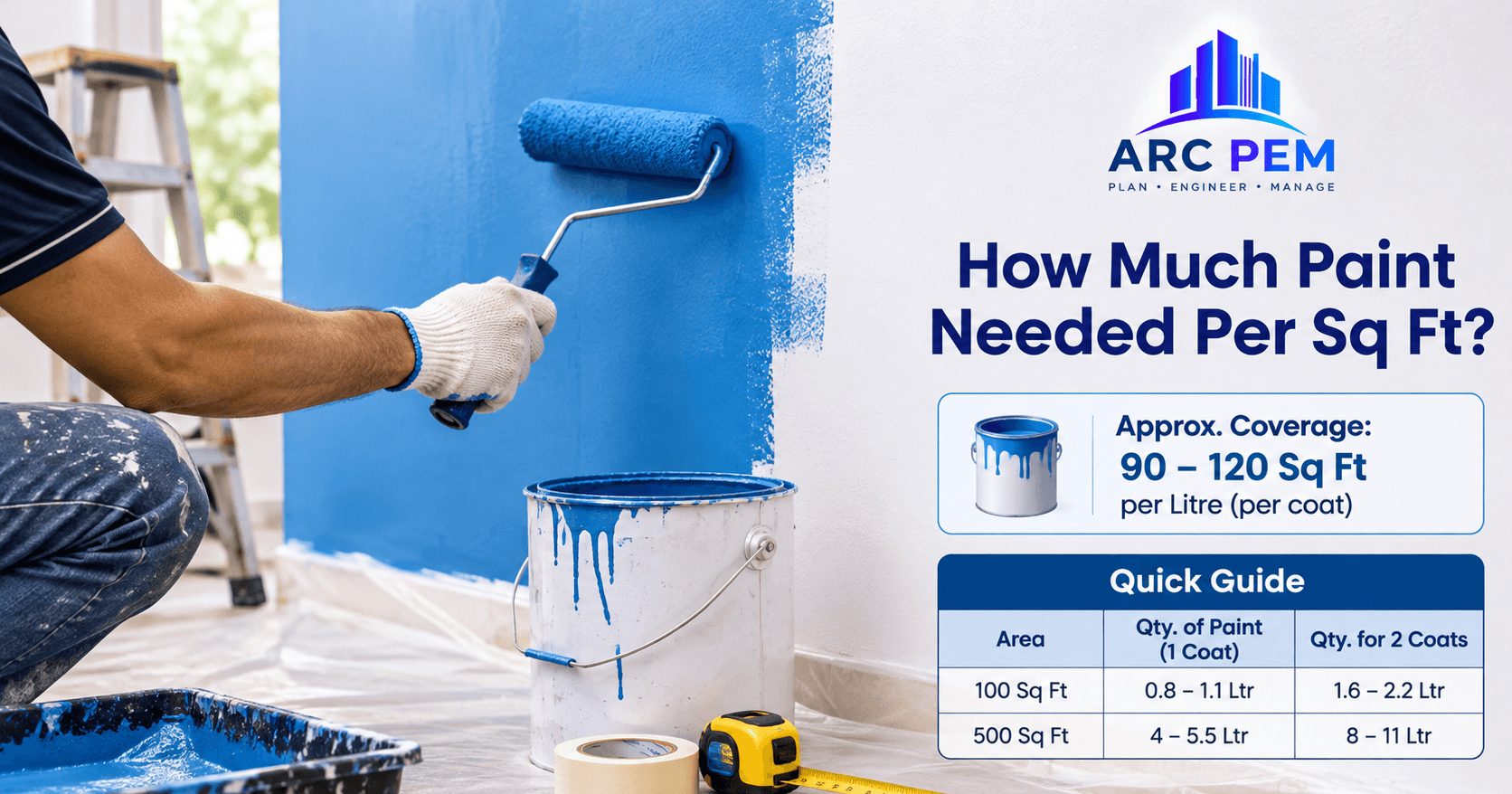
Paint Quantity per 100 Sq Ft: Quick Reference
The quantities are for 100 sq ft of painted surface, before wastage. Coverage is taken from the middle of the ranges published by Indian paint guides, so use the technical data sheet of the product you actually buy.
| Material | Coats | Coverage used | Quantity per 100 sq ft |
|---|---|---|---|
| Premium emulsion | 2 | 150 sq ft per litre for 2 coats | 0.67 litre |
| Standard emulsion | 2 | 125 sq ft per litre for 2 coats | 0.80 litre |
| Distemper | 2 | 100 sq ft per litre for 2 coats | 1.00 litre |
| Wall primer | 1 | 240 sq ft per litre | 0.42 litre |
| Wall putty | 2 | 15 to 35 sq ft per kg | 2.9 to 6.7 kg |
Putty coverage depends heavily on how thick the layer is and how rough the wall is, which is why it is shown as a range.
How to Calculate Paint Quantity
- Measure the paintable area. For walls, multiply the perimeter by the height. Add the ceiling area if it is being painted.
- Deduct the openings. Subtract doors and windows, subject to the measurement rules in your contract.
- Choose the paint and the number of coats. New work typically takes primer, putty and two coats of emulsion. A repaint may need only the emulsion, with touch-up putty and primer where needed.
- Check what the coverage figure means. Is it per coat, or for two coats?
- Divide and add wastage. Divide the area by the coverage, then add a wastage allowance.
Litres = (net area ÷ coverage for the number of coats) × (1 + wastage)
If the coverage is given per coat, use this instead:
Litres = (net area × number of coats ÷ coverage per coat) × (1 + wastage)
To convert, coverage for two coats = coverage per coat ÷ 2. A paint that covers 280 sq ft per litre per coat covers 140 sq ft per litre for two coats.
In Excel, if the area is in A2, the coverage for your coats is in B2, and the wastage is in C2 (for example 5%):
=A2/B2*(1+C2)
Per coat or for two coats: why it matters
Indian paint guides publish both. For example, one gives premium emulsion at 260 to 280 sq ft per litre for one coat and 140 to 160 sq ft per litre for two coats. A paint calculator elsewhere says "about 130 sq ft per litre per coat". If you use 130 as a per-coat figure for a paint that really gives 130 for two coats, you will buy about half the paint you need for two coats at the rate you assumed.
| Paint (published ranges) | Per coat (sq ft per litre) | For two coats (sq ft per litre) |
|---|---|---|
| Premium emulsion | 260 to 280 | 140 to 160 |
| Standard emulsion | 220 to 240 | 120 to 130 |
| Distemper | 180 to 200 | 90 to 110 |
| Wall primer | 210 to 270 (one coat) | not applicable |
These are ranges published by Indian paint-cost guides and brand sites, and they vary by brand, product, surface and application method. Treat them as planning figures, and replace them with the coverage on the product's technical data sheet.
Worked Example: Painting a Room
All dimensions are hypothetical and for teaching only.
A room is 12 ft × 10 ft with a 10 ft ceiling height. It has one door of 3 ft × 7 ft and one window of 4 ft × 4 ft. The walls and ceiling are painted with premium emulsion, with one coat of primer and putty on the walls.
Area
- Gross wall area = 2 × (12 + 10) × 10 = 440 sq ft
- Openings = 21 + 16 = 37 sq ft
- Net wall area = 440 − 37 = 403 sq ft
- Ceiling = 12 × 10 = 120 sq ft
- Paintable area = 403 + 120 = 523 sq ft
Emulsion, 2 coats at 150 sq ft per litre for 2 coats
- 523 ÷ 150 = 3.49 litres
- With 5% to 10% wastage = 3.66 to 3.84 litres, so buy a 4 litre pack
- At the ends of the published range, 140 to 160 sq ft per litre, the quantity would be 3.27 to 3.74 litres
Primer, 1 coat at 240 sq ft per litre
- 523 ÷ 240 = 2.18 litres, or about 2.3 litres with 5% wastage
Putty on walls only, 2 coats
- At 25 sq ft per kg, 403 ÷ 25 = 16.1 kg
- Across the 15 to 35 sq ft per kg range, it is 11.5 to 26.9 kg, which shows why you should ask your painter or dealer for a figure that matches your wall
Paint is usually sold in packs such as 1, 4, 10 and 20 litres, so round up to the pack sizes available. If you are comparing a painter's quote with your own quantity, remember that labour, scaffolding, masking and surface preparation are not in the paint volume.
How Many Coats Do You Need?
- New plastered walls: commonly one or two coats of putty, one coat of primer and two coats of emulsion.
- Repainting: touch-up putty where needed, primer where the old paint is patchy, and one or two coats of emulsion.
- Dark colours over light ones, or the reverse: may need an extra coat.
Skipping primer on a new wall can make the wall absorb more of the emulsion, so you may use more paint than you saved.
Why Different Websites Give Different Paint Quantities
- Per coat versus two coats. The same paint can be quoted as 280 or 140 sq ft per litre.
- Brand and product. Premium, standard and economy paints cover different areas.
- Surface. Rough, porous or fresh plaster absorbs more paint than a smooth, sealed wall.
- Dilution and method. Thinning, roller, brush and spray all change the coverage.
- Wastage. Some figures include 5% to 10%, some none.
- Area measured. Some include the ceiling and some don't, and some deduct openings and some don't.
Common Mistakes When Estimating Paint
- Using the built-up area as the paintable area. Walls and ceilings have their own area. See built-up area vs carpet area.
- Mixing coverage per coat with coverage for two coats.
- Forgetting the ceiling, or painting it with a different paint.
- Not deducting openings, or not adding the area of window frames and grills if they are painted.
- Ignoring primer and putty. They are separate materials, with their own quantities and costs.
- Buying exactly the calculated amount. Add wastage, and keep a small amount for touch-ups.
- Buying paint from different batches, which can differ slightly in shade.
From Paint Quantity to BOQ and Purchase
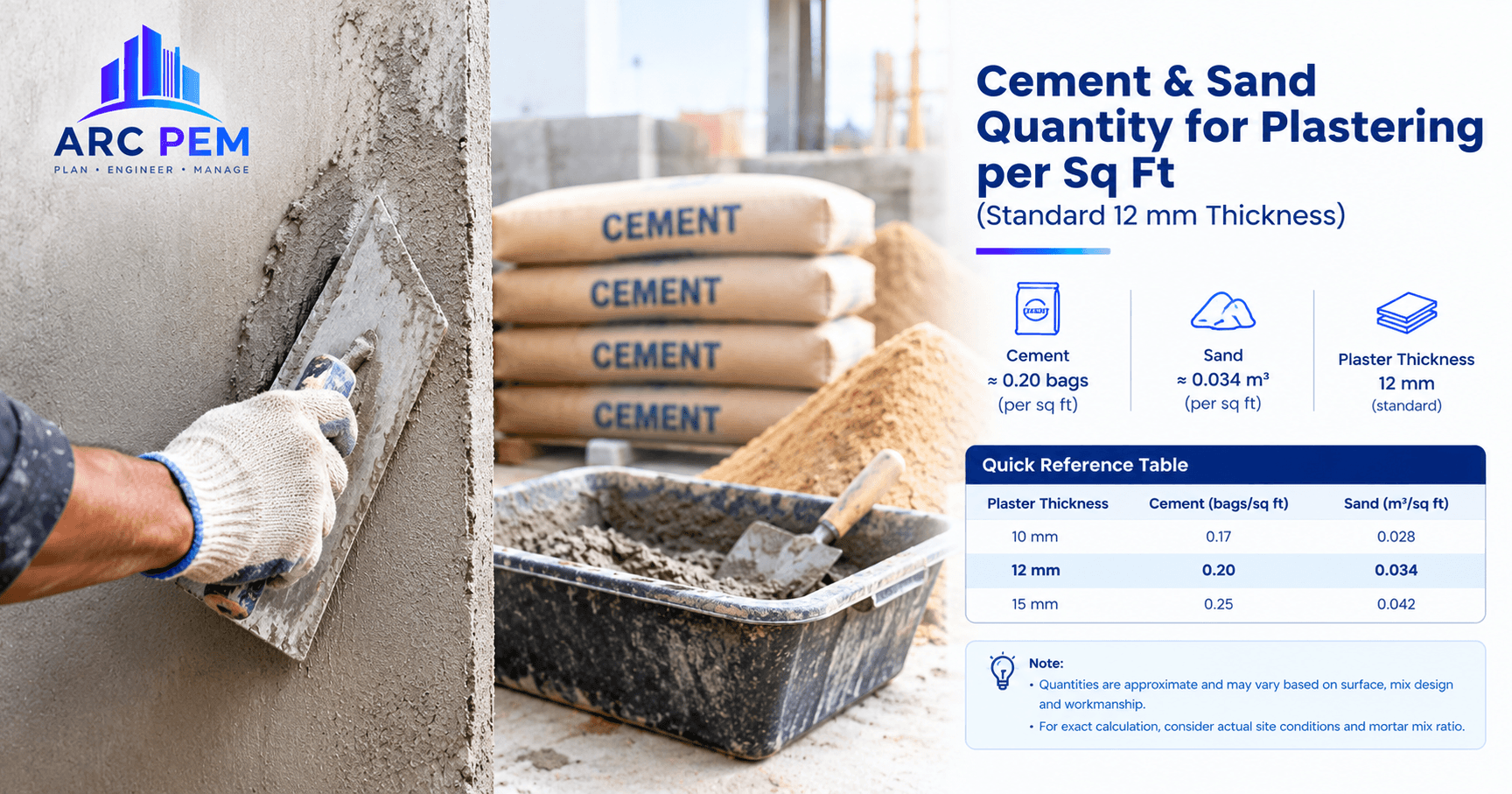
Painting is measured by area in the BOQ, so put the net area into your BOQ, and price it with rates you have verified, as in the construction estimate template. Painting follows plastering, so the same wall areas feed both. See plaster quantity for cement and sand.
When you buy, state the product, shade and pack size in a purchase order, and compare the paint delivered and used with your calculation using construction material reconciliation.
ARC PEM tracks material purchases and vendor bills against your BOQ, project by project, so estimated versus actual material cost is always one report away. Try the free Construction Cost Calculator for a project-level budget, or view pricing.