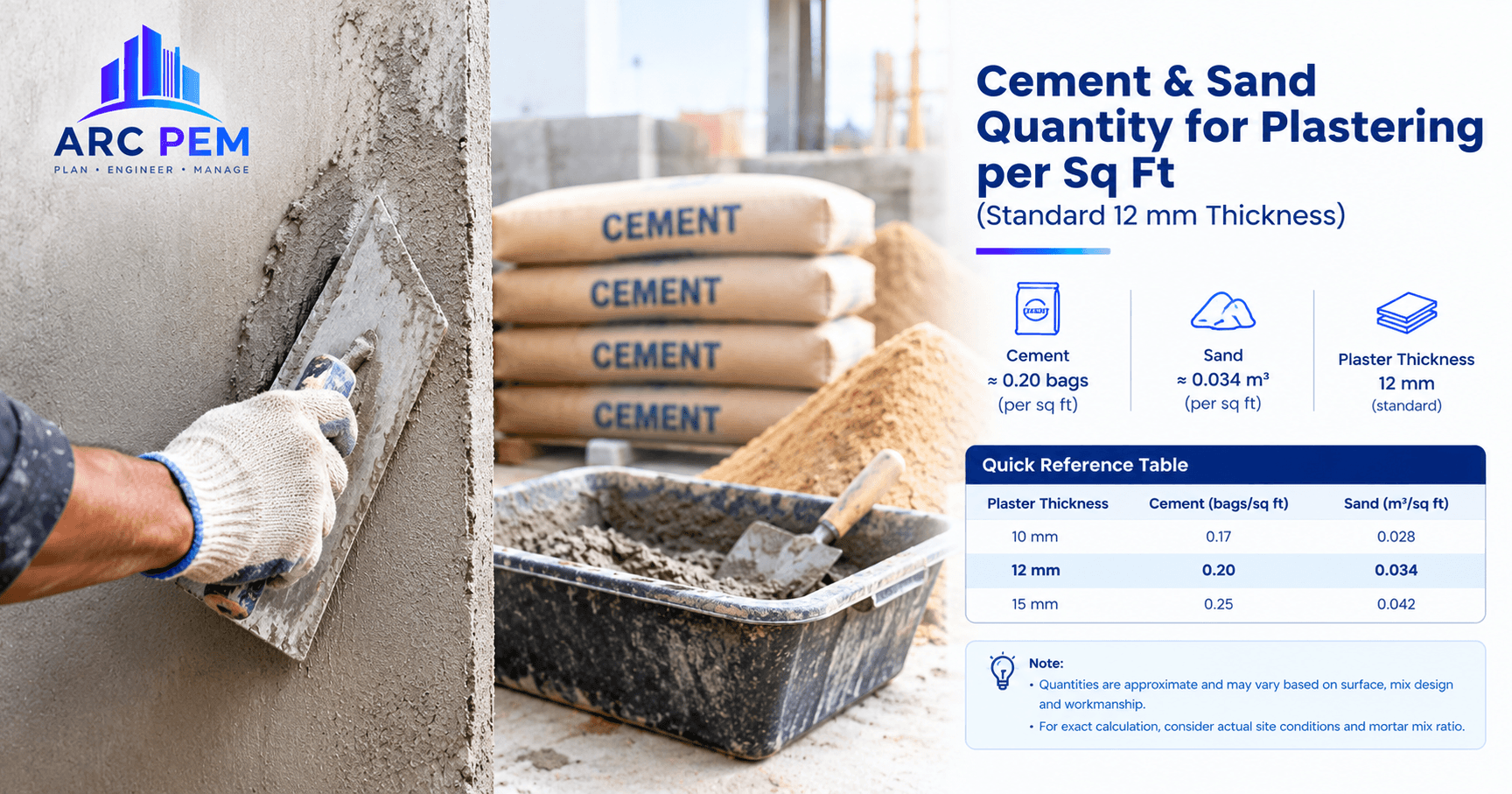
Quick answer: for 12 mm plaster, 100 sq ft of wall needs about 0.82 bag of cement and 4.0 cft of sand in a 1:4 mix, or about 0.58 bag of cement and 4.3 cft of sand in a 1:6 mix, before wastage. This post shows the full table for other thicknesses and ratios, the formula behind it, and a worked example for a room.
Plaster quantity is one of the most searched estimates on any building site, and the answers online vary because of different thicknesses, mix ratios and assumptions. Here, every number comes from one method, so you can check it and change the inputs for your own specification.
Plaster Quantity per 100 Sq Ft: Quick Reference Table
The quantities are for 100 sq ft of plastered surface, using one 50 kg bag of cement as the unit, and exclude wastage.
| Plaster thickness | Mix (cement : sand) | Cement (kg) | Cement (50 kg bags) | Sand (cft) |
|---|---|---|---|---|
| 6 mm | 1:3 | 25.5 | 0.51 | 1.9 |
| 6 mm | 1:4 | 20.4 | 0.41 | 2.0 |
| 10 mm | 1:4 | 34.0 | 0.68 | 3.3 |
| 12 mm | 1:4 | 40.8 | 0.82 | 4.0 |
| 12 mm | 1:5 | 34.0 | 0.68 | 4.2 |
| 12 mm | 1:6 | 29.1 | 0.58 | 4.3 |
| 15 mm | 1:4 | 51.0 | 1.02 | 5.0 |
| 15 mm | 1:6 | 36.4 | 0.73 | 5.4 |
| 20 mm | 1:4 | 68.0 | 1.36 | 6.7 |
| 20 mm | 1:5 | 56.6 | 1.13 | 6.9 |
Based on a dry-volume factor of 1.27, cement at 1,440 kg/m³ and 1 m³ of sand = 35.3 cft. These are planning figures. Follow your own specification for thickness and mix.
How to Calculate Plaster Quantity: The Formula
Plaster is a layer of mortar. The method is to find the volume of wet mortar, convert it to dry materials, and split it by the mix ratio.
- Wet volume of mortar = plastered area × thickness
- Dry volume = wet volume × 1.27. Mortar shrinks when water is added to dry cement and sand, so the dry materials take more space than the wet mortar.
- Cement volume = dry volume × [cement part ÷ (cement part + sand part)]
- Sand volume = dry volume × [sand part ÷ (cement part + sand part)]
- Cement weight = cement volume × 1,440 kg/m³, then divide by 50 for bags.
Example: 100 sq ft of 12 mm plaster in a 1:4 mix
- Area = 100 sq ft × 0.0929 = 9.29 m²
- Wet mortar = 9.29 × 0.012 = 0.1115 m³
- Dry mortar = 0.1115 × 1.27 = 0.1416 m³
- Cement = 0.1416 × 1 ÷ 5 = 0.02832 m³ × 1,440 = 40.8 kg, which is 0.82 bag
- Sand = 0.1416 × 4 ÷ 5 = 0.1133 m³ × 35.3 = 4.0 cft
Per square metre, the same plaster needs about 4.4 kg of cement and 0.012 m³ of sand.
What Thickness and Mix Ratio Should You Use?
The right thickness and mix come from your specification, and the figures below are common practice, not a rule.
- Ceilings: thin plaster, commonly around 6 mm, in a richer mix such as 1:3 or 1:4.
- Internal walls: commonly about 12 mm, in a leaner mix such as 1:5 or 1:6.
- External walls: thicker, commonly about 20 mm, often in two coats and in a richer mix such as 1:4, because they face weather.
Ratio and thickness vary with the wall surface, the climate and the specification. If your drawings or contract say otherwise, use those. Indian practice follows codes such as IS 1661 for cement plaster finishes, so check what your specification refers to.
Worked Example: Plastering a Room
All dimensions are hypothetical and for teaching only.
A room is 12 ft × 10 ft with a 10 ft ceiling height. It has one door of 3 ft × 7 ft and one window of 4 ft × 4 ft. Walls are plastered 12 mm thick in 1:6, and the ceiling is plastered 6 mm thick in 1:4.
Areas
- Gross wall area = 2 × (12 + 10) × 10 = 440 sq ft
- Openings = 21 + 16 = 37 sq ft
- Net wall area = 440 − 37 = 403 sq ft
- Ceiling area = 12 × 10 = 120 sq ft
Quantities (using the method above)
| Surface | Area | Plaster | Cement | Sand |
|---|---|---|---|---|
| Walls | 403 sq ft | 12 mm, 1:6 | 117.4 kg (2.35 bags) | 17.3 cft |
| Ceiling | 120 sq ft | 6 mm, 1:4 | 24.5 kg (0.49 bag) | 2.4 cft |
| Total | 141.8 kg (2.84 bags) | 19.7 cft (0.56 m³) |
Add an allowance. Walls are rarely perfectly flat, so extra mortar goes into hollows. A planning allowance of 10% to 15% for unevenness and wastage is common, and you can set your own after measuring your walls. With 15%:
- Cement = 2.84 × 1.15 = about 3.3 bags, so buy 4
- Sand = 19.7 × 1.15 = about 22.6 cft (0.64 m³)
Why Different Websites Give Different Quantities
- Different thickness. 12 mm and 15 mm are both called "standard", but the quantities differ by about 25%.
- Different mix ratio. Cement for the same area falls by about 30% between 1:4 and 1:6.
- Dry-volume factor. We use 1.27. Some sources use 1.33, which gives about 5% more of every material.
- Wastage and unevenness. Some figures already include 10% to 20%, so they look higher.
- Cement density. We use 1,440 kg/m³, so a 50 kg bag is about 0.0347 m³.
- Area measured. Some figures count the wall including openings, others net of them.
Always check what a source assumed before you compare it with yours.
Common Mistakes When Estimating Plaster
- Not deducting openings. Doors and windows reduce the plastered area, subject to the measurement rules in your contract.
- Ignoring the ceiling. It uses a different thickness and often a different mix.
- Using one mix for the whole building. Internal, external and ceiling plaster often differ.
- Forgetting unevenness. A rough brick wall takes more mortar than the nominal thickness suggests.
- Mixing cft and m³. 1 m³ is about 35.3 cft.
- Counting only the cement. Sand, water, labour and scaffolding are part of the cost too.
From Quantity to BOQ and Site Control
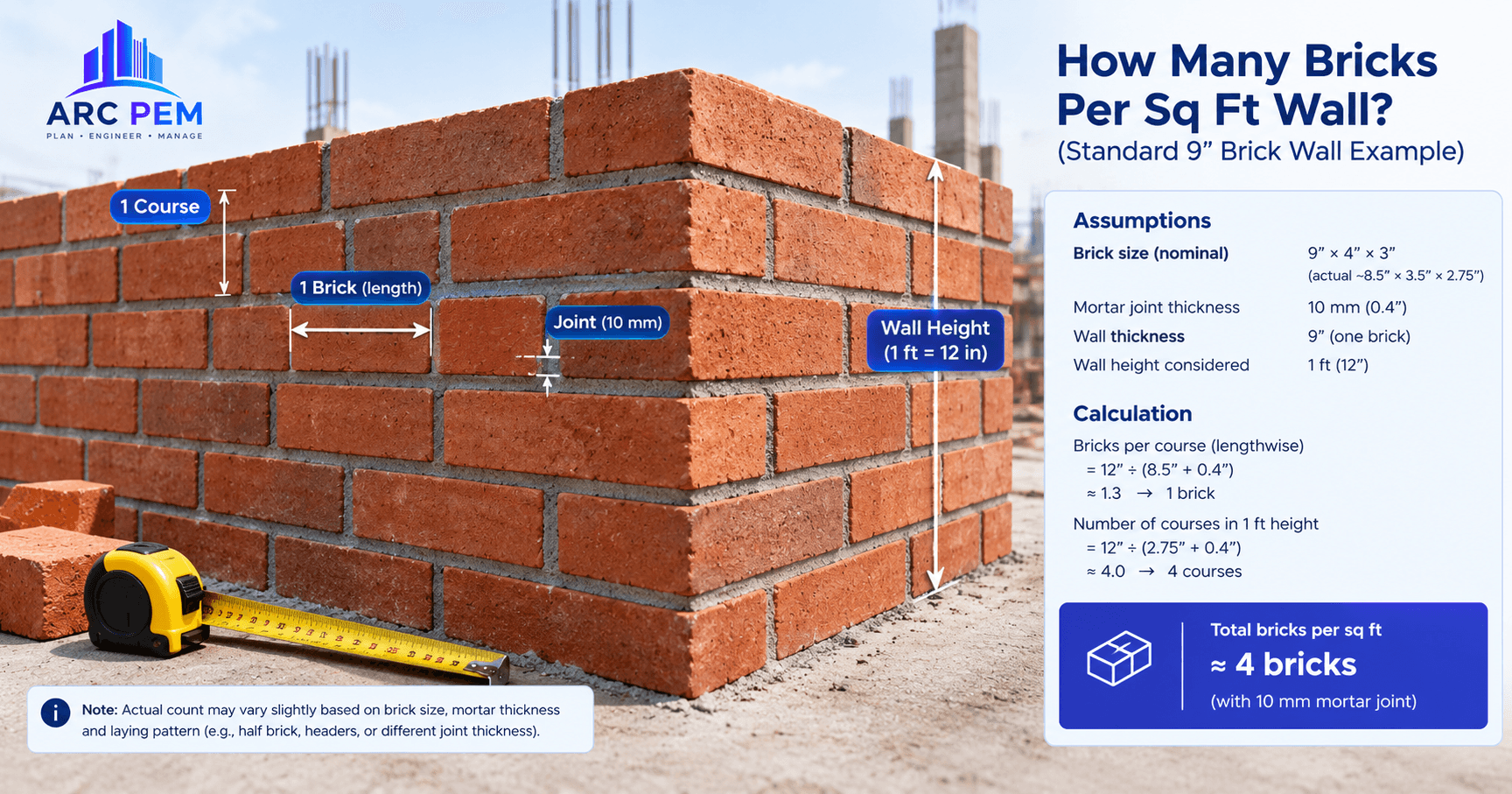
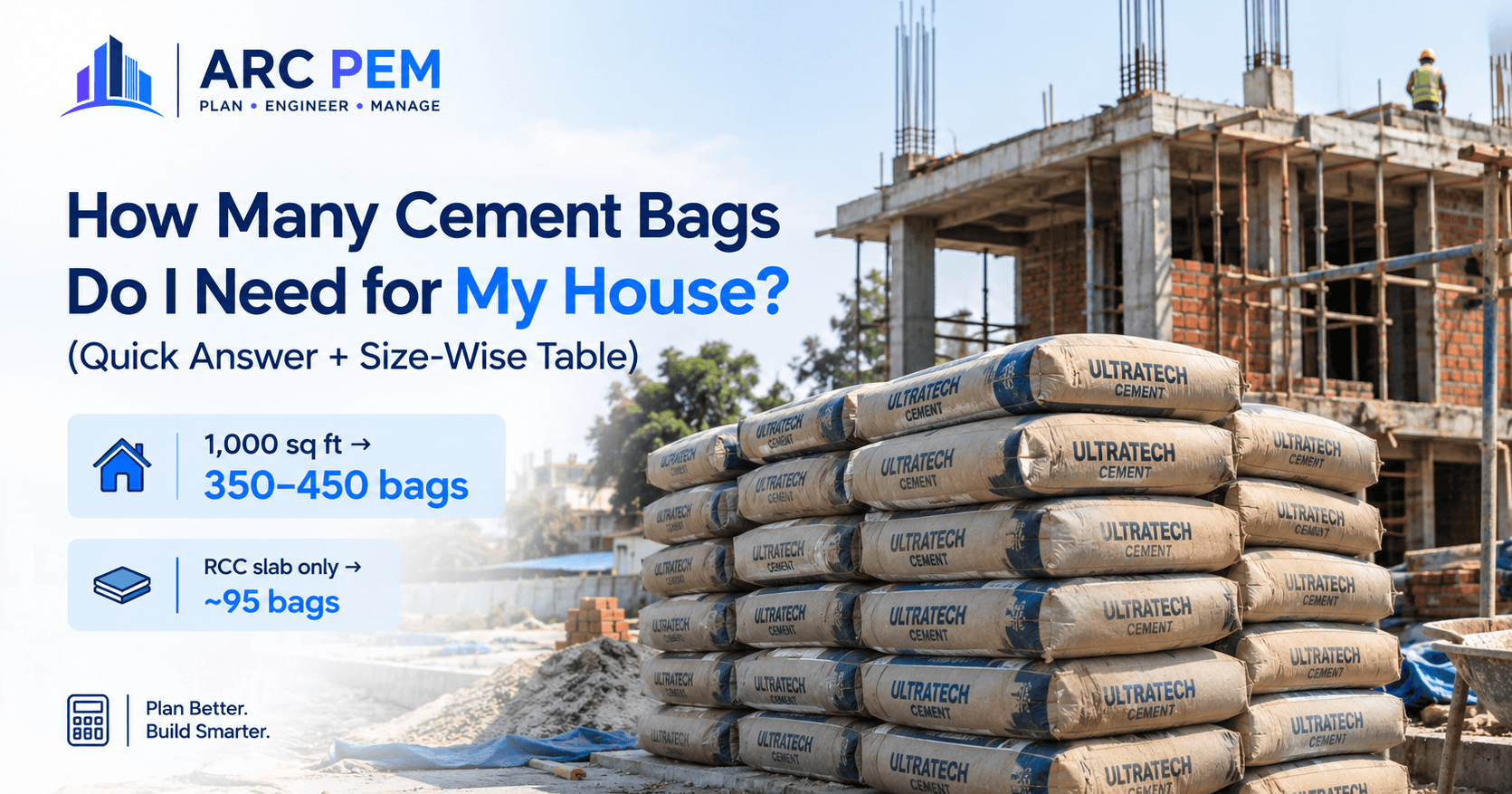
Plaster is measured by area in the BOQ, and cement and sand are the materials behind it. Put the quantity into your BOQ, and price it with a rate you have verified, as in the construction estimate template. The same method gives mortar for the walls themselves, as shown in how many bricks per sq ft, and cement for concrete in how many cement bags a house needs.
During the work, compare the cement and sand issued with your calculated quantity, using the method in construction material reconciliation. A large gap is worth investigating before it repeats on every floor.
ARC PEM tracks material purchases and vendor bills against your BOQ, project by project, so estimated versus actual material cost is always one report away. You can also try the free Construction Cost Calculator, or view pricing.