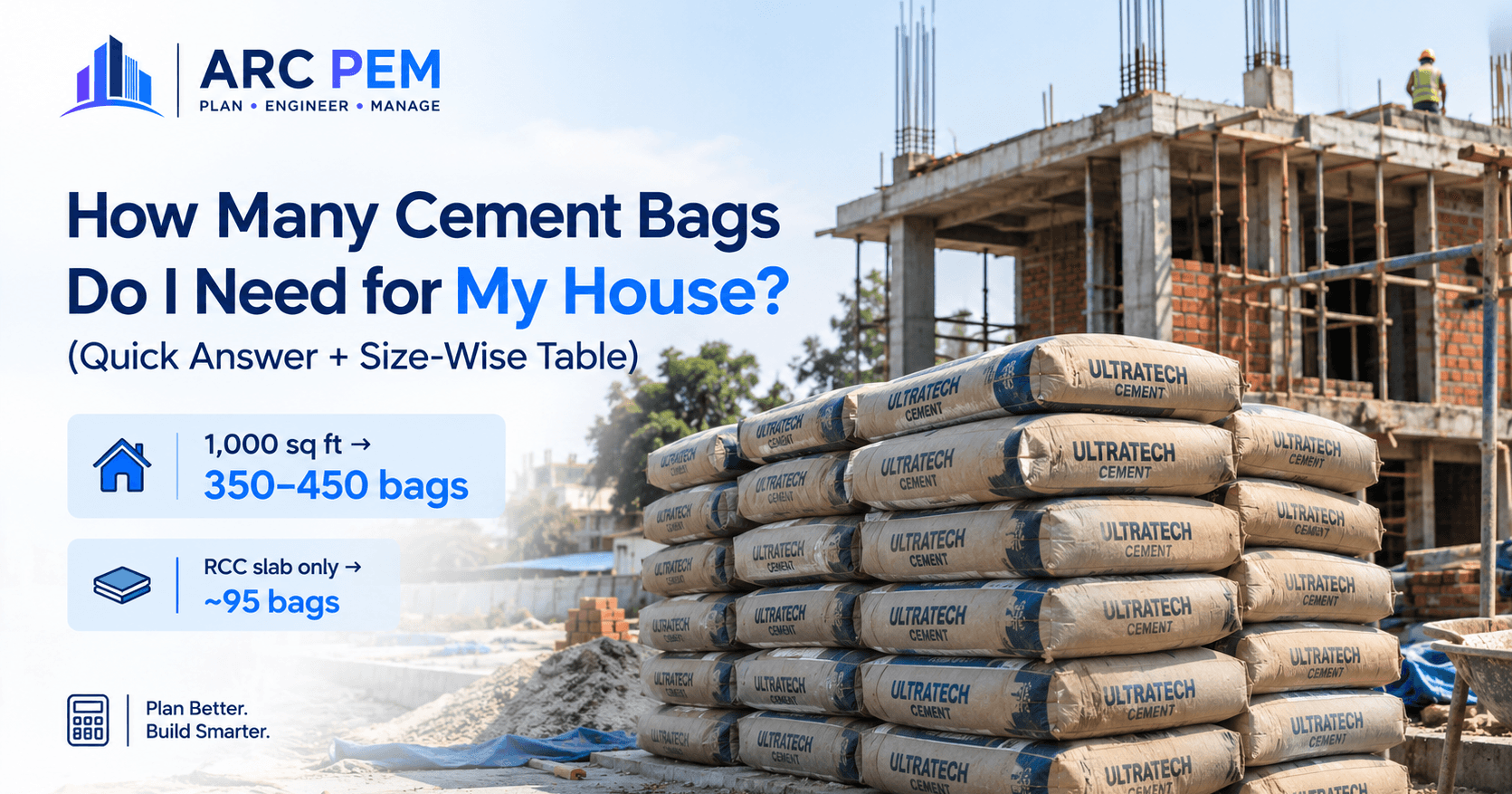
Quick answer: for the RCC slab alone, budget roughly 0.095 bags of cement per sq ft at standard 5-inch thickness (M20) — so a 1,000 sq ft slab needs about 95 bags. But if you're asking about the whole house — foundation, columns, slabs, brickwork mortar, and plastering combined — the number is much higher, typically 0.35 to 0.45 bags per sq ft of built-up area, or roughly 350 to 450 bags for a 1,000 sq ft house. The gap between these two numbers is the single most common source of confusion in this search, so this post covers both, with a size-wise table for each.
Why "How Many Bags Do I Need" Doesn't Have One Answer
This question gets asked in two genuinely different ways, and mixing them up is why online answers vary so wildly:
- "How much cement for my roof slab?" — a narrow, calculable question with one clear answer once you know area, thickness, and grade.
- "How much cement for my whole house?" — a much broader question that includes foundation, plinth beam, columns, slabs at every floor, brickwork mortar, and plastering — each with a different cement requirement per sq ft.
Most online answers quote one number without saying which question they're actually answering. Here's both, clearly separated.
Cement for the RCC Slab Only — Size-Wise Table
For a standard M20 slab at 5-inch (125mm) thickness, the residential norm:
| Built-up Area | Cement Bags (Slab Only) |
|---|---|
| 500 sq ft | ~48 bags |
| 1,000 sq ft | ~95 bags |
| 1,500 sq ft | ~143 bags |
| 2,000 sq ft | ~190 bags |
| 2,500 sq ft | ~238 bags |
(Based on M20 nominal mix, 1:1.5:3, at 5-inch slab thickness — the standard for residential RCC work per IS 456. Thicker slabs, or M25 grade, will need proportionally more.)
Cement for the Whole House — Size-Wise Table
This is the number most people actually want when they ask this question — it bundles foundation, columns, all floor slabs, brick mortar, and plastering:
| Built-up Area | Total Cement Bags (Whole House) |
|---|---|
| 500 sq ft | ~175–225 bags |
| 1,000 sq ft | ~350–450 bags |
| 1,500 sq ft | ~525–675 bags |
| 2,000 sq ft | ~700–900 bags |
| 2,500 sq ft | ~875–1,125 bags |
(This range reflects typical residential construction practice across cement-intensive elements: RCC structure, brickwork mortar, and plastering. Actual consumption varies with number of floors, wall thickness, plaster coats, and site wastage — treat this as a planning-stage estimate, not a final material order.)
Why the Range Is So Wide for the Whole-House Number
A few things genuinely move this number by 20-30% between two houses of the same size:
- Number of floors. A G+1 or G+2 house needs more columns and additional slabs per sq ft of ground footprint than a single-storey house, which increases cement consumption relative to plot area (though it doesn't scale linearly with floor count).
- Wall thickness and plaster coats. A 9-inch wall needs more mortar than a 4.5-inch partition wall, and double-coat plastering (common on external walls) uses meaningfully more cement than a single coat.
- Concrete grade. M25, often used for footings or taller structures, needs more cement per unit volume than M20 — see the mix ratios in our Concrete Calculator for the exact proportions by grade.
- Site wastage. Even well-run sites lose 3-5% of cement to handling and minor overordering — factor this into whatever number you land on before finalising a purchase order.
Getting a Number Specific to Your House
The tables above use standard assumptions — a real house rarely matches every assumption exactly. For an exact figure based on your actual dimensions, grade, and element type (slab, beam, column, or footing), our free Concrete Calculator works out cement, sand, aggregate, and water for your specific measurements in seconds — it's the same calculation method used for the slab-only table above, applied to your exact numbers instead of a size bracket.
If you're pricing multiple elements across a full house — footing, columns, beams, and every floor slab — run each through the calculator separately and add the cement bag counts together; that will land closer to your actual requirement than any single per-sq-ft rule of thumb, including the ones in this article.
A Quick Sanity Check Before You Order
Whatever number you land on, a good practice is to order in two batches rather than the full estimate upfront — enough for the foundation and ground-floor structure first, then reconcile actual consumption against your estimate before ordering the balance. If your site is consuming noticeably more cement than these figures suggest for the same built-up area, that's worth investigating early — it usually points to either a wastage issue or a plaster/mortar mix that's richer than standard practice.