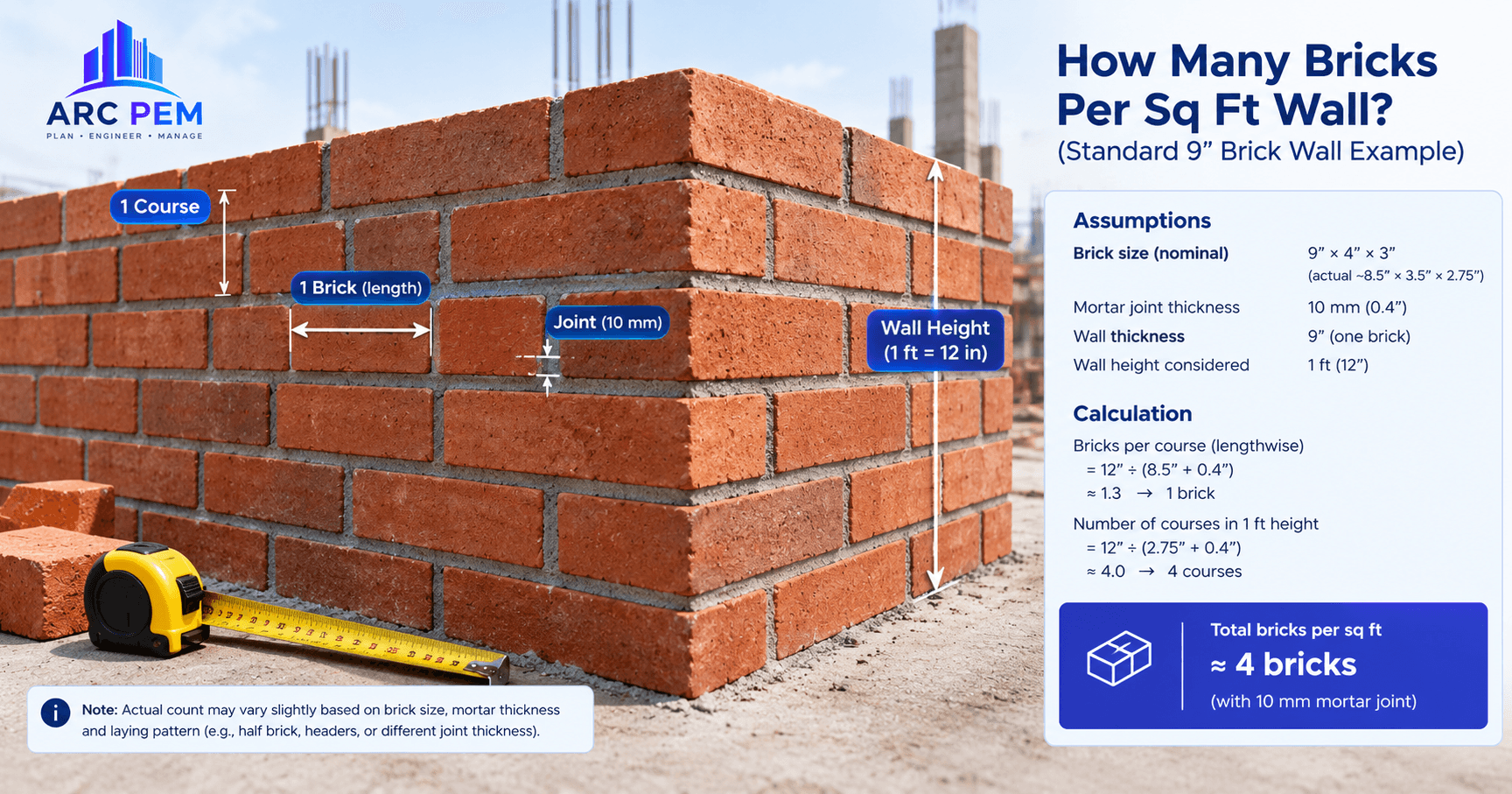
Quick answer: a 9-inch (two-brick) wall needs about 9 bricks per sq ft of wall face, and a 4.5-inch (one-brick) wall needs about 4.5 bricks per sq ft, before wastage. Per 100 sq ft, that is roughly 905 to 930 bricks for a 9-inch wall and 450 to 465 bricks for a 4.5-inch wall, depending on the brick size.
You will see other numbers online, such as 10 or even 12 bricks per sq ft for a 9-inch wall. The difference comes from brick size, joint thickness and the calculation method, and we explain it below so you can trust the figure you use.
Bricks per Sq Ft: Quick Reference Table
The table counts bricks laid in a wall face, with 10 mm mortar joints. The last column adds a 5% allowance for breakage and cutting.
| Brick | Wall | Bricks per sq ft | Bricks per m² | Per 100 sq ft | Per 100 sq ft + 5% |
|---|---|---|---|---|---|
| Modular, 190 × 90 × 90 mm | One brick wide (100 mm nominal) | 4.65 | 50 | 465 | 488 |
| Modular, 190 × 90 × 90 mm | Two bricks wide (200 mm nominal) | 9.29 | 100 | 929 | 975 |
| Traditional, 9 × 4.5 × 3 in (about 229 × 114 × 76 mm) | 4.5-inch wall | 4.52 | 48.7 | 452 | 475 |
| Traditional, 9 × 4.5 × 3 in | 9-inch wall | 9.04 | 97.3 | 904 | 949 |
Modular bricks follow the IS 1077 size of 190 × 90 × 90 mm, which becomes a 200 × 100 × 100 mm module with a 10 mm joint. Traditional bricks are the older 9 × 4.5 × 3 inch size, still common in many regions. Use the size of the brick you will actually buy.
How to Calculate Bricks for a Wall
The method is to count how many bricks cover one square metre of wall face, then multiply by the area.
Bricks per m² (one brick deep) = 1 ÷ [(L + j) × (H + j)]
where L is the brick length, H is the brick height and j is the mortar joint thickness, all in metres. For a two-brick-thick wall, multiply by 2, because there are two layers of bricks across the thickness.
- Modular brick: 1 ÷ (0.200 × 0.100) = 50 bricks per m², so 100 for a two-brick wall.
- Traditional brick: 1 ÷ (0.239 × 0.086) = 48.7 bricks per m², so 97.3 for a two-brick wall.
- To convert to sq ft: multiply by 0.0929. For example, 50 × 0.0929 = 4.65 bricks per sq ft.
For fly ash bricks, concrete blocks or any other unit, use the same formula with your actual unit size and joint thickness.
Bricks per cubic metre of brickwork
If your BOQ measures brickwork in m³, count the bricks in the nominal volume of one brick. Modular bricks give 1 ÷ (0.2 × 0.1 × 0.1) = 500 bricks per m³. Traditional bricks, at about 0.239 × 0.124 × 0.086 m with joints, give roughly 392 bricks per m³. The difference is why "500 bricks per m³" is wrong for traditional bricks.
Why Different Websites Give Different Numbers
If you search this question, you will find answers from 5 to 13 bricks per sq ft for the same wall. These are the usual reasons.
- Different brick sizes. A modular brick and a traditional brick are not the same size, and some sites don't say which they use.
- Different joint thickness. Using 12 mm instead of 10 mm lowers the count by about 3%.
- Volume method overstating the count. Some sources multiply the wall thickness by bricks per m³. For a true 9-inch (229 mm) wall and a modular brick at 500 per m³, that gives about 10.6 bricks per sq ft. But a modular two-brick wall is actually about 190 to 200 mm thick, so the real figure is about 9.3. The volume method is right only when the wall thickness is a multiple of the brick unit.
- Wastage already included. Some figures quietly add 5% to 10%, so they look higher.
- Different wall definitions. "9-inch wall" can mean one brick length across, or two brick widths, depending on the bond.
The face-area method used in this post avoids those traps, because it counts the bricks that actually appear in the wall face.
Worked Example: A 20 ft × 10 ft Wall With Openings
All dimensions are hypothetical and for teaching only.
A 9-inch wall is 20 ft long and 10 ft high, with one door of 3 ft × 7 ft and one window of 4 ft × 4 ft.
- Gross area = 20 × 10 = 200 sq ft
- Door = 3 × 7 = 21 sq ft; window = 4 × 4 = 16 sq ft
- Net wall area = 200 − 21 − 16 = 163 sq ft
Traditional brick, 9-inch wall (9.04 per sq ft):
- 163 × 9.04 = 1,474 bricks
- Add 5% for breakage and cutting: 1,474 × 1.05 = about 1,547 bricks
Modular brick, two bricks wide (9.29 per sq ft):
- 163 × 9.29 = 1,514 bricks
- Add 5%: about 1,590 bricks
The 5% is a common planning allowance, not a rule. Use your own site's breakage record, and compare it with the actual issues from the store.
How Much Mortar Does the Wall Need?
Mortar fills the joints, so it is a share of the brickwork volume. With 10 mm joints, wet mortar is roughly 22% to 23% of the brickwork volume. For planning, we use 22.5%.
For the 163 sq ft wall above, with a 230 mm (0.23 m) thickness:
- Brickwork volume = 163 sq ft × 0.0929 × 0.23 m = 3.48 m³
- Wet mortar = 3.48 × 0.225 = 0.78 m³
- Dry mortar = 0.78 × 1.27 = 0.995 m³, using a commonly used dry-volume factor for mortar. Confirm the factor with your estimator or specification.
- For a 1:6 cement-sand mortar: cement = 0.995 ÷ 7 = 0.142 m³, and sand = 0.995 × 6 ÷ 7 = 0.853 m³.
- Convert cement to bags. One 50 kg bag is about 0.0347 m³, so 0.142 ÷ 0.0347 = about 4 bags. Sand is about 0.85 m³ (30 cft).
This is a planning estimate. The mix ratio, joint thickness, plastering and wastage on your project change it, so follow your specification. For concrete and cement in other members, see how many cement bags a house needs and use the free Concrete Calculator.
Common Mistakes When Estimating Bricks
- Not deducting openings. Doors, windows and ventilators reduce the brick count.
- Using one number for every brick type. A modular and a traditional brick give different counts.
- Mixing m² and sq ft. Multiply by 0.0929 to convert correctly.
- Using the plastered wall thickness. Estimate bricks from the brick wall thickness, not the finished thickness with plaster.
- Forgetting breakage and cutting. Plan for an allowance, and track it against actual issues.
- Counting the volume of the whole wall as brickwork when the wall has large openings or columns inside it.
From Brick Quantity to BOQ and Site Control
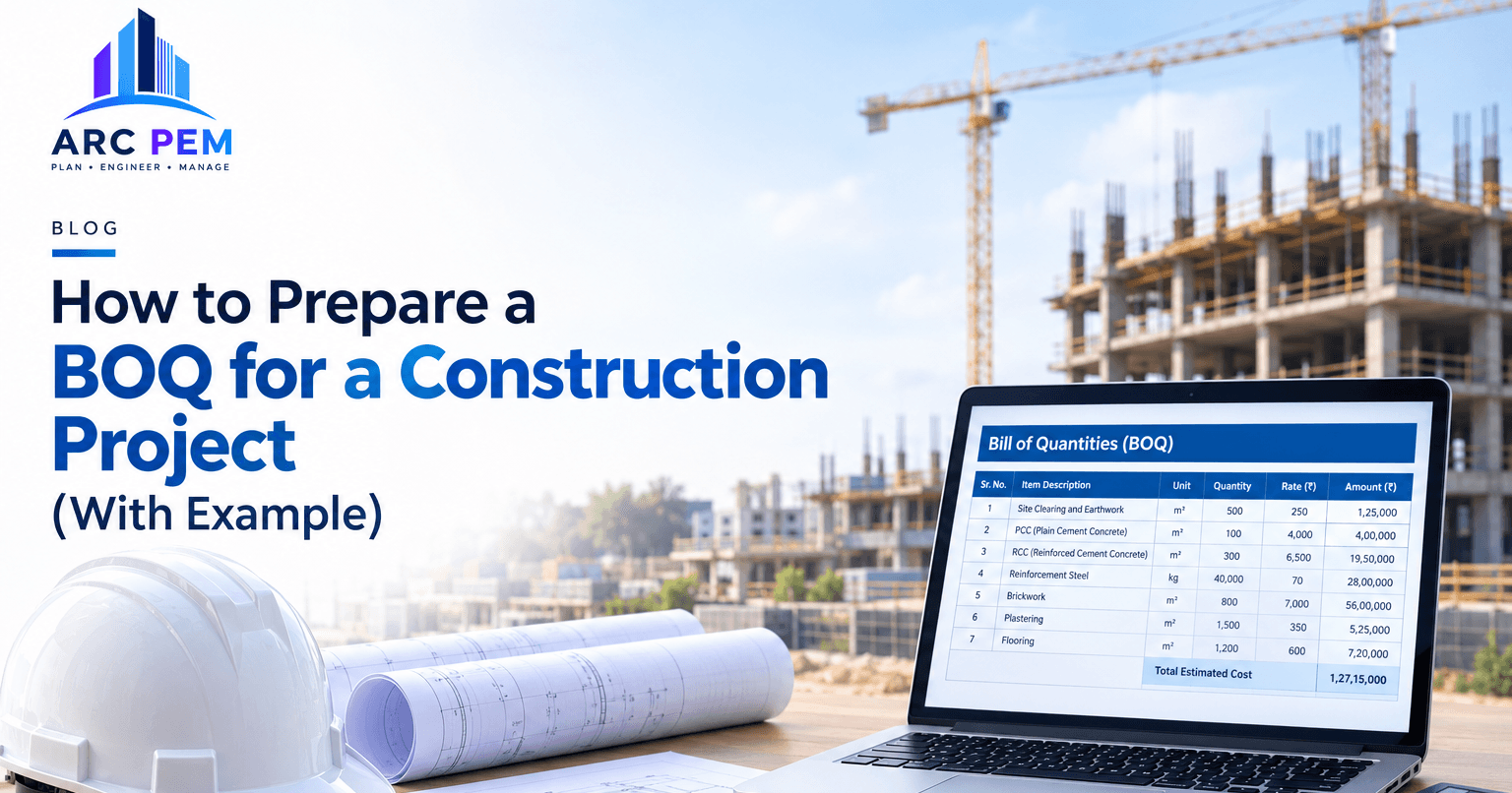
A brick count is only useful if it flows into your estimate and then into site control. Put it into your BOQ as a measured quantity, as shown in how to prepare a BOQ, and price it with a rate you have verified, as in the construction estimate template.
During the work, compare bricks delivered and issued with the quantity you calculated. Our guide to construction material reconciliation shows how, with a cement example that works the same way for bricks.
ARC PEM tracks material purchases and vendor bills against your BOQ, project by project, so estimated versus actual brick cost is always one report away. You can also try the free Construction Cost Calculator for a project-level budget, or view pricing.