
Short answer: Architects in India typically charge about 4% to 10% of the project cost, depending on project type, size and scope. Smaller residential and interior-heavy jobs sit at the higher end, large projects at the lower end. Fees may instead be quoted as a lump sum, a rate per sq ft, an hourly rate or a mix of these.
That's the number clients search for. But if you run an architecture practice, the more useful question is different: after staff time, consultants, site visits and revisions, how much of that fee do you actually keep?
This guide covers both sides: how architect fees are structured, how to quote one, and how to check your real margin.
Note: The percentages here are market ranges, not an official rate card. The Council of Architecture (CoA) publishes a minimum scale of charges. Check the current official scale for your project type before you quote, and treat any figure on a blog, including this one, as a guide.
The 5 common architect fee models
| Model | How it works | Best for | Main risk |
|---|---|---|---|
| Percentage of project cost | Fee = a % of the construction cost, paid in stages | Full-service projects with defined scope | Cost base changes; fee disputes if the "actual cost" isn't defined |
| Lump sum (fixed fee) | One agreed amount for a defined scope | Clear, limited scope (e.g., design only) | Scope creep eats your margin |
| Per sq ft rate | Rate × built-up area | Residential and standard layouts | Area changes mid-design |
| Hourly / man-day | Time-based billing | Consultancy, advisory, small tasks | Hard to sell for large projects |
| Hybrid (stage-wise) | Different method per stage, such as lump sum for concept and % for execution | Most real-world projects | Needs a clear proposal |
Which one should you quote? Use the model that matches how predictable the scope is. If the client keeps changing the brief, a fixed fee is dangerous unless revisions are capped in writing.
What a typical percentage looks like
Published ranges in India vary widely. You'll see 4–6% in some places, 4–10% or more in others, and up to 15% for small, detail-heavy work. The reasons are practical:
- Smaller projects cost the same design effort per drawing but have a smaller cost base, so the percentage is higher.
- Interior and high-finish work needs more detailing and site supervision per rupee spent.
- Complex commercial, hospital or institutional work carries more coordination, and may follow the CoA scale for that building type.
- Design-only engagements cost less than design + construction administration.
What the fee should include (and what to price separately)
A fee proposal should say clearly what's inside the fee and what's extra:
Usually inside the fee
- Concept and design development
- Working drawings (architectural)
- Reasonable client revisions at defined stages
- Coordination with structural and MEP consultants
- A set number of site visits
Often priced separately
- Additional revisions after sign-off
- Structural, MEP, landscape or interior consultants (if not passed through)
- Extra site visits beyond the agreed number
- Printing, plotting, models and renders
- Travel and out-of-town expenses
- Statutory approvals and liaison work
Spell this out in your proposal. Most fee disputes start with an unwritten assumption.
Stage-wise payment: a sample schedule
Fees are usually billed against project stages so that cash flow follows work done. This is an illustrative split. Adjust it to your project.
| Stage | Sample % of fee |
|---|---|
| Appointment / advance | 10% |
| Concept design approval | 20% |
| Design development / preliminary drawings | 20% |
| Working drawings / tender documents | 30% |
| Construction administration (spread over the build) | 15% |
| Completion and handover | 5% |
For milestone logic on the client side, see our guide to the construction payment schedule.
Tax on architect fees: the basics
- GST: Architectural services are a taxable professional service. If your aggregate turnover crosses the registration limit, you charge GST on your fee, and your client may claim it as input credit if eligible.
- TDS: Clients that are companies or other deductors commonly deduct tax on professional fees before paying you. Track the TDS certificates and match them to your returns.
- Reimbursables: Show out-of-pocket costs separately on the invoice so tax treatment stays clear.
Confirm the current rate, section numbers and thresholds with your CA, since the Income-tax Act renumbering changed section references.
The question most blogs skip: what do you actually keep?
Here is an illustrative example. Say you win a ₹2 crore residential project at a 6% fee = ₹12,00,000.
| Item | Amount (₹) |
|---|---|
| Staff time (design, drafting, coordination) | 5,50,000 |
| Structural consultant (not passed through) | 1,20,000 |
| Site visits and travel | 60,000 |
| Printing, plotting, renders | 40,000 |
| Software, rent and office overhead share | 1,50,000 |
| Total cost to you | 9,20,000 |
| Margin | 2,80,000 (about 23%) |
Now add the usual real-life events: three extra design revisions and six more site visits than planned. If that adds ₹1,00,000 of staff and travel cost and you didn't bill for it:
- Margin falls to ₹1,80,000, about 15%.
- The fee percentage didn't change. Your profit did.
This is why tracking expenses and time per project matters as much as quoting well. The same discipline applies to builders. See construction job costing for the method.
How to protect your margin
- Define scope in writing. List deliverables and the number of revisions per stage.
- Cap revisions. Charge for extra rounds as a separate line.
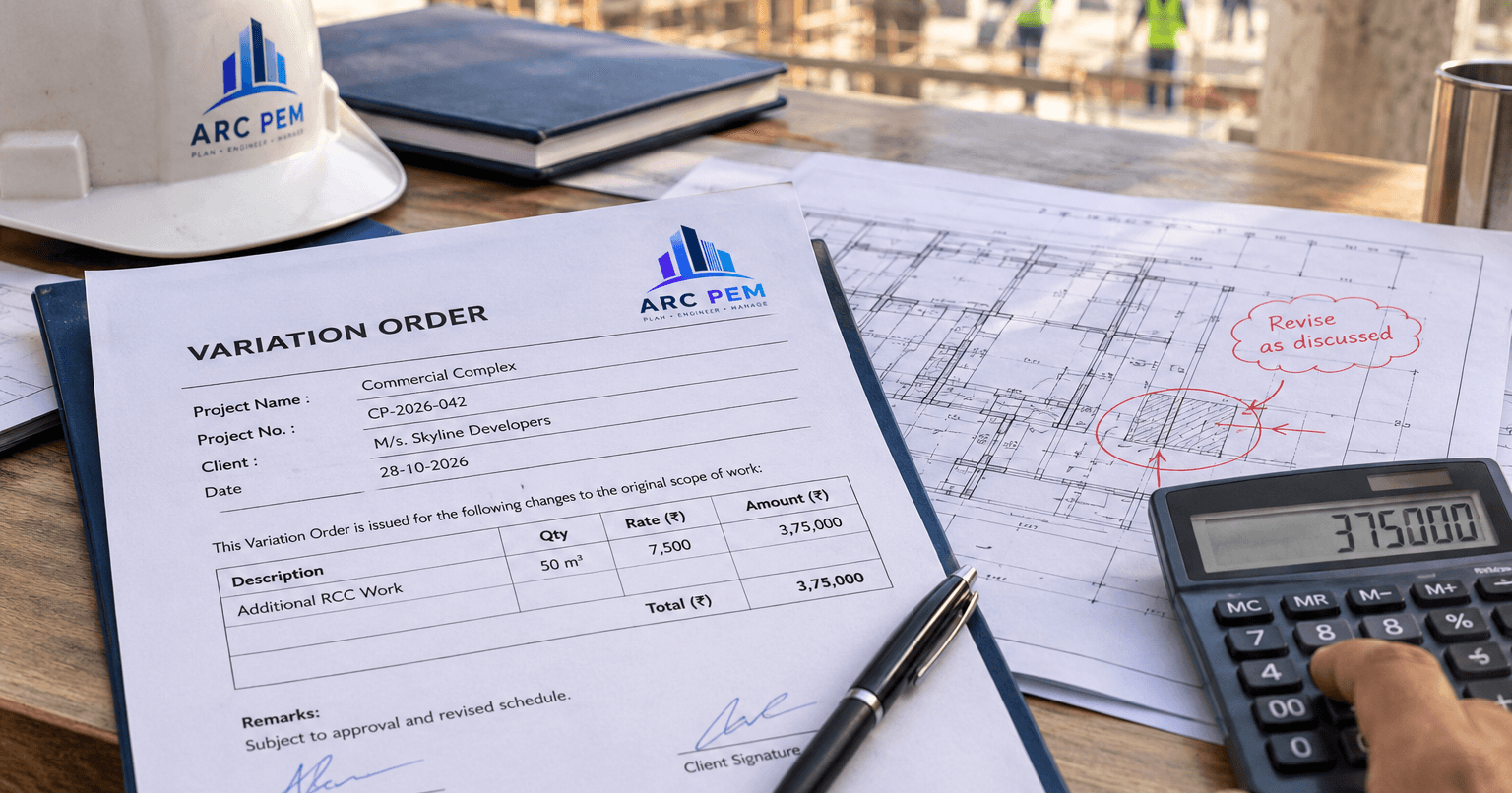
- Use variation orders for scope changes. The logic is the same as for contractors. See variation orders in construction.
- Bill reimbursables. Travel, plotting and consultant charges should be itemised, not absorbed.
- Invoice on time. Delayed stage invoices are the most common cash-flow gap in small practices.
- Track expenses per project. Log every project cost against the project it belongs to, weekly, not at month end. ARC PEM is built for exactly this. See how ARC PEM tracks a project's money end to end.
Estimate the project cost before you quote a percentage
A percentage fee depends on the cost base. Use our free Construction Cost Calculator for a quick estimate, and cross-check against construction cost per sq ft in India. Always define in the proposal whether the fee is on the estimated cost, the tendered cost or the actual final cost.
For clients: how to compare architect quotes
- Compare scope, not just the percentage. A 5% fee with unlimited revisions and site visits can beat a 4% fee with everything charged extra.
- Ask what site visits, consultants and approvals are included.
- Check the payment schedule. It should follow work completed.
- Get the proposal in writing, with the cost base and revision limits.
Key takeaways
- Architect fees commonly fall around 4–10% of project cost, with lump sum, per sq ft, hourly and hybrid models also in use.
- The CoA publishes a minimum scale. Check the current official version before quoting.
- A clear scope, revision cap and reimbursables list protects both sides.
- Bill in stages and keep GST and TDS records clean.
- Your real margin comes from tracking cost per project, not from the headline percentage.
This article is for general information and is not legal or tax advice. Confirm CoA rules and tax treatment with the relevant authority or a qualified CA.