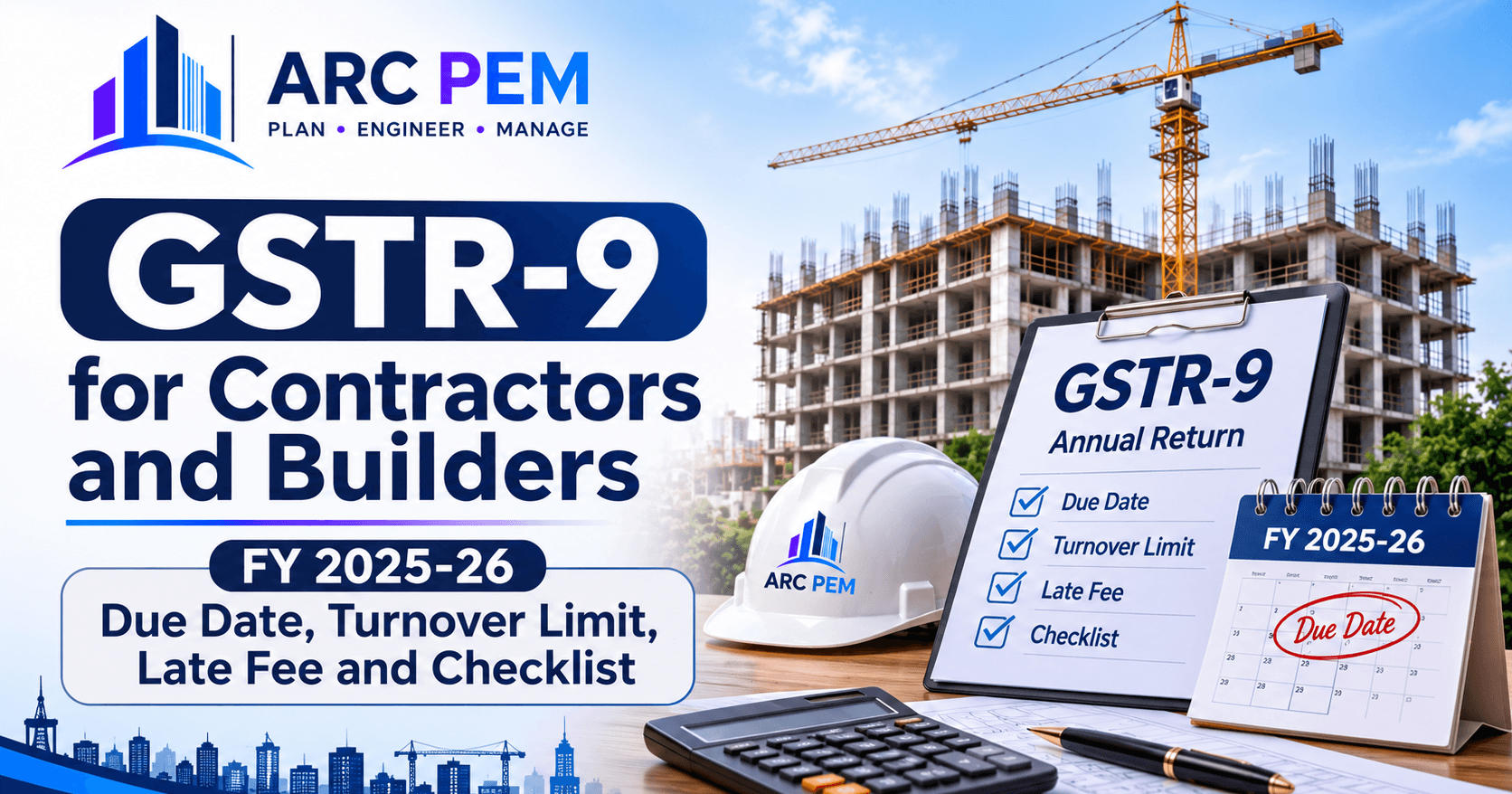
Quick answer: The GSTR-9 due date for FY 2025-26 is 31 December 2026. If your aggregate turnover (all GSTINs under one PAN) is up to ₹2 crore, GSTR-9 is optional. Above ₹5 crore, you must also file the self-certified GSTR-9C reconciliation. But the date most contractors miss is 30 November 2026, the last date to claim any input tax credit you forgot for FY 2025-26.
The GST annual return is where a year of RA bills, material purchases, RCM payments and rate changes has to add up. For contractors and builders, FY 2025-26 is harder than usual, because GST 2.0 rates changed mid-year on 22 September 2025 and the form has new ITC tables. This guide covers the GSTR-9 due date, turnover limit, late fee, the tables that changed, and the construction-specific mistakes to check before you file.
GSTR-9 for FY 2025-26 at a glance
| Item | FY 2025-26 position |
|---|---|
| GSTR-9 due date | 31 December 2026 (no extension notified as of 27 November 2026) |
| Last date to claim missed ITC for FY 2025-26 | 30 November 2026, or the date you file GSTR-9 if that is earlier (Section 16(4)) |
| Who must file GSTR-9 | Regular taxpayers with aggregate turnover above ₹2 crore (optional up to ₹2 crore) |
| Who must file GSTR-9C | Aggregate turnover above ₹5 crore; self-certified, no CA audit needed |
| Who does not file GSTR-9 | Composition taxpayers (they file GSTR-4), casual taxpayers, non-residents, ISDs, TDS/TCS deductors |
| Revision | Not allowed once filed, so check before you submit |
Who needs to file GSTR-9? (turnover limit)
The GSTR-9 turnover limit is tested on aggregate turnover: the total for all GSTINs registered under the same PAN across India, not one state registration.
- Up to ₹2 crore: filing is optional. Many small contractors still file it to keep a clean year-end record.
- Above ₹2 crore: GSTR-9 is mandatory for each GSTIN.
- Above ₹5 crore: GSTR-9 plus GSTR-9C (reconciliation of books with returns, self-certified).
Example: A contractor has a Delhi GSTIN with ₹1.5 crore turnover and a Haryana GSTIN with ₹1 crore. Aggregate turnover is ₹2.5 crore, so both GSTINs must file GSTR-9, even though each is below ₹2 crore on its own.
If you are a small contractor under the composition scheme, GSTR-9 doesn't apply to you. You file GSTR-4 instead. See GST Registration and Composition Scheme for Contractors.
The 30 November deadline that matters more than 31 December
Under Section 16(4) of the CGST Act, ITC on an FY 2025-26 invoice can be claimed only up to 30 November 2026 or the date you file the annual return, whichever is earlier.
So GSTR-9 cannot be used to claim ITC you missed. If a supplier's bill for cement, steel or a subcontractor's invoice never made it into your GSTR-3B, the last chance is your GSTR-3B for October 2026, filed by 30 November 2026. After that, the credit is lost for good.
Do this now: run a final GSTR-2B reconciliation for FY 2025-26 and pick up anything missing.
Also note: filing GSTR-9 before 30 November ends the ITC window for that year early. Unless you're sure nothing is missing, don't file before you've done the final reconciliation.
GSTR-9 late fee
The GSTR-9 late fee is charged under Section 47 of the CGST Act. The tiered rates notified in Notification 07/2023-Central Tax apply from FY 2022-23 onwards:
| Aggregate turnover | Late fee per day (CGST + SGST) | Maximum cap |
|---|---|---|
| Up to ₹5 crore | ₹50 | 0.04% of turnover in the state |
| ₹5 crore – ₹20 crore | ₹100 | 0.04% of turnover in the state |
| Above ₹20 crore | ₹200 | 0.5% of turnover in the state |
Worked example: A builder with ₹8 crore turnover files GSTR-9 on 31 March 2027, 90 days late. Late fee = ₹100 × 90 = ₹9,000 (below the cap of 0.04% × ₹8 crore = ₹32,000).
The late fee runs from 1 January 2027. Any tax shortfall you find while preparing GSTR-9 must be paid through Form DRC-03, with interest at 18%. The late fee is separate from that tax and interest.
What changed in GSTR-9 for FY 2025-26
These are the changes that affect contractors most:
- Table 6A1 and 6A2 (new split of ITC): Credit from earlier years that you claimed in FY 2025-26 goes in 6A1. Current-year credit stays in 6A2. Don't mix them.
- Table 6H: Credit reclaimed under Rules 37/37A (for example, ITC reversed for non-payment to a supplier within 180 days, then re-availed after payment) is reported here.
- Table 7A1 / 7A2: Reversals under Rule 37A (supplier didn't file returns) and Rule 38 are shown separately.
- Table 8H1: Import IGST paid in FY 2025-26 but claimed as ITC in a later year.
- Table 8A: Auto-filled from GSTR-2B. Use it to compare what your suppliers reported with what you claimed.
- Tables 12 and 13 (ITC reversed/claimed in the next year) and Table 6E (import ITC) must now be filled in full. They can no longer be combined or skipped.
- Some tables are still optional, such as Tables 15, 16 and 18 and some sub-splits in Tables 5 and 6. Check the portal instructions before you skip any.
The ICAI has updated its technical guides on GSTR-9 and GSTR-9C for FY 2025-26. Your accountant should go through them.
Construction-specific checks before you file
General GSTR-9 guides miss these. Contractors and builders should check each one:
1. Split HSN lines for the 22 September 2025 rate change
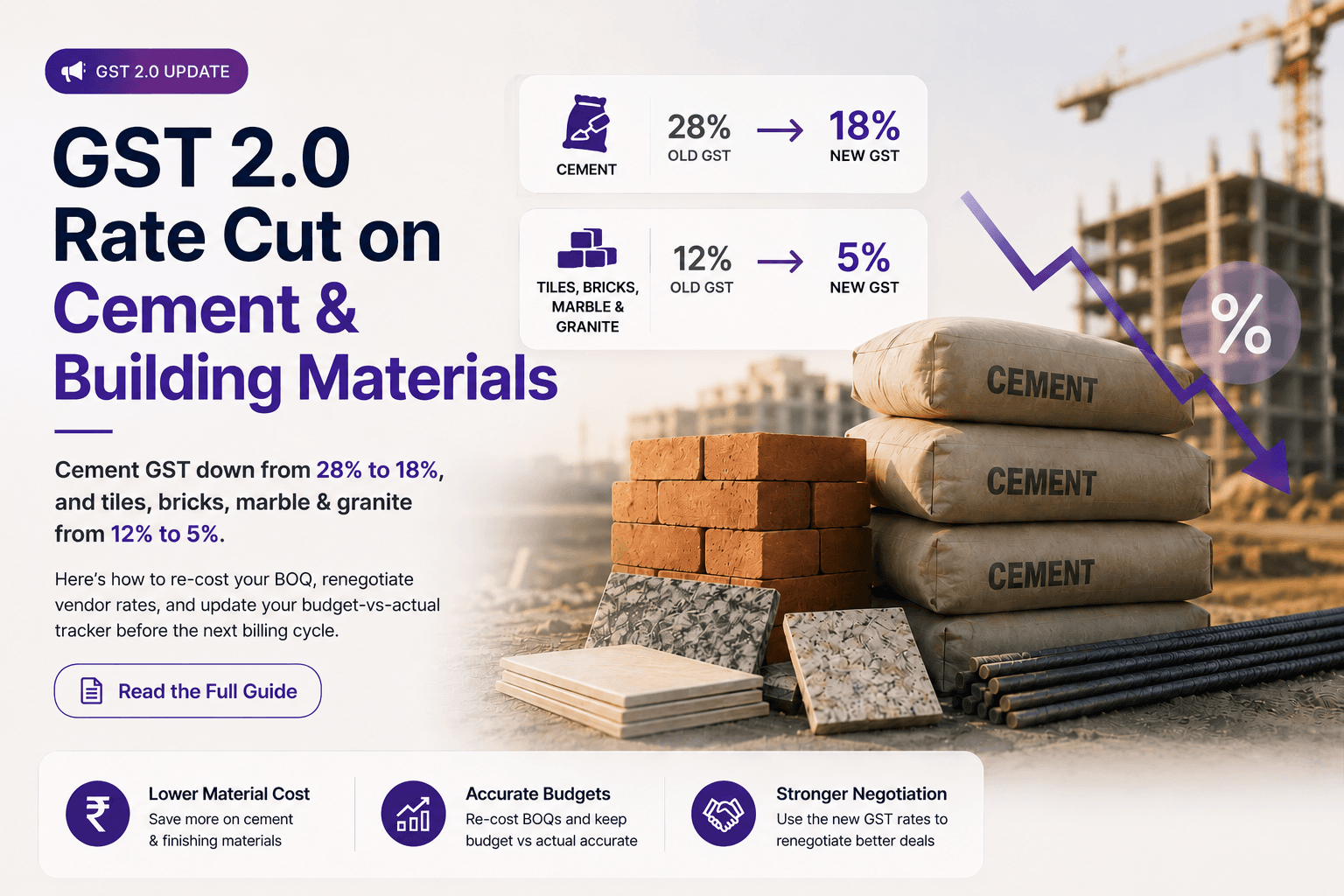
GST 2.0 changed several construction rates from 22 September 2025. Cement went from 28% to 18%, and certain government works contracts went from 12% to 18%. If the same HSN or SAC was billed at two rates during the year, report it on two lines in Table 17 (outward) at each rate. Don't merge them into one figure. See GST 2.0 Rate Cut on Cement & Building Materials.
HSN digits in Table 17: use 6 digits if your aggregate turnover in the previous year was above ₹5 crore, and 4 digits if it was ₹5 crore or less.
2. Blocked credits under Section 17(5)
ITC on construction of immovable property for your own use, such as your own office or a building you will keep, is blocked under Section 17(5)(c)/(d). These bills still appear in GSTR-2B and so in Table 8A. They should not be in Table 6. The difference shows up in Table 8. Don't treat it as "missed ITC".
3. Reverse charge (RCM)
Check that RCM liability paid in cash (for example on unregistered supplies covered by RCM, legal services or GTA freight on material transport) is reported correctly. The outward tax side goes in Table 4G and the ITC side in Tables 6C/6D. Real estate promoters must also reconcile the RCM on shortfall in purchases from registered suppliers (under the 80% rule), which is paid separately.
4. RA bills, advances and retention money
- Advances received in FY 2025-26 for work not yet billed: check whether tax was paid on them and how they were adjusted against later RA bills.
- Retention money: GST is charged on the full RA bill value. Retention is a payment deduction, not a reduction of taxable value. Make sure your books and GSTR-1 agree.
- Credit notes for rate revisions or variations: these go in Tables 9 and 10/11 where they relate to the year.
Related: How to Raise a GST-Compliant RA Bill and Retention Money, Advances and TDS.
5. GSTR-1 vs GSTR-3B vs books
Every difference has to be explained. Common causes in construction:
- an RA bill raised in March but reported in April's GSTR-1
- a bill amended after the client's certification
- TDS under GST deducted by government clients (2%), which shows in your electronic cash ledger and has to be matched
Step-by-step: how to file GSTR-9
- Close FY 2025-26 ITC by 30 November 2026. Run the final 2B reconciliation and claim anything missing in October's GSTR-3B.
- Make sure all GSTR-1 and GSTR-3B returns for April 2025 – March 2026 are filed. The portal won't open GSTR-9 otherwise.
- Download the GSTR-9 system-computed summary and Table 8A from the GST portal.
- Reconcile with your books: turnover by rate, ITC by type, RCM, credit notes and HSN.
- Fill Tables 4–7, then 8 to 18. Edit auto-filled figures only where your books support the change.
- Pay any shortfall through DRC-03 before filing, with interest.
- Preview, download the draft and review it. Then file with DSC or EVC.
- If turnover is above ₹5 crore, file GSTR-9C after GSTR-9.
Track GST project-wise with ARC PEM
GSTR-9 is hard for contractors because GST data sits in dozens of RA bills, supplier invoices and site purchases across projects. ARC PEM records the GST on every bill and expense against the project it belongs to, so year-end reconciliation becomes a report instead of a month of spreadsheet work.
Try ARC PEM free → · Make GST-ready RA bills with the free GST Contractor Bill Generator.
Key takeaways
- GSTR-9 due date for FY 2025-26: 31 December 2026.
- Last date to claim missed FY 2025-26 ITC: 30 November 2026. You cannot claim it later through GSTR-9.
- Turnover limit: optional up to ₹2 crore; mandatory above ₹2 crore; GSTR-9C above ₹5 crore (self-certified).
- Late fee: ₹50, ₹100 or ₹200 per day depending on turnover, capped at 0.04% or 0.5% of state turnover.
- New tables 6A1, 6A2, 6H, 7A1, 7A2 and 8H1 separate prior-year and current-year ITC.
- For construction, split HSN lines for the 22 September 2025 rate change, keep Section 17(5) blocked credit out of Table 6, and reconcile RCM and RA bills.
- GSTR-9 cannot be revised, so review the draft before filing.
Sources
- CGST Act, 2017: Sections 16(4), 17(5), 44 and 47; CGST Rules, Rule 80
- Notification 07/2023-Central Tax (late fee); Notification 15/2025-Central Tax (exemption up to ₹2 crore)
- ICAI Technical Guides on GSTR-9 and GSTR-9C (updated for FY 2025-26)
- GST portal (gst.gov.in): GSTR-9 instructions and system-computed summary