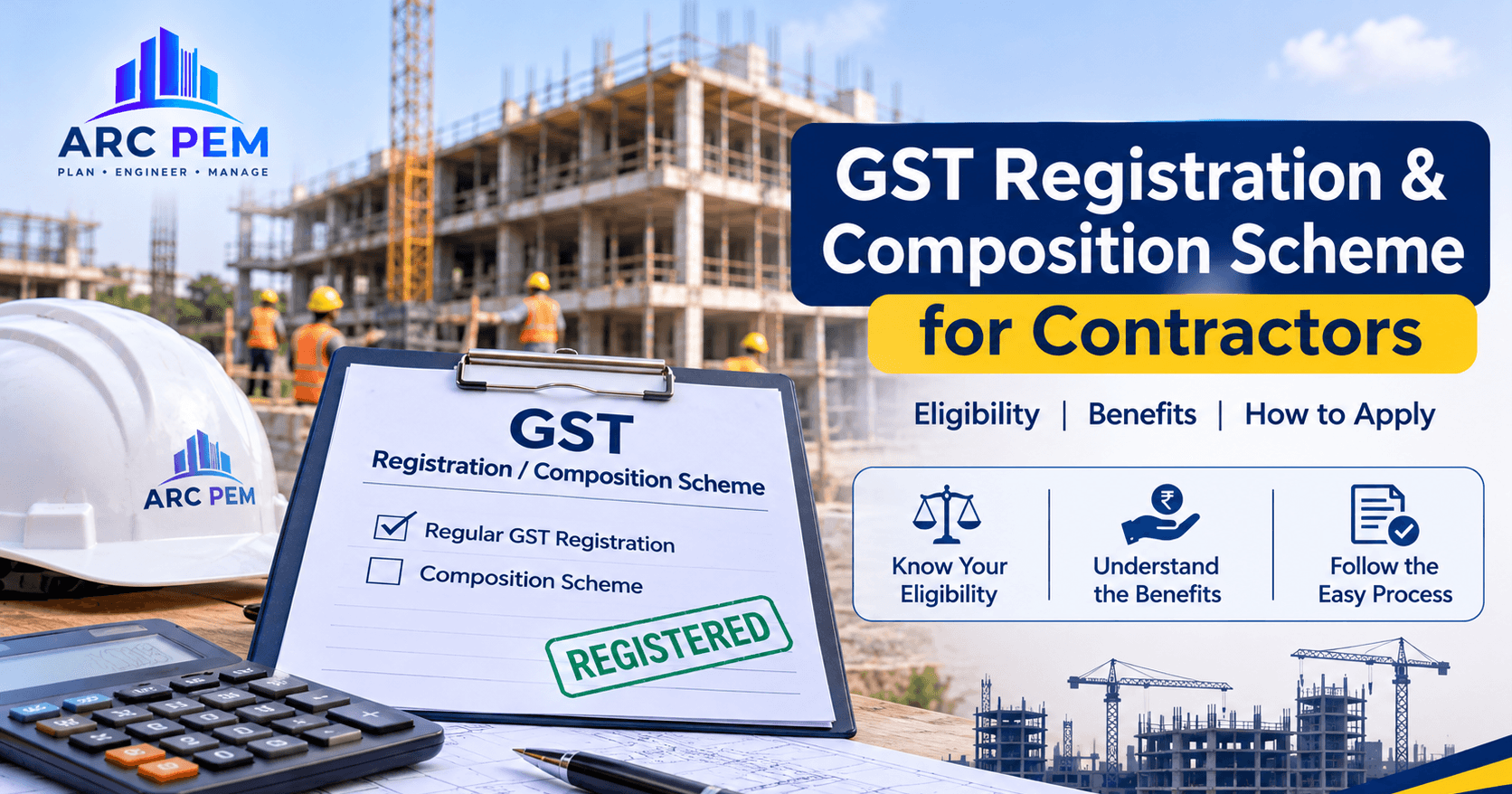
"Do I really need a GST number?" is the first question almost every new contractor asks. The honest answer: sometimes no, often yes, and the real decision is not just about the turnover limit. Government tenders, bigger clients and input tax credit (ITC) all push contractors toward registration even when the law doesn't force them.
This guide helps you decide: when registration is mandatory, whether the composition scheme is worth it, and how to register without mistakes.
Note: Thresholds and rules are updated from time to time. Our post on GST changes from 1 November 2026 covers recent changes. Confirm the current limits on the GST portal or with your CA before acting.
Is GST registration mandatory for a contractor?
A works contract is a supply of services. So the services turnover limit usually applies to you.
| Situation | Registration needed? |
|---|---|
| Aggregate annual turnover above ₹20 lakh (services) | Yes. The limit is ₹10 lakh in special category states |
| Turnover below the limit, supplying within your state | Not mandatory |
| Providing services to clients in other states | Often exempt for service providers under the limit, but check your case |
| Supplying goods across states (selling materials) | Yes, regardless of turnover |
| Liable to pay tax under reverse charge | Yes |
| Working as an agent or e-commerce seller | Yes |
"Aggregate turnover" is calculated PAN-wise across all your businesses and states. It includes taxable, exempt and export supplies, so don't count just one site or one firm.
You must apply within 30 days of crossing the limit. Operating without registration after that point can attract a penalty of 10% of the tax due (minimum ₹10,000), plus the tax itself and interest.
When to register even if you're below the limit
Voluntary registration is common among contractors because:
- Tenders: Government and PSU tenders usually ask for a GSTIN.
- Client demand: Companies and builders want invoices with GST so they can claim ITC. Many will not onboard an unregistered vendor.
- Your own ITC: Material, machinery and service purchases carry GST. Registered contractors can claim it back. Unregistered ones absorb it as cost.
- Credibility and bank finance: A GSTIN and regular returns help with loans and bank guarantees.
The composition scheme in plain words
The composition scheme lets small taxpayers pay a fixed percentage of turnover and file fewer returns, instead of calculating tax on every invoice.
- Who can opt in: service providers (including many contractors) with turnover up to ₹50 lakh in the previous year can choose the scheme for services. Goods traders have a different, higher limit. Confirm which category applies to your contract mix.
- Rate for service providers: 6% of turnover (3% CGST + 3% SGST).
- Returns: a quarterly payment statement (CMP-08) and one annual return (GSTR-4), instead of monthly GSTR-1 and GSTR-3B.
The catches
- You cannot claim ITC on purchases.
- You cannot collect GST from the client. You issue a bill of supply, not a tax invoice, and mention "composition taxable person, not eligible to collect tax on supplies".
- You cannot make inter-state supplies under the scheme.
- Your client gets no ITC on your bill, so B2B clients and companies may prefer a regular vendor.
Regular vs composition: which is better?
| Factor | Regular scheme | Composition scheme |
|---|---|---|
| Tax on invoices | Charged to client (rate as applicable) | Not charged. You pay 6% of turnover from your own pocket |
| ITC on purchases | Yes | No |
| Client gets ITC | Yes | No |
| Returns | Monthly or quarterly (GSTR-1, 3B) | Quarterly CMP-08, annual GSTR-4 |
| Best for | Contractors serving businesses or government, with material purchases | Very small contractors serving homeowners (individuals) |
Rule of thumb: If most clients are individual homeowners who can't claim ITC anyway and you purchase little taxable material, composition can save paperwork. If you work with builders, companies or departments, regular registration almost always wins.
Documents needed to register
- PAN of the business or proprietor
- Aadhaar (for authentication)
- Photograph
- Proof of business address (rent agreement or electricity bill, plus NOC if rented)
- Bank account proof (cancelled cheque or statement)
- Constitution proof (partnership deed, incorporation certificate) for non-proprietors
- Authorisation letter or board resolution for the authorised signatory
How to register on the GST portal: step by step
- Go to the GST portal and open Services > Registration > New Registration.
- Fill Part A (PAN, mobile, email) and verify the OTPs. You'll receive a TRN.
- Log in with the TRN and complete Part B: business details, address, bank and goods/services.
- Pick SAC 9954 (construction services) as your main service where it applies.
- Upload documents and verify with Aadhaar or e-sign.
- Note your ARN. Approval usually comes in a few working days, unless the officer asks for clarification.
Registration itself is free. Beware of agents charging heavy fees for a simple application.
What to do right after getting your GSTIN
- Put your GSTIN on invoices, quotations and the board at your office.
- Switch to GST-compliant bills. Use our free GST Contractor Bill Generator so every field is right.
- Learn how to raise a compliant bill in How to Raise a GST-Compliant RA Bill.
- Track TDS credits if you work for government clients: see TDS on Contractor Payments.
- Set a monthly reconciliation habit: GSTR-2B Reconciliation for Contractors.
Mistakes to avoid
- Counting only one project's turnover. The limit applies to your total PAN turnover.
- Choosing composition and then billing GST. Composition dealers cannot collect GST from clients.
- Opting for composition without checking client expectations. Some clients will drop you.
- Forgetting to file nil returns. Late fees apply even with zero sales.
- Not updating the registration when you add a new site office in another state. Additional places of business need to be added.
Key takeaways
- A contractor's registration limit is usually ₹20 lakh (₹10 lakh in special category states), counted PAN-wise.
- Register voluntarily if you want tenders, B2B clients and ITC.
- Composition (6%) suits very small contractors serving homeowners, but you lose ITC and can't charge GST.
- Registration is free and takes a few working days.
- After registering, standardise your billing and reconciliation from day one.
This article is for general information and is not tax advice. Consult a qualified CA before choosing a scheme.