
An architect fee proposal is a written offer that states your scope of services, fee basis, inclusions, exclusions, stage-wise payment schedule and taxes before the project starts. It wins the client and protects your margin. This guide gives you a ready architect fee proposal format for India, a stage-wise billing schedule and an architect invoice format with sample numbers.
Illustrative figures: All percentages and amounts here are examples. Check the current Council of Architecture (CoA) scale of charges and confirm GST and TDS treatment with your CA before using any figure in a live proposal. To choose a fee model, read Architect Fees in India.
What should an architect fee proposal include?
A one-page quote is not a proposal. Use these ten sections.
| # | Section | What to write |
|---|---|---|
| 1 | Project details | Client, site address, project type, built-up area, brief |
| 2 | Scope of services | Deliverables per stage: concept, design development, working drawings, tender documents, site supervision |
| 3 | Fee basis | Percentage, lump sum, per sq ft, hourly or hybrid, and the cost base |
| 4 | Inclusions | Design options, revisions per stage, site visits, consultant coordination |
| 5 | Exclusions | Extra revisions, consultants, approvals, renders, models |
| 6 | Reimbursables | Printing, plotting, courier, travel and how they're billed |
| 7 | Payment schedule | Stage-wise percentages and invoice triggers |
| 8 | Taxes | GST applicability and TDS handling |
| 9 | Timeline | Duration per stage and client approval turnaround |
| 10 | Terms | Variations, termination, copyright of drawings, validity of the offer |
Copy-paste architect fee proposal template
FEE PROPOSAL: [Project name]
To: [Client name, address]     Date: [dd-mm-yyyy]     Ref: [No.]

1. PROJECT: [Type, location, built-up area, brief]
2. SCOPE: Stage 1 Concept | Stage 2 Design development |
   Stage 3 Working drawings and tender documents |
   Stage 4 Construction administration | Stage 5 Handover
3. FEE: [x]% of [estimated / tendered / actual] project cost
   (estimated cost: Rs. [amount]) = Rs. [fee], plus GST
4. INCLUDED: [n] design options, [n] revisions per stage,
   [n] site visits, coordination with structural and MEP
5. EXCLUDED: extra revisions, consultants' fees, statutory
   approvals, renders and models, out-of-town travel
6. REIMBURSABLES: plotting, courier and travel at [actuals /
   fixed allowance of Rs. ___]
7. PAYMENT: [10]% advance | [20]% concept | [20]% design
   development | [30]% working drawings | [15]% construction
   administration | [5]% handover
8. TAXES: GST as applicable. TDS as per law
9. TIMELINE: [weeks per stage]. Client approvals within [7] days
10. TERMS: Variations in writing before work. Drawings remain
    the architect's copyright. Offer valid [30] days.

Accepted by: ____________   Date: ________
How do you decide the cost base for a percentage fee?
If you charge a percentage, write exactly which cost it applies to. Disputes usually start when "project cost" changes.
- Estimated cost at design stage
- Tendered cost after contractor bids
- Actual final cost at completion
A common approach is to bill early stages on the estimated cost and adjust at the end against the actual cost. Whichever you choose, put it in writing. For a quick estimate, use our free Construction Cost Calculator.
Architect payment schedule: stage-wise billing example
This continues the example from our fees guide: a ₹2 crore residential project at a 6% fee = ₹12,00,000 (excluding GST). The split is illustrative.
| Stage | Invoice trigger | % of fee | Amount (₹) |
|---|---|---|---|
| 1. Appointment advance | Signing the proposal | 10% | 1,20,000 |
| 2. Concept design | Client approves concept | 20% | 2,40,000 |
| 3. Design development | Approval of preliminary drawings | 20% | 2,40,000 |
| 4. Working drawings and tender documents | Issue of drawings | 30% | 3,60,000 |
| 5. Construction administration | Monthly or at milestones | 15% | 1,80,000 |
| 6. Completion and handover | Handover | 5% | 60,000 |
| Total | 100% | 12,00,000 |
Tips for stage-wise payment
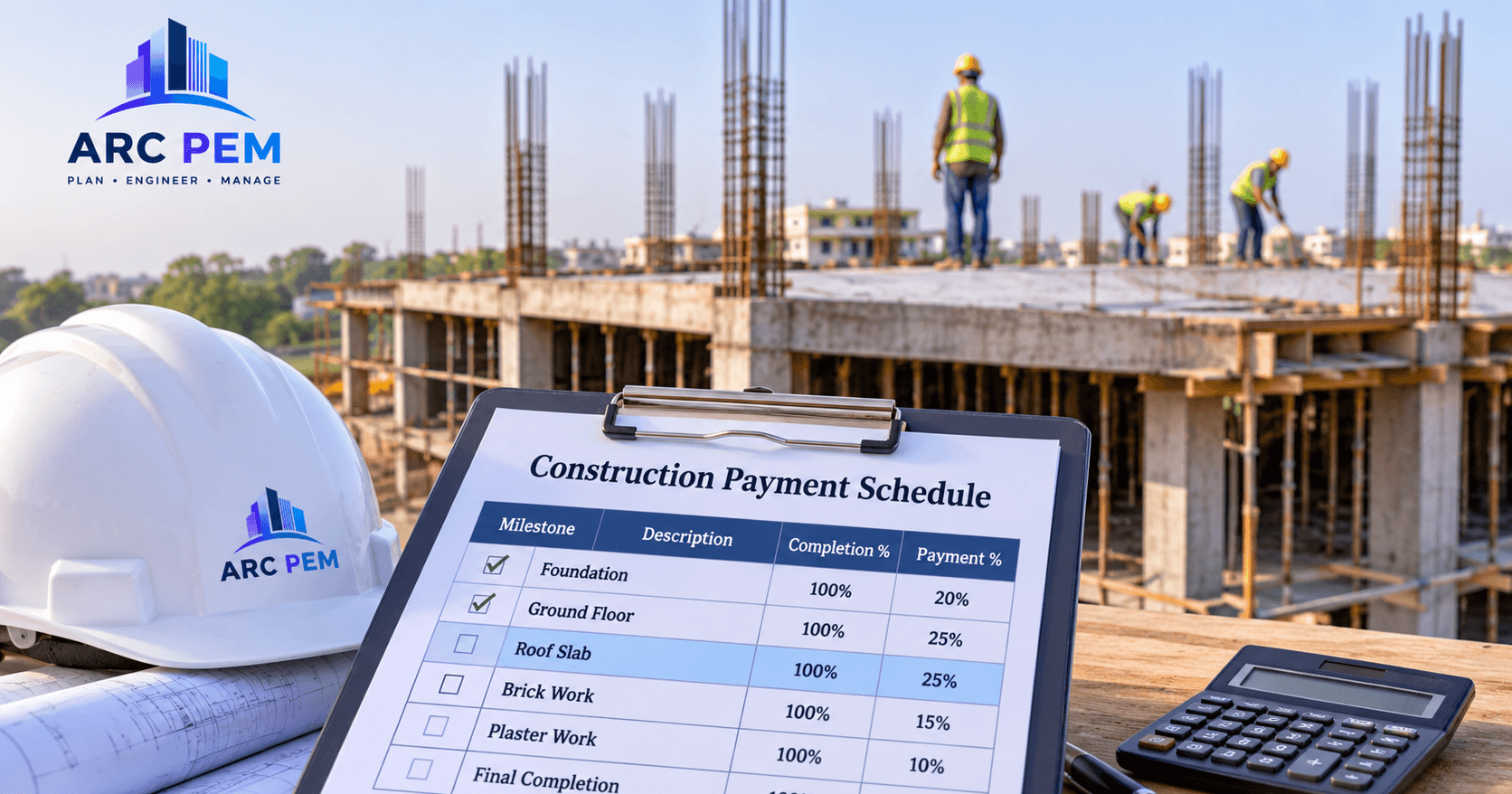
- Tie each payment to a deliverable the client can approve, not to a date.
- Add an approval turnaround (for example, "approval within 7 days or the stage is deemed approved").
- Bill construction administration monthly so cash flow doesn't stall until handover.
Architect invoice format in India (with sample)
Here is a sample invoice for Stage 2: Concept design.
| Field | Example |
|---|---|
| Invoice no. and date | ARC/2026-27/014, 20-11-2026 |
| Billed to | Client name, address, GSTIN (if registered) |
| Project | Residential building, plot no. and location |
| Description | Architectural professional services: Stage 2, concept design |
| Fee basis | 6% of ₹2,00,00,000 = ₹12,00,000. Stage 2 = 20% |
| Amount | ₹ |
|---|---|
| Professional fee, Stage 2 | 2,40,000 |
| GST @ 18% | 43,200 |
| Invoice total | 2,83,200 |
| Less: TDS deducted by client (illustrative, at 10% of fee) | (24,000) |
| Net receivable | 2,59,200 |
Invoice checklist
- Include all mandatory tax-invoice fields if you are GST-registered. See GST-compliant billing for construction for the logic.
- Ask for the TDS certificate and match it with your returns.
- Show reimbursables on a separate line.
Architect appointment letter and agreement: what to add
Many clients also ask for an architect appointment letter or consultancy agreement. Your fee proposal can become one once the client accepts it. Add these points:
- Parties and project with legal names and the site address
- Scope and fee by reference to the accepted proposal
- Payment terms, including due days and late-payment interest
- Client responsibilities: timely approvals, site access, information
- Termination: notice period and payment for work done up to that point
- Ownership and copyright of drawings
- Dispute resolution: negotiation, then arbitration or the agreed forum
Have a lawyer review your standard agreement once. After that, reuse it.
How should you bill reimbursable expenses?
Plotting, courier, travel and consultant charges quietly eat margin when they aren't billed. Choose one approach and state it:
- Fixed allowance included in the fee, or
- At actuals with receipts, sometimes with a small handling charge.
If you appoint a structural or MEP consultant but the client pays them, say so. Whoever contracts with the consultant carries the payment risk.
How do you handle scope changes?
- Cap revisions per stage in the proposal.
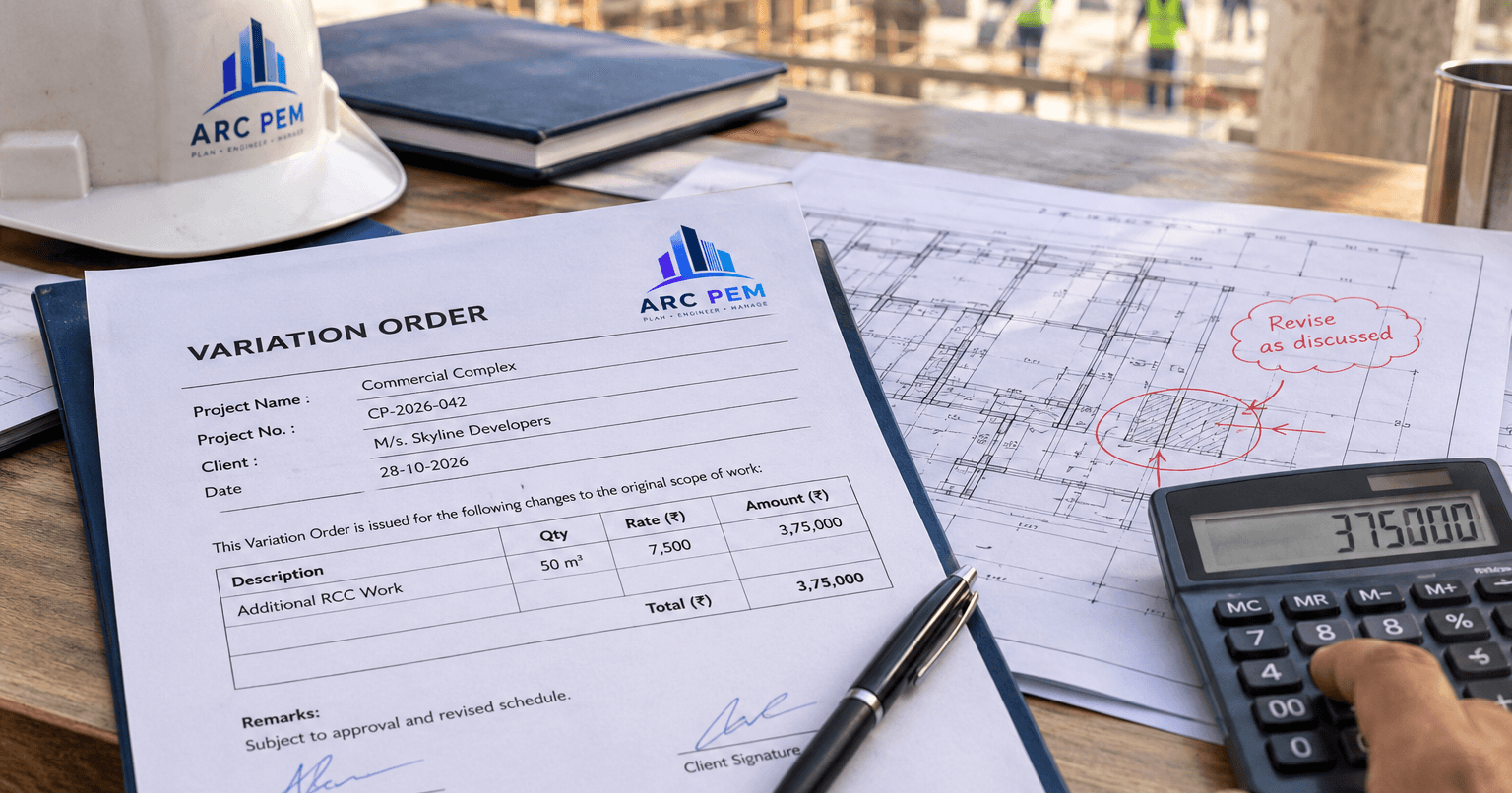
- When the client asks for more, send a short variation note: what changed, extra effort, extra fee.
- Get written approval before the extra work.
- Invoice the variation as a separate line.
The logic mirrors a contractor's change order. See variation orders in construction.
Common mistakes in architect billing
- No written scope. "Full service" means different things to different clients.
- Percentage with an undefined cost base.
- Payments tied to dates, not deliverables.
- Unbilled reimbursables and extra site visits.
- Late invoicing after approval.
- Missed TDS reconciliation, leaving credits unclaimed.
Track your billing against real project cost
The proposal sets the fee, but profit depends on what you spend to deliver it. Log staff time, consultants, site visits and plotting against each project and compare it with what you've billed. ARC PEM does this with project-wise expense tracking. See how ARC PEM tracks a project's money end to end.
Key takeaways
- A fee proposal covers scope, inclusions, exclusions, reimbursables, payment schedule and taxes.
- Define the cost base (estimated, tendered or actual) for any percentage fee.
- Link stage payments to approved deliverables with an approval turnaround.
- Show GST, TDS and reimbursables clearly on every invoice.
- Use variation notes and per-project cost tracking to protect your margin.
Updated November 2026. This article is for general information and is not legal or tax advice. Check the current CoA scale and confirm tax treatment with a qualified CA.