Quick answer: India's four new labour codes came into force on 21 November 2025, replacing 29 old labour laws. For construction, the biggest changes are: a contract labour licence is now needed only at 50 or more contract workers (up from 20), a single licence valid for 5 years (with an all-India option for multi-state contractors), establishment registration for sites with 10 or more workers, mandatory appointment letters for every worker, and wages paid by the 7th of the following month. If a contractor doesn't pay, the principal employer (the builder or client) must pay the workers and recover the amount from the contractor.
A year after the labour codes took effect, many contractors and builders are still running sites on the old rules: CLRA licences, BOCW registers and paper muster rolls. This guide explains what the new labour code for contractors means on a construction site, and gives you a labour compliance checklist to work through this month.
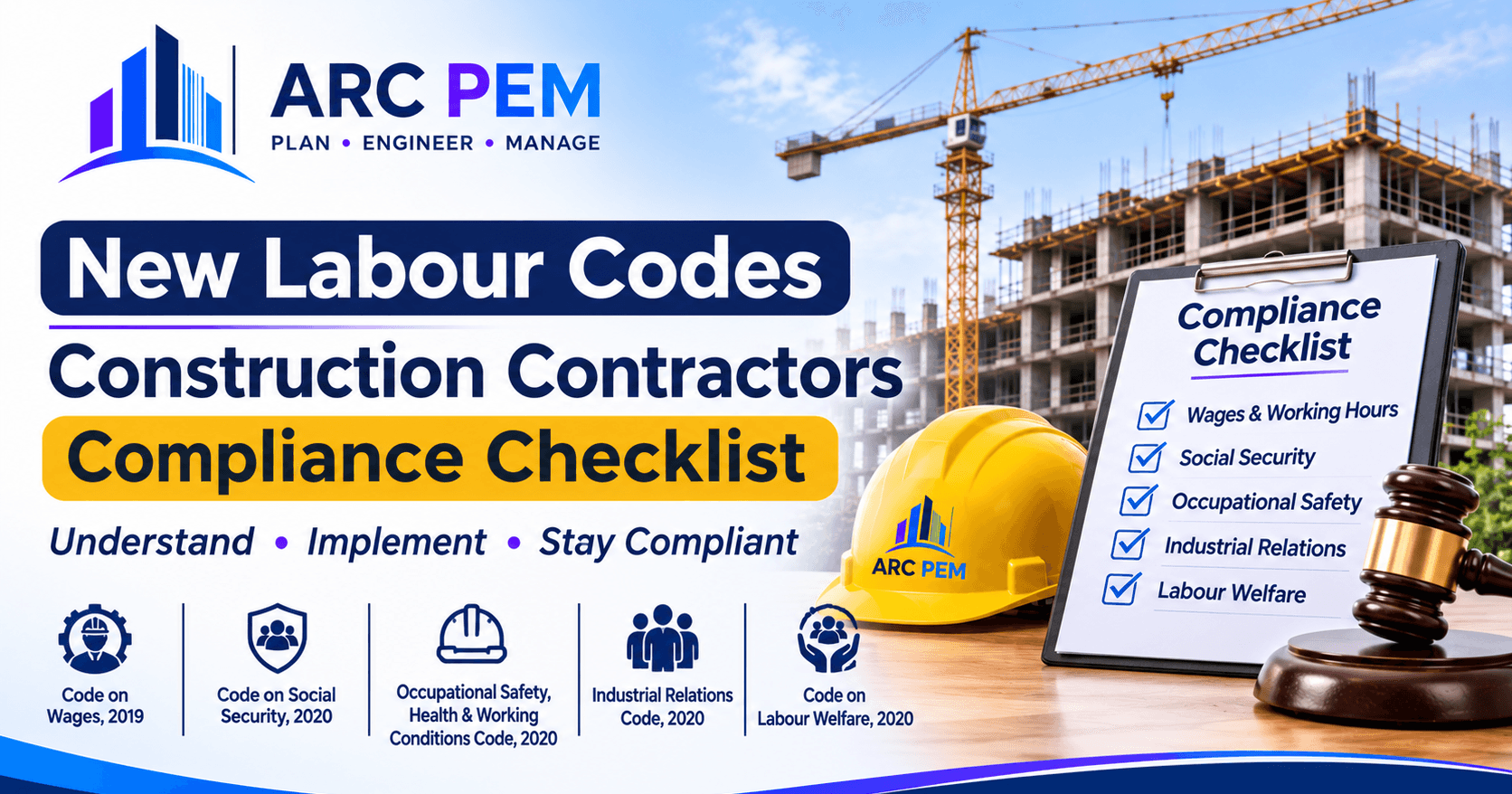
The four labour codes at a glance
| Labour code | What it replaced (examples) | Why it matters on a construction site |
|---|---|---|
| Code on Wages, 2019 | Minimum Wages Act, Payment of Wages Act, Payment of Bonus Act | Wage payment deadlines, minimum wages, equal pay |
| Code on Social Security, 2020 | EPF Act, ESI Act, Gratuity Act, BOCW Cess Act | PF/ESI, gratuity, and the 1% construction cess |
| Occupational Safety, Health and Working Conditions (OSH) Code, 2020 | Contract Labour (R&A) Act, 1970, BOCW Act, 1996, Factories Act | Contractor licence, establishment registration, safety, welfare facilities |
| Industrial Relations Code, 2020 | Industrial Disputes Act, Trade Unions Act | Standing orders, retrenchment, dispute resolution |
The Contract Labour Act, 1970 and the Building and Other Construction Workers (BOCW) Act, 1996 have been replaced. Their requirements now sit mainly in the OSH Code, with the construction cess and workers' welfare under the Code on Social Security.
1. Contract labour licence: now at 50 workers
This is the change contractors ask about most.
| Old law (CLRA Act, 1970) | New law (OSH Code, 2020) | |
|---|---|---|
| Licence needed when | 20 or more contract workers | 50 or more contract workers |
| Validity | Usually work-specific or one year, then renewed | 5 years |
| Multi-state contractors | Separate licence in each state | Option of a single all-India licence |
| Application | Paper/state portals | Online (Shram Suvidha / state portals) |
What this means:
- A small subcontractor with fewer than 50 contract workers generally no longer needs a contractor licence. Other duties still apply, such as wages, registers, safety and appointment letters.
- A contractor with 50 or more workers on any day needs the licence before deploying them.
- Contractors working in several states can apply for one all-India licence instead of one per state.
Count carefully: the threshold is based on the number of contract workers you engage, so a short peak (for example during a slab casting) can push you over 50. Check your highest daily muster across the year, not the average.
2. Establishment registration: sites with 10 or more workers
Under the OSH Code, an establishment employing 10 or more workers must register online. For a builder or principal employer, that usually means each project site that crosses the threshold. Existing registrations under the old Acts are generally treated as valid. Check your state portal for how to migrate them.
Who registers:
- Builder or developer (principal employer): registers the establishment or site.
- Contractor: gets the licence (if 50 or more workers) and keeps their own registers and wage records.
3. Appointment letters for every worker
The labour codes make appointment letters mandatory for all workers, including contract and daily-wage workers. For a site with 80 workers coming and going, this is new paperwork.
A simple appointment letter should include:
- worker name, Aadhaar or ID, and bank account
- employer or contractor name and the site
- job role and skill category (unskilled, semi-skilled, skilled, highly skilled)
- wage rate and payment cycle
- working hours and weekly rest day
Tip: create one template per skill category and issue the letters from your labour register on the worker's first day.
4. Wages: paid by the 7th, and the principal employer is the backstop
Under the Code on Wages:
- Monthly wages must be paid by the 7th day of the following month. Weekly and daily wage cycles have shorter deadlines.
- Contractors should pay by bank transfer or another electronic mode and keep proof.
- If the contractor fails to pay, or pays less, the principal employer must pay the workers and recover the amount from the contractor's bills.
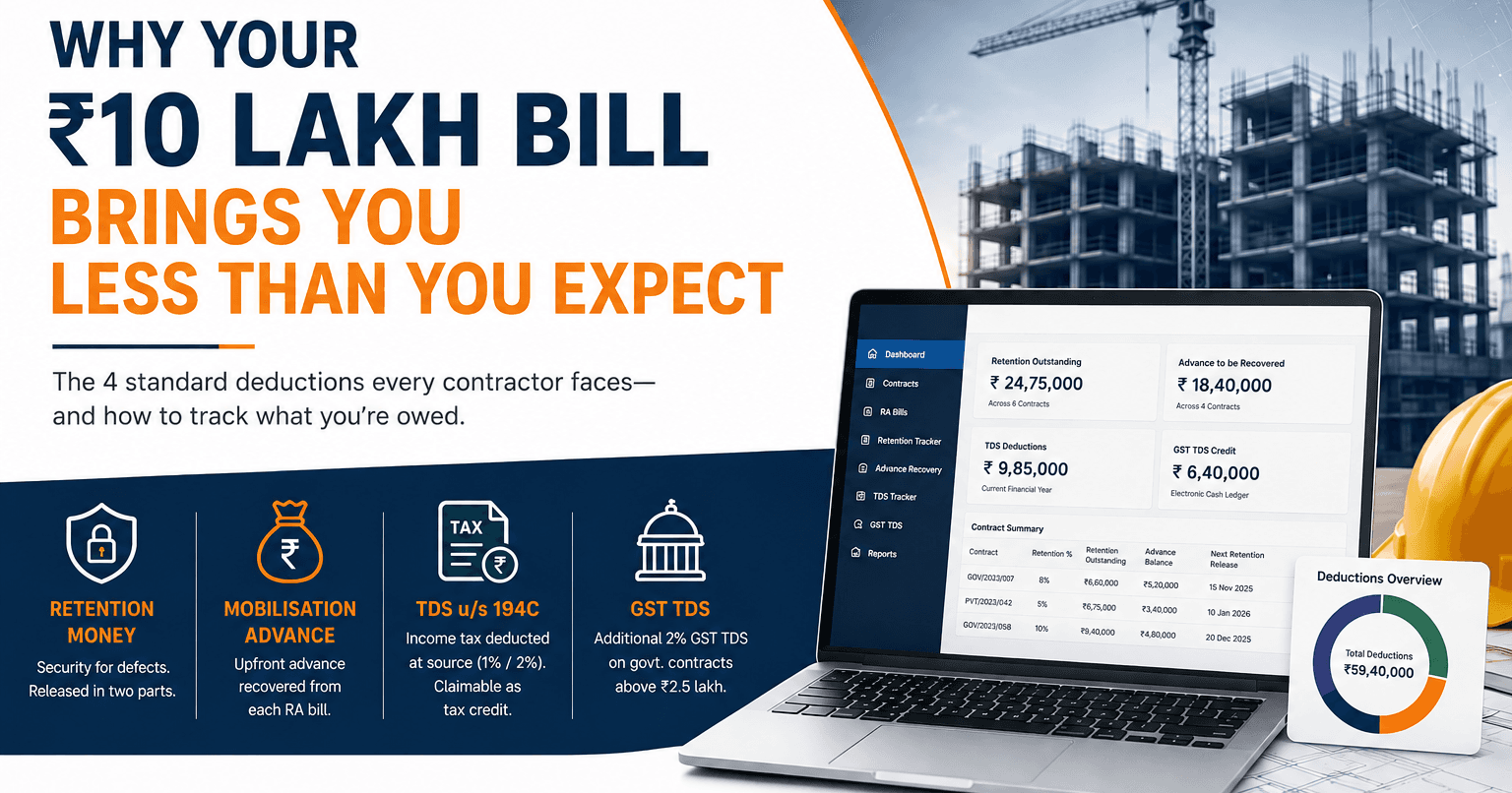
For builders: this is a direct financial risk. If a subcontractor disappears with an advance, the workers' wages can become your liability. Before you release an RA bill, ask the contractor for proof that the previous month's wages were paid. See Retention Money, Advances and TDS for how to hold back money safely.
5. BOCW cess: still 1%, now under the Social Security Code
The construction workers' welfare cess continues at 1% of the cost of construction, now levied under the Code on Social Security, 2020. Builders pay it in the same way as before, either at plan approval or deducted from contractor bills, depending on the state. The money still goes to the state Building and Other Construction Workers Welfare Board.
Full details on calculation, exemptions and who pays: BOCW Labour Cess 2026: 1% Construction Cess.
6. Other changes that affect construction sites
- Gratuity for fixed-term employees after 1 year (down from 5 years). This matters if you hire site engineers or supervisors on project-length contracts.
- Free annual health check-ups: the codes provide for these, with the requirement most widely reported as applying to workers aged 40 and above. Check your state rules for site workers.
- Social security coverage extends to unorganised, gig and platform workers through a Social Security Fund.
- Safety and welfare requirements from the BOCW Act (drinking water, toilets, first aid, shelters, crèches on larger sites, safety officers) continue under the OSH Code and its rules.
Who is responsible for what?
| Duty | Builder / developer (principal employer) | Contractor / subcontractor |
|---|---|---|
| Establishment registration (10+ workers) | ✅ | — |
| Contractor licence (50+ contract workers) | Check the contractor has one | ✅ |
| Appointment letters | For own workers | ✅ For their workers |
| Wages by the 7th | Backstop if the contractor defaults | ✅ Primary duty |
| 1% construction cess | ✅ (usually) | Deducted from bills in some states |
| Safety and welfare facilities on site | ✅ Shared | ✅ Shared |
| Registers and returns | ✅ | ✅ |
Worked example: does your site need a licence?
Project: G+7 residential tower in Pune. The builder engages three contractors.
| Contractor | Peak contract workers | Licence needed? |
|---|---|---|
| RCC contractor | 72 | Yes, 50 or more |
| Masonry & plaster subcontractor | 38 | No licence, but wages, letters and registers still apply |
| MEP subcontractor | 18 | No licence |
Total on site at peak: 128 workers, so the builder must register the establishment (10 or more workers). Before releasing each monthly RA bill, the builder checks the wage payment proof for all three contractors, because the builder is liable if any of them defaults.
Labour code compliance checklist for construction (December 2026)
Builders / developers
- ☐ Each site with 10 or more workers is registered under the OSH Code (or old registration confirmed valid)
- ☐ List of all contractors with peak worker counts
- ☐ Copy of the licence on file for every contractor with 50 or more workers
- ☐ Wage payment proof checked before each RA bill is released
- ☐ 1% construction cess paid or deducted, with challans filed
- ☐ Safety and welfare facilities in place (water, toilets, first aid, shelter, crèche where required)
Contractors / subcontractors
- ☐ Peak worker count checked against the 50-worker licence threshold
- ☐ Licence obtained or renewed (5-year validity; all-India if multi-state)
- ☐ Appointment letters issued to every worker
- ☐ Wages paid electronically by the 7th, with records kept
- ☐ Attendance (muster) and wage registers maintained
- ☐ PF/ESI coverage checked for eligible workers
How ARC PEM helps
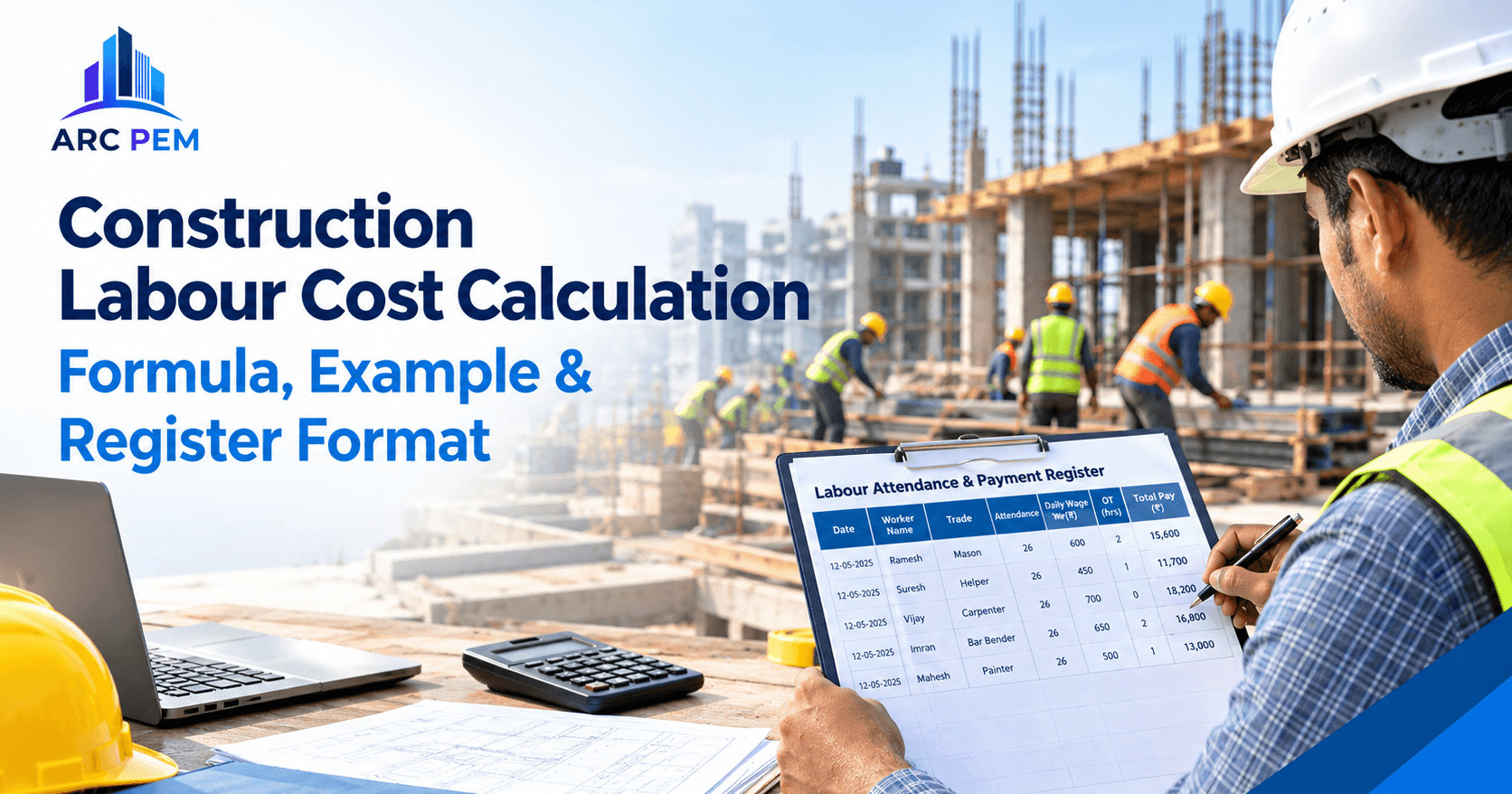
Labour compliance comes down to records: who worked, how many days, what they were paid, and when. In ARC PEM you record daily labour attendance and wages project by project and contractor by contractor. You get:
- the peak worker count per contractor, so you know when the licence threshold is crossed
- a wage payment record you can check before releasing an RA bill
- labour cost against budget for every site
Related: Construction Labour Cost Calculation · Daily Progress Report Format
Try ARC PEM free → · Raise GST-ready contractor bills with the free GST Contractor Bill Generator.
Key takeaways
- The four labour codes have applied since 21 November 2025, replacing 29 laws including the CLRA Act and BOCW Act.
- Contract labour licence: only at 50 or more workers, valid 5 years, with an all-India option.
- Establishment registration: sites with 10 or more workers.
- Appointment letters are mandatory for all workers, including contract workers.
- Wages by the 7th. The principal employer pays if the contractor defaults.
- 1% BOCW cess continues under the Social Security Code.
- Many details, such as fees, forms and portals, depend on state rules. Check with your state labour department.
This article is general guidance, not legal advice. Labour rules vary by state, so confirm the details with your state labour department or a labour law consultant.
Sources
- Press Information Bureau, Ministry of Labour & Employment: releases on the implementation of the four labour codes (from 21 November 2025) and provisions for workers
- Code on Wages, 2019; Code on Social Security, 2020; Occupational Safety, Health and Working Conditions Code, 2020; Industrial Relations Code, 2020
- Ministry of Labour & Employment: labour.gov.in