Last updated: 29 November 2026 · Reviewed by the ARC PEM Construction Finance & Compliance team
Short answer: No. Input tax credit (ITC) on constructing a commercial building on your own account (a mall, office, hotel or warehouse you keep or rent out) is blocked under Section 17(5)(d) of the CGST Act, 2017. The Supreme Court's Safari Retreats judgment (3 October 2024) briefly allowed ITC where a building passed a "functionality test", but the Finance Act, 2025 amended Section 17(5)(d) retrospectively from 1 July 2017 to block it again. ITC is still allowed on plant and machinery, on works contracts executed for clients, on construction for sale before the completion certificate, and on repairs charged to profit and loss.
Key facts at a glance
| Question | Answer (as of November 2026) |
|---|---|
| Law that blocks the credit | Section 17(5)(c) and 17(5)(d), CGST Act, 2017 |
| Supreme Court case | Chief Commissioner of CGST v. Safari Retreats Pvt. Ltd., decided 3 October 2024 |
| What Safari Retreats allowed | ITC where a building qualifies as a "plant" under a functionality test |
| What overturned it | Finance Act, 2025: "plant or machinery" replaced with "plant and machinery", retrospective from 1 July 2017 |
| Current status | ITC on own-account commercial buildings is blocked; challenges to the retrospective amendment are pending in some High Courts |
| Still eligible | Plant and machinery (incl. foundations), contractor works contracts for clients, construction for sale, expensed repairs, movable items |
| Possible relief | GST Council reportedly considering ITC rationalisation for real estate and construction (October 2026); nothing notified yet |
What is Section 17(5)(d) of the CGST Act?
Section 17(5)(d) of the CGST Act, 2017 blocks input tax credit on goods and services that a taxable person receives to construct an immovable property on their own account, other than plant and machinery, even when that property is used in the course or furtherance of business. In practice, GST paid on cement, steel, contractors' services and other inputs for your own office, factory building, mall or warehouse cannot be claimed as credit.
Its companion clause, Section 17(5)(c), blocks ITC on works contract services used to construct immovable property (other than plant and machinery). The exception is where the service is an input for a further works contract, such as a main contractor hiring a subcontractor.
Two definitions in the Explanation to Section 17 decide most cases:
- "Construction" includes reconstruction, renovation, additions, alterations and repairs, to the extent capitalised in the books.
- "Plant and machinery" means apparatus, equipment and machinery fixed to earth by a foundation or structural support and used to make outward supplies, including that foundation. It excludes land, buildings and other civil structures, telecom towers, and pipelines laid outside factory premises.
Can you claim ITC on construction of a commercial building for rent?
No. As of November 2026, a developer who builds a mall, office complex, hotel or warehouse to keep or lease out cannot claim ITC on the construction cost. The building is constructed on the developer's own account, and buildings are excluded from "plant and machinery". The rent remains taxable at 18% GST, so the developer pays output GST every year with no credit for the construction GST. This mismatch is why the issue reached the Supreme Court.
What did the Supreme Court decide in Safari Retreats?
In Chief Commissioner of CGST v. Safari Retreats Pvt. Ltd. (3 October 2024), the Supreme Court of India held that a building can be treated as a "plant" under Section 17(5)(d) if it passes a functionality test: whether it was planned and built to serve the taxpayer's specific business function. The Court noted that clause (d) used "plant or machinery", while the defined term is "plant and machinery", and treated the difference as deliberate.
The Court also:
- Upheld the constitutional validity of Sections 17(5)(c) and (d).
- Sent the case back to the Orissa High Court to apply the functionality test to the mall in question.
How did the Finance Act, 2025 change Section 17(5)(d)?
The Finance Act, 2025 replaced the words "plant or machinery" with "plant and machinery" in Section 17(5)(d), with retrospective effect from 1 July 2017, the date GST began. The change applies regardless of any court judgment, so the Safari Retreats functionality test no longer works for buildings. No refund is allowed of credit already reversed. (TaxGuru analysis, AM Legals)
Effect: For all years since GST started, ITC on own-account construction of buildings and civil structures is blocked again.
Is the retrospective amendment being challenged in 2026?
Yes. Taxpayers have challenged the retrospective amendment in several High Courts, and some have received interim protection, but no court has struck it down as of November 2026.
- The Bombay High Court has reportedly granted interim protection against coercive recovery to a hotel developer facing a demand based on the amendment. (Juris Hour)
- The Karnataka High Court has reportedly stayed proceedings in a challenge.
- The Delhi High Court has reportedly left individual claims to the tax authorities, subject to the facts and the outcome of the pending challenges.
- The Supreme Court sent at least one matter (Konkan LNG) back for fresh decision under the amended clause.
On the policy side, Business Standard reported in October 2026 that the GST Council may consider ITC relief for real estate, construction and hospitality. (Business Standard) No change has been notified.
When is ITC on construction still allowed?
ITC on construction is still allowed in five situations: works contracts a contractor executes for a client, construction of units for sale before the completion certificate, plant and machinery including its foundation, repairs charged to profit and loss, and movable items that are not part of the building.
| Situation | ITC allowed? | Reason |
|---|---|---|
| Contractor buying cement, steel and subcontract services for a client's project | ✅ Yes | Not own-account construction; works contract chain is excepted under 17(5)(c) |
| Builder constructing units for sale before the completion certificate | ✅ Generally yes | A taxable supply, not own account. Residential projects at the 1% / 5% concessional rates do not get ITC |
| Plant and machinery and its foundation | ✅ Yes | Expressly excluded from the block |
| Repairs charged to P&L (not capitalised) | ✅ Yes | "Construction" covers repairs only to the extent capitalised |
| Movable items (loose furniture, computers) | ✅ Usually yes | Not construction of immovable property |
| Mall / office / warehouse / hotel built to lease | ❌ No | Own account; buildings are not plant and machinery |
| Factory or office building for own use | ❌ No | Own account |
| Capitalised renovation of a building | ❌ No | Counts as construction |
| Telecom towers, pipelines outside the factory | ❌ No | Expressly excluded from plant and machinery |
How much does blocked ITC cost? A worked example
On a ₹10 crore warehouse built to lease, about ₹1.4 crore of GST on inputs becomes a permanent part of the project cost, while the developer still pays ₹18 lakh a year in GST on rent.
| Item | Amount (₹) |
|---|---|
| Construction cost before GST | 10,00,00,000 |
| GST paid on inputs (blended, illustrative) | 1,40,00,000 |
| ITC available under Section 17(5)(d) | Nil |
| Effective project cost | 11,40,00,000 |
| Annual rent | 1,00,00,000 |
| Output GST on rent at 18% (paid every year) | 18,00,000 |
The developer can still claim ITC on items that qualify as plant and machinery (for example equipment fixed on its own foundation), on repairs charged to P&L, and on movable equipment, provided these costs are recorded separately.
How can builders protect their ITC? (Checklist)
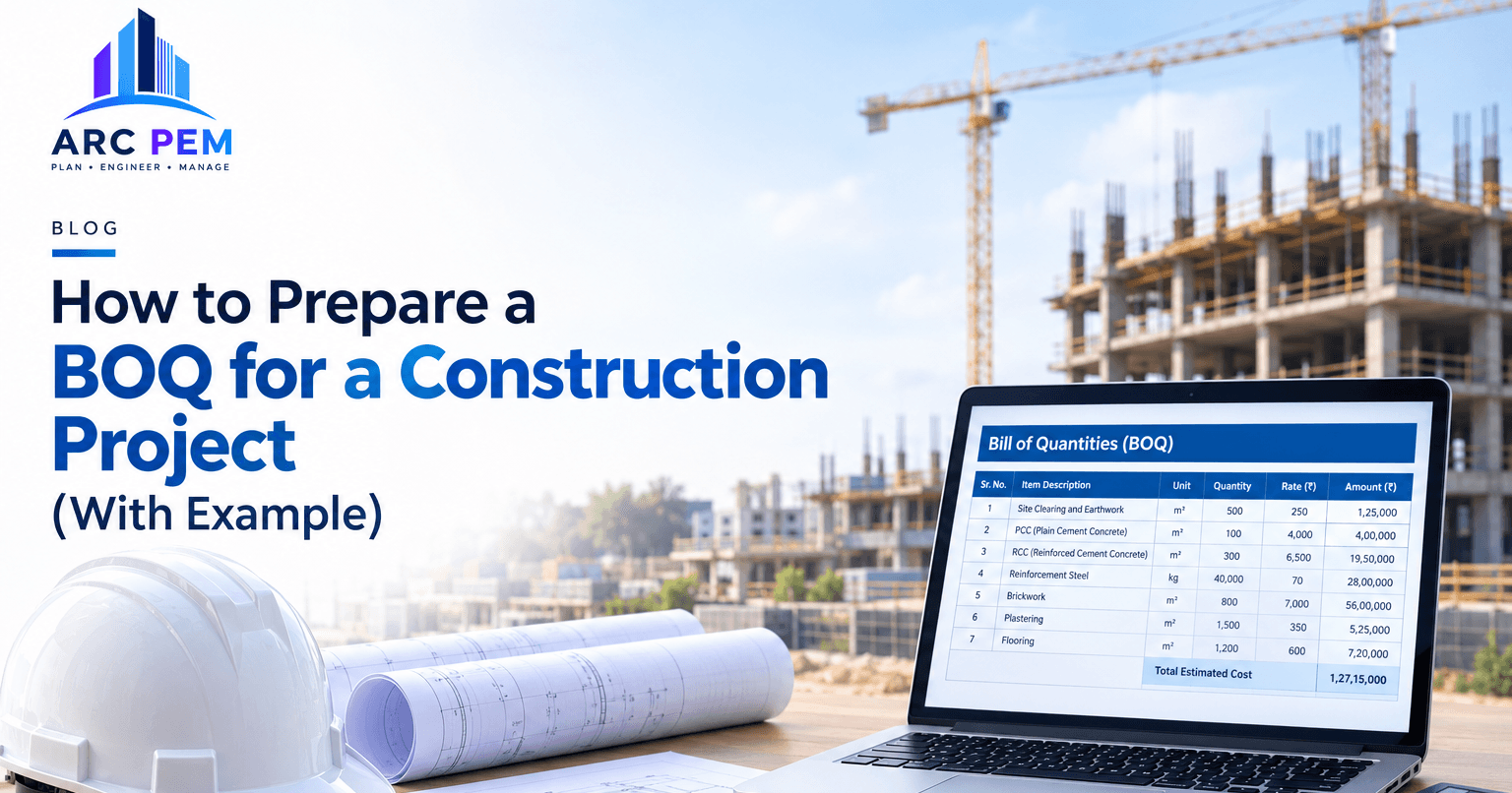
- Split costs at the BOQ stage into civil/building, plant and machinery (with foundations), and movable items. See How to Prepare a BOQ.
- Agree a capitalisation policy for repairs and renovation with your auditor.
- Report blocked ITC as ineligible in GSTR-3B and reconcile the difference in GSTR-9 Table 8. See GSTR-9 for Contractors and Builders.
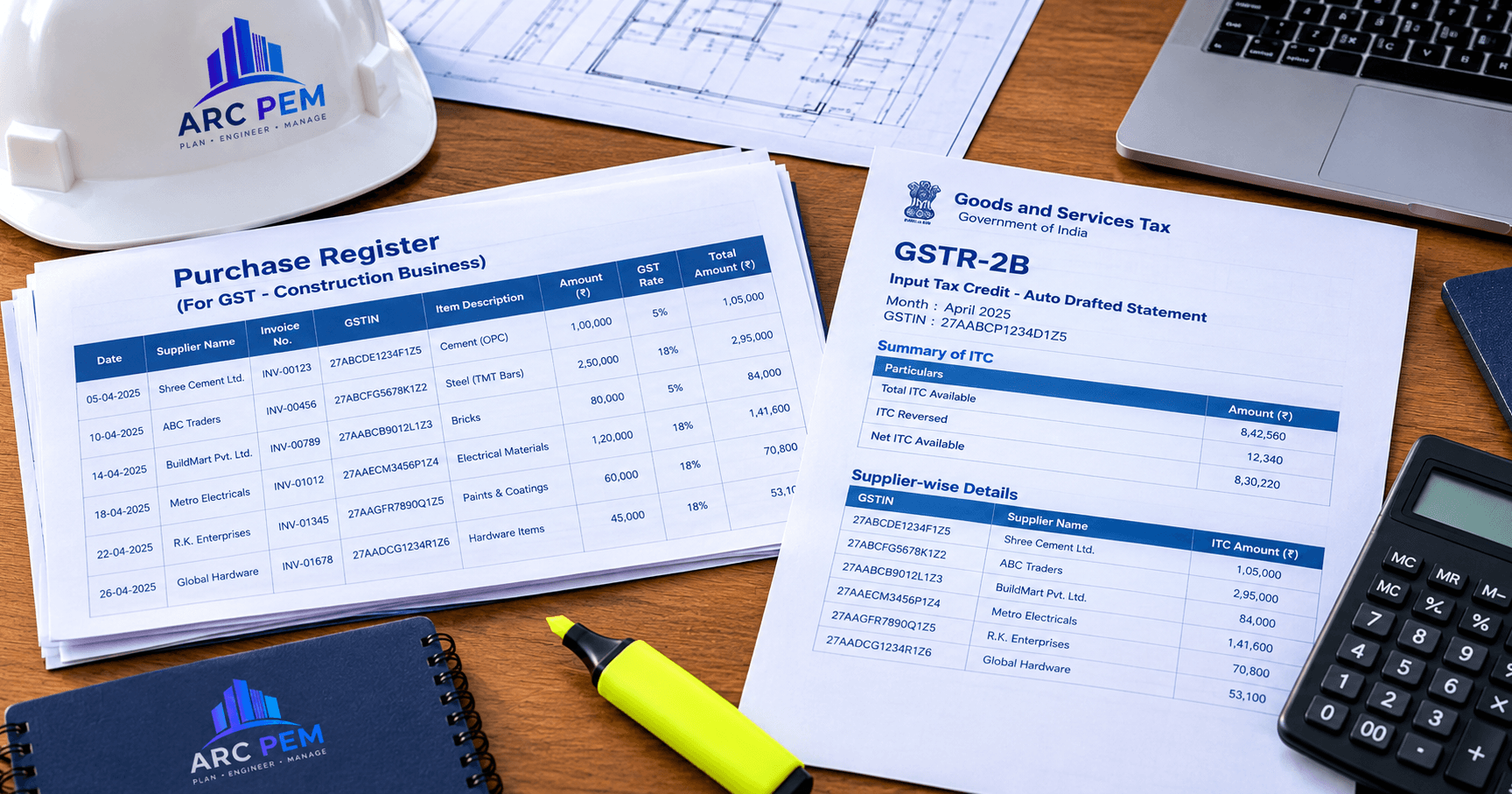
- Match supplier invoices in GSTR-2B reconciliation so eligible credit isn't missed.
- If you claimed ITC relying on Safari Retreats, review the exposure with a GST professional, respond to notices on time, and consider protective steps.
- Watch GST Council announcements for any relief on construction ITC.
Track eligible and blocked GST project by project with ARC PEM
Whether ITC is allowed is decided bill by bill: civil or plant, capitalised or expensed. ARC PEM records every purchase and works contract bill against its project and cost head, so you can tag eligible and blocked GST as you go and give your CA a clean split at year end.
Try ARC PEM free → · Create GST-ready bills with the free GST Contractor Bill Generator · Glossary: Input Tax Credit
Key takeaways
- Section 17(5)(d) blocks ITC on own-account construction of immovable property, even for business or rental use.
- Safari Retreats (3 Oct 2024) allowed ITC for buildings passing a functionality test.
- The Finance Act, 2025 reversed this retrospectively from 1 July 2017 by changing "plant or machinery" to "plant and machinery".
- Challenges are pending and the GST Council may consider relief, but treat commercial building ITC as blocked for now.
- ITC is still allowed for client works contracts, construction for sale, plant and machinery, expensed repairs and movable items.
This article is general information, not legal or tax advice. ITC on construction is under active litigation; consult a GST professional on your facts.
Sources
- CGST Act, 2017: Section 17(5)(c), 17(5)(d) and the Explanation to Section 17 (cbic-gst.gov.in)
- Supreme Court of India: Chief Commissioner of CGST v. Safari Retreats Pvt. Ltd., 3 October 2024
- Finance Act, 2025: amendment to Section 17(5)(d) w.e.f. 1 July 2017 (TaxGuru)
- Juris Hour: Bombay High Court interim protection after the amendment (link)
- Business Standard: GST Council may consider ITC relief for realty and construction, October 2026 (link)