Quick answer: The third advance tax instalment for tax year 2026-27 is due on 15 December 2026. By then, you must have paid 75% of your estimated tax for the year, after deducting the TDS your clients will deduct. Advance tax applies if your tax after TDS is ₹10,000 or more. Contractors under the presumptive scheme pay 100% in one instalment by 15 March 2027. Late or short payment costs 1% interest per month under Sections 424 and 425 of the new Income-tax Act, 2025 (previously 234B and 234C).
Contractors have a particular problem with advance tax: income arrives in uneven RA bills, clients deduct TDS, and profit isn't clear until the project closes. This guide explains the advance tax due dates, how to calculate advance tax as a contractor or builder, how TDS reduces it, and the interest if you miss the 15 December instalment.
Advance tax due dates for tax year 2026-27
| Due date | Cumulative advance tax to be paid | Presumptive taxpayers |
|---|---|---|
| 15 June 2026 | At least 15% of estimated tax | — |
| 15 September 2026 | At least 45% | — |
| 15 December 2026 | At least 75% | — |
| 15 March 2027 | 100% | 100% (single instalment) |
What changed with the new Act: From tax year 2026-27, advance tax falls under the Income-tax Act, 2025, as the Income Tax Department confirms. The "assessment year" label is replaced by "tax year". The due dates and percentages are the same as before. Only the section numbers changed.
| What | Old section (1961 Act) | New section (2025 Act) |
|---|---|---|
| Liability to pay advance tax | 207 | 403 |
| ₹10,000 threshold | 208 | 404 |
| Computation | 209 | 405 |
| Instalments and due dates | 211 | 408 |
| Interest for default (under 90% paid) | 234B | 424 |
| Interest for deferment (missed instalments) | 234C | 425 |
Who must pay advance tax?
You must pay advance tax if your estimated tax for the year, after deducting TDS and TCS, is ₹10,000 or more. That includes:
- Contractors and subcontractors: proprietors, partnership firms, LLPs and companies
- Builders and developers
- Architects, interior designers and engineering consultants
- Anyone with significant rent, interest or capital gains that isn't fully covered by TDS
Exemption: A resident senior citizen (60+) with no business or professional income doesn't have to pay advance tax. If you are 60+ and run a contracting business, you still have to pay.
How TDS reduces your advance tax
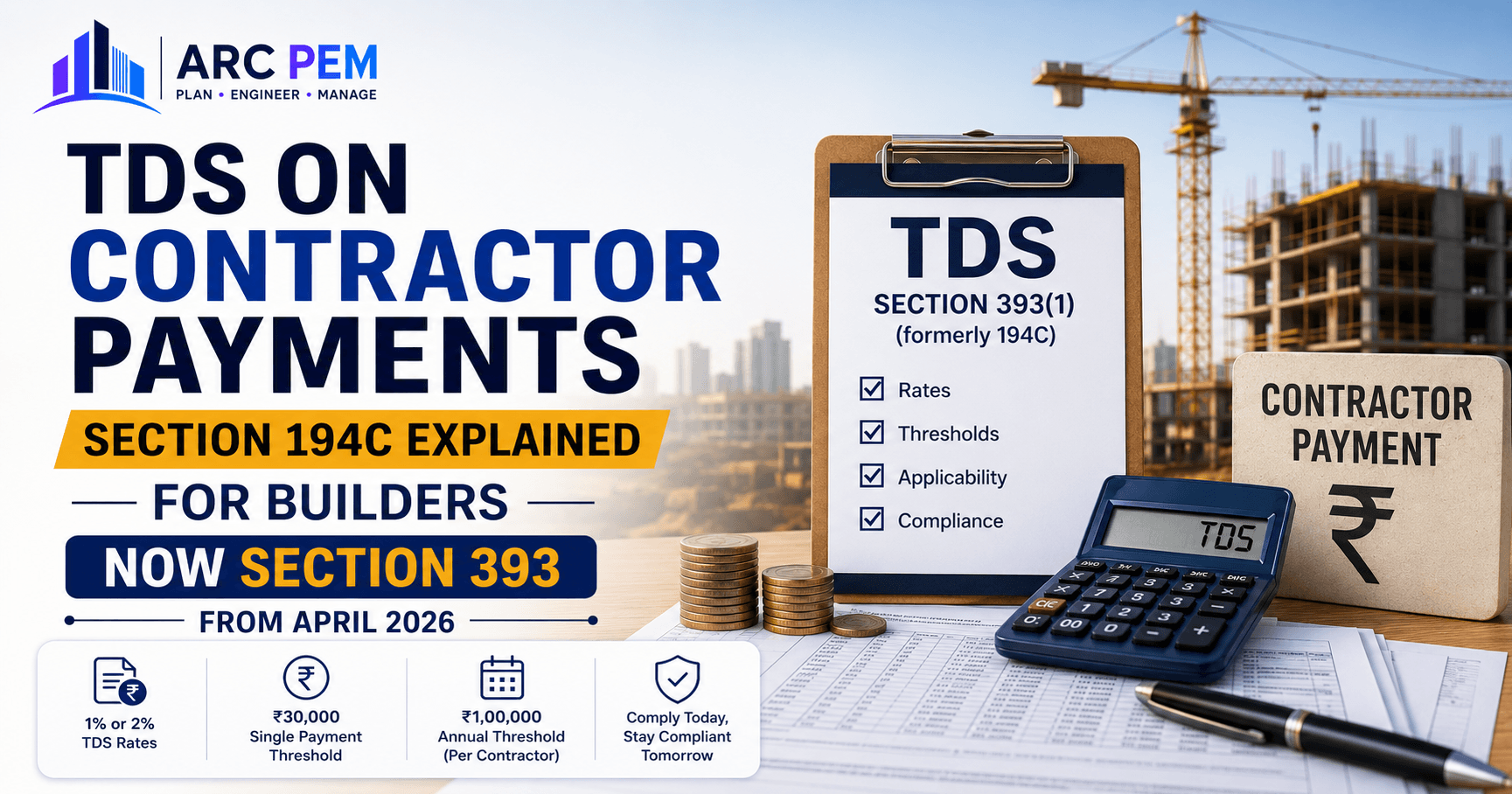
Your clients deduct TDS on contractor payments from your RA bills (1% for individual/HUF contractors, 2% for others, under Section 393 of the new Act, previously 194C). That TDS is tax already paid on your behalf, so you deduct it before calculating advance tax.
Advance tax payable = Estimated tax on total income − TDS/TCS expected for the year
Make sure the TDS actually appears in your Form 26AS / AIS. A client who deducted but didn't deposit it gives you no credit. See TDS on Contractor Payments: Section 194C, Now Section 393.
How to calculate advance tax: 5 steps for contractors
- Estimate your turnover for the full year: RA bills raised so far, plus bills expected by 31 March.
- Estimate net profit: turnover minus material, labour, subcontractor, site overhead and office costs. Use your project-wise profit, not a guess.
- Add other income: rent, interest, capital gains.
- Calculate tax at your applicable rates (slab or firm/company rate, including cess).
- Deduct expected TDS/TCS, then pay the instalment percentage due, less what you have already paid.
Worked example: contractor's 15 December instalment
M/s Sharma Constructions (proprietorship), civil contractor. Tax year 2026-27:
| Item | Amount (₹) |
|---|---|
| Estimated tax on total income for the year (incl. cess) | 6,40,000 |
| Less: TDS expected from clients' RA bill deductions | 2,40,000 |
| Net advance tax for the year | 4,00,000 |
| Instalment | Cumulative % | Cumulative due (₹) | Paid so far (₹) | Pay now (₹) |
|---|---|---|---|---|
| 15 Jun 2026 | 15% | 60,000 | 60,000 | — |
| 15 Sep 2026 | 45% | 1,80,000 | 1,80,000 | — |
| 15 Dec 2026 | 75% | 3,00,000 | 1,80,000 | 1,20,000 |
| 15 Mar 2027 | 100% | 4,00,000 | — | 1,00,000 |
If Sharma Constructions misses 15 December and pays the shortfall with the March instalment: Interest under Section 425 = ₹1,20,000 × 1% × 3 months = ₹3,600.
That's avoidable. And if the total paid by 31 March is below 90% of the final tax, Section 424 interest also runs at 1% per month from 1 April until payment.
Interest for late or short advance tax payment
| Section (new Act) | Old section | When it applies | Interest |
|---|---|---|---|
| 425 | 234C | An instalment is short or late | 1% per month on the shortfall: 3 months for the June, September and December instalments, 1 month for March |
| 424 | 234B | Total advance tax paid by 31 March is less than 90% of the tax finally payable | 1% per month on the unpaid amount, from 1 April until it's paid |
Safe harbour: there's no Section 425 interest on the early instalments if you've paid at least 12% by 15 June and 36% by 15 September.
Presumptive scheme contractors: one payment by 15 March
Small contractors who use the presumptive taxation scheme (old Section 44AD, now Section 58 of the 2025 Act) pay 100% of advance tax in one instalment by 15 March 2027. There are no June, September or December instalments.
Key conditions:
- Turnover up to ₹2 crore, or ₹3 crore if cash receipts are 5% or less of turnover
- Income is taken as 6% of turnover received digitally and 8% of the rest, or your actual profit if that's higher
Most growing contractors cross the presumptive limit within a few years. When you do, the four-instalment schedule applies.
Why contractors get advance tax wrong
- Lumpy RA bills: a big bill certified in February can push profit up sharply after the December instalment has been paid. Re-estimate every quarter.
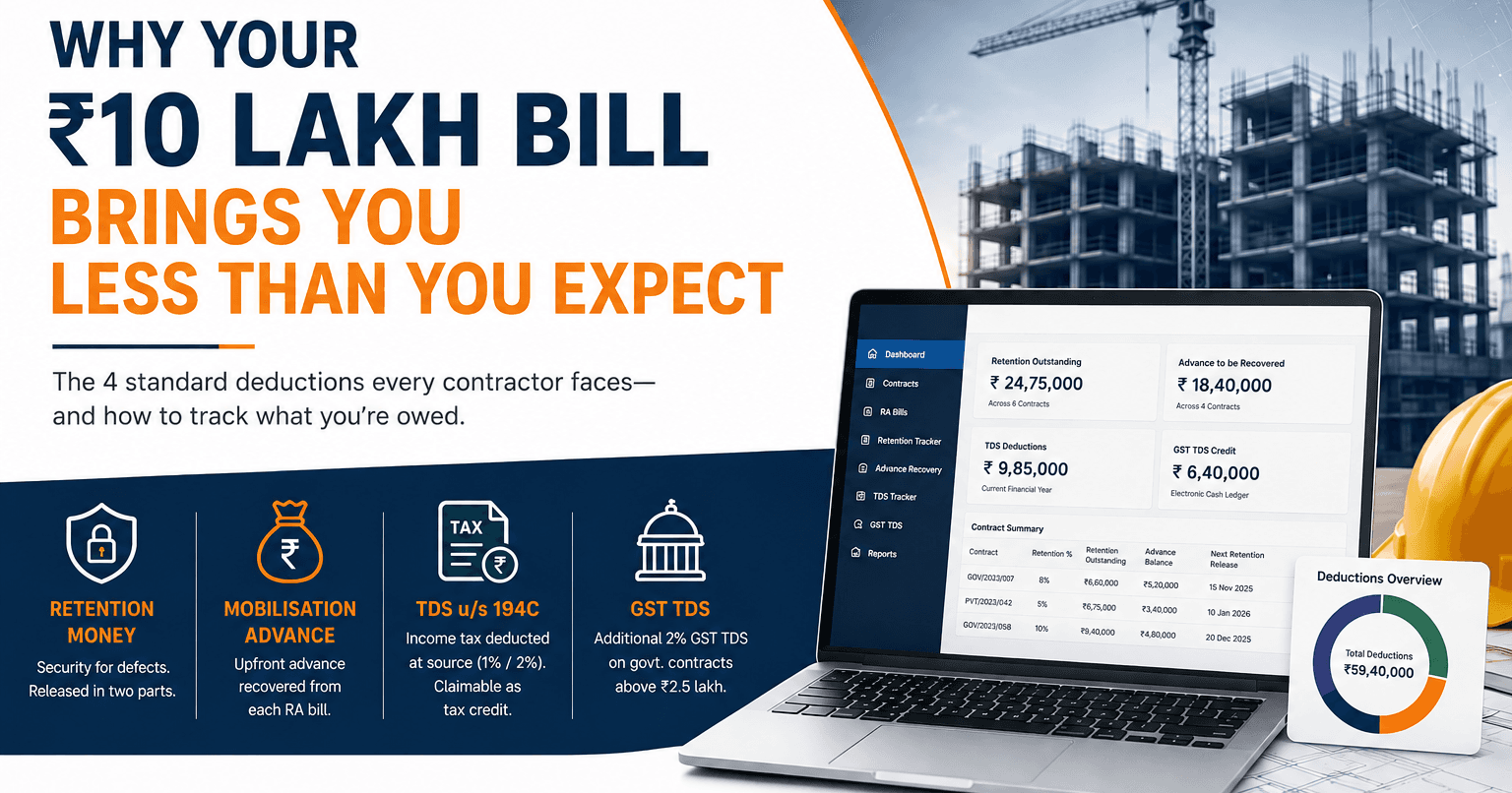
- Ignoring retention money: retention is still part of your income when the bill is raised, even though the cash comes later. See Retention Money, Advances and TDS.
- Counting TDS that wasn't deposited: check Form 26AS / AIS before you rely on a client's TDS.
- No project-wise profit view: without it, contractors either overpay (and block working capital) or underpay (and pay interest).
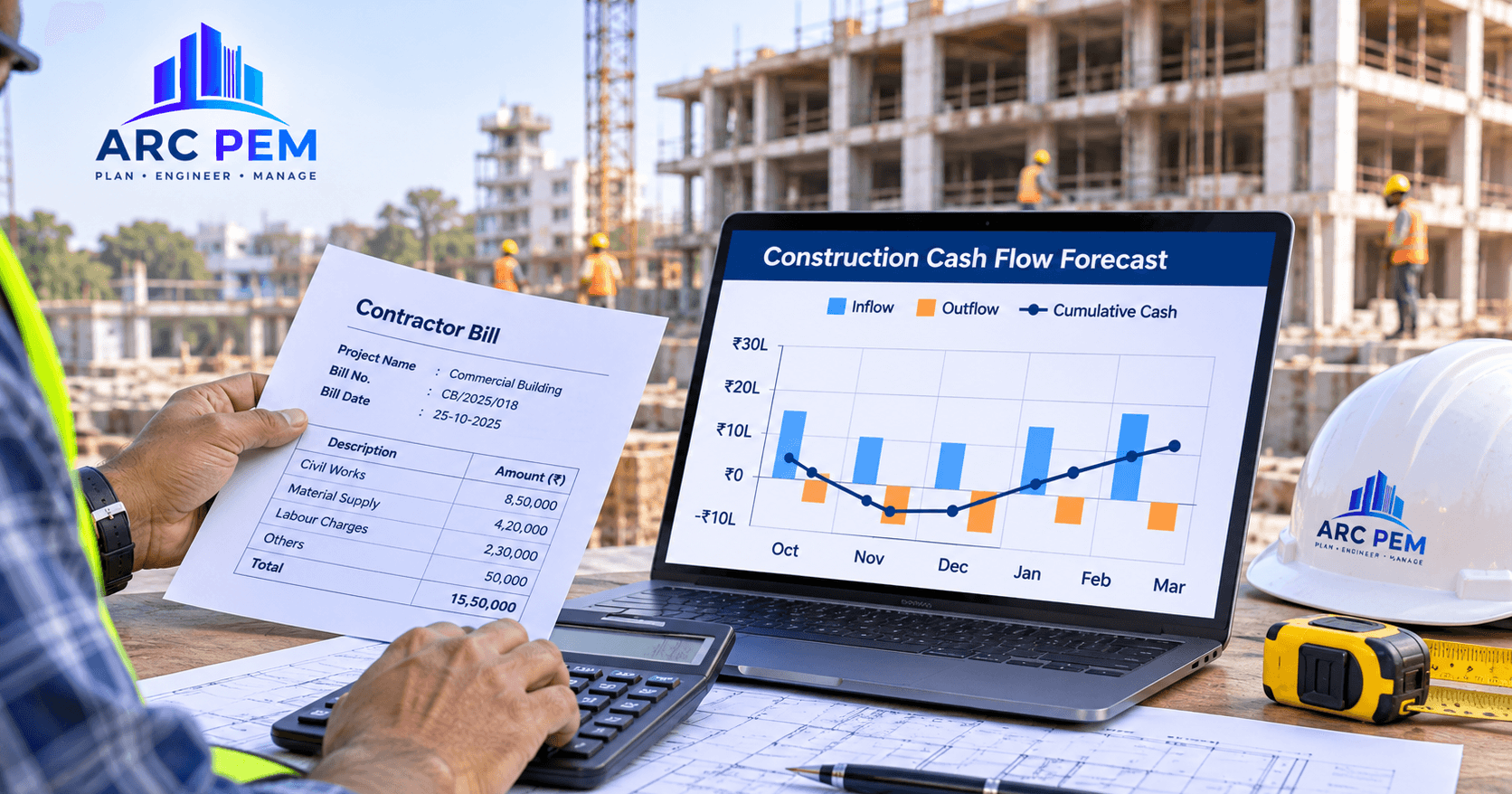
- Cash flow crunch in December: plan the instalment in your construction cash flow forecast.
How to pay advance tax online
- Log in to the income tax e-filing portal (incometax.gov.in) with your PAN.
- Go to e-File → e-Pay Tax → New Payment.
- Choose Income Tax, select tax year 2026-27 and type of payment Advance Tax (100).
- Enter the amount, generate the CRN (Challan Reference Number) and pay by net banking, UPI, debit card or at the bank.
- Download the challan receipt and keep the BSR code and challan number for your return.
A generated challan is valid for 15 days from CRN generation, so pay before 15 December, not on it.
Get your profit number right with ARC PEM
Advance tax is only as accurate as your profit estimate, and for a contractor, profit lives in project data: RA bills, material, labour and subcontractor payments. ARC PEM tracks income and expenses project by project, so before every instalment you can see the profit earned to date, the bills still to come and the TDS deducted by each client.
Try ARC PEM free → · Raise TDS-ready RA bills with the free GST Contractor Bill Generator.
Key takeaways
- Advance tax due date: 15 December 2026 for 75% of your estimated tax for tax year 2026-27. The final instalment is due 15 March 2027.
- Applies if tax after TDS is ₹10,000 or more.
- TDS deducted by clients under Section 393 reduces your advance tax, but only if it appears in Form 26AS.
- Interest is 1% per month under Sections 424 and 425 (previously 234B and 234C).
- Presumptive scheme contractors (Section 58) pay 100% by 15 March.
- Re-estimate profit before every instalment using project-wise figures.
This article is general information, not tax advice. Confirm your figures with your chartered accountant.
Sources
- Income Tax Department, e-filing portal FAQs: applicable law for Tax Year 2026-27 (incometax.gov.in)
- Income-tax Act, 2025: Sections 403–408, 424, 425 and 58
- Income-tax Act, 1961: Sections 207–211, 234B, 234C and 44AD (for comparison)